Shakespeare

  • The Taming of the Shrew (1967)

    The Taming of the Shrew (1967)

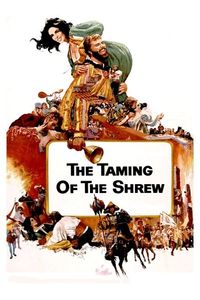
    (On Cable TV, August 2021) I’m reliably not the best audience for Shakespeare movie adaptations, and The Taming of the Shrew is an even rockier prospect given its theme of female subjugation (although the more you look, the less this stays true). But there are a few good times to be had in the 1968 Franco Zeffirelli adaptation of it, largely because it happens to feature Elizabeth Taylor and Richard Burton in the lead roles. At the time, both were the best-known couple on the planet: both exceptional actors, having begun their relationship in scandalous circumstances and often playing opposite each other in films. In here, Burton plays an uncultured lord who comes to town and sets off to tame the headstrong woman played by Taylor. Perhaps the best moments of the film are those early ones when we see the extent of her uncontrollable nature, furiously berating those around her and throwing things. Despite the doubly-dated nature of a Shakespearian play executed in mid-1960s style, there’s an unnerving contemporary quality to the loutish discourse among the male characters as they discuss their designs on the female characters. It builds up to a conclusion that plays ironically, with a speech on submissiveness undermined by a dramatic exit and a chase. Director Zeffirelli keeps things generally accessible for modern audiences, but it’s really Burton and Taylor (plus Michael York in a supporting role) who get our interest.
  • Anonymous (2011)

    Anonymous (2011)

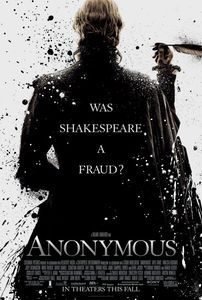
    (On Cable TV, October 2012) My appreciation for Anonymous is severely limited by my lack of interest regarding the Shakespeake Authorship question.  Call me a Stratfordian, if you think I care: I’m not a good audience for conspiracy theories, and the one featured in this film is so ludicrous that it repeatedly challenges any suspension of disbelief.  But let’s give Anonymous the benefit of its premise, which is to say that Shakespeare’s plays were truly written by a nobleman who wished to conceal his identity:  How well does the film manage to execute this idea?  At first, not very well: while the film begins with a superb framing device seamlessly taking modern audiences back in time, it quickly hobbles itself with confusing character introductions, blunt nestled flashbacks five-then-forty years earlier and a lack of grace in the way it sets up its plot elements.  Fortunately, the ride gets smoother once the premise is established and the pieces finally start moving in the direction of a political thriller.  Still, the ending will challenge viewers, as every-harder-to-accept revelations are piled on until credulity snaps and even viewers without deep knowledge of the period will understand that it’s all fantasy.  (For a so-called virgin queen, Elizabeth I in this film had enough illegitimate kids to keep a daycare facility busy.)  While the structure of the plot is distinctively unusual, there are still a lot of unpleasant edges in the script that could have used some polishing.  Fortunately, Anonymous isn’t all about the writing: The biggest thrill of the film is a gorgeously presented Elizabethan-era London, including a convincing re-creation of the Globe theater.  Director Roland Emmerich may have issues with scripts (see; well, his entire filmography) but his eye for striking cinematography remains intact.  He also lucked out with a few capable actors in key roles: Rhys Ifans becomes a fascinating Edward de Vere, a complex figure who never manages to reconcile his desires with what is expected of him as the Earl of Oxford. (He gets the film’s best lines as he explains his compulsion to write.)  Elizabeth I is also cleverly incarnated by a mother/daughter pair: Vanessa Redgrave as the elder queen comfortable in the power of her station, and Joely Richardson as her red-hot younger self.  It amounts to a surprisingly engaging film despite the imperfect, perhaps fundamentally flawed film.  Anonymous works quite a bit better as a gonzo historical fantasy than an attempt to tell a true story –you don’t have to look long to find accounts of historians laughing themselves to tears over the film.  Historical accuracy aside, it’s a film with a surprisingly strong list of assets, and I won’t let my basic disagreement about its premise blind me to its merits.  Have a look… but don’t believe a single word of it.