Sharlto Copley

  • The Hollars (2016)

    The Hollars (2016)

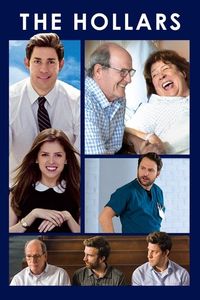
    (In French, On TV, September 2021) While writer-director-actor John Krasinski earned rave reviews as director of A Quiet Place, he already had two feature-length movies in his filmography before his horror breakout. The Hollars is the second of them, and it falls squarely in that favourite playground of low-budget independent cinema: the dysfunctional family dramedy, coupled with a “city boy comes back to town” plot to tie it all together. A cherubic beardless Krasinski anchors the picture as the prodigal son coming back to his childhood home after his mom gets ill — only to discover a bankrupt father, bitter brother, clinging ex-girlfriend and the realization of the fears holding him back from marrying his pregnant girlfriend. This is thoroughly familiar stuff, only slightly elevated by decent execution and a rather good cast. While such familiar names as Anne Kendrick, Sharlto Copley, Charlie Day, and Richard Jenkins add to the film, it’s Margo Martindale who earns the most attention in a tough part as a sick matriarch. The rest of the film is not bad, but it is familiar enough to be forgettable, and there are enough half-sketched subplots to make anyone wonder if the film ended up stuck between comedy and drama, instead aiming for a half-satisfying compromise. Watchable but not memorable, The Hollars is an honourable result for Krasinski, but a pale precursor to his next films.
  • Open Grave (2013)

    Open Grave (2013)

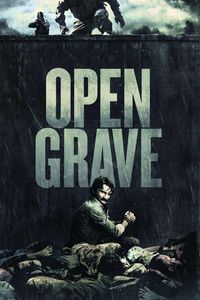
    (In French, On Cable TV, October 2020) Good directors can manage to elevate any kind of dross, while bad directors can find a way to suck the life out of even the most promising material. I haven’t yet seen enough of Gonzalo López-Gallego’s work to say if Open Grave is a fluke, but it manages to mishandle what could have been an interesting take on the zombie genre in any other hands. It begins as a man (Sharlto Copley) wakes up amnesiac in a mass grave. Clawing his way out, he discovers a group of equally-amnesiac people, some of whom he suspects knowing. It quickly becomes clear that there’s a zombie apocalypse unfolding, and there’s too much medical equipment lying around to pretend that they’re average people. Sadly, that’s roughly Open Grave’s peak moment—everything after that is duller and duller, blander and blander, longer and longer. Your only reward for making it to the end of the film is how the sight of a gigantic open mass grave can actually become boring by simply going on, and on, and on until we’re actually clamouring for the end credits. The film is too mean-spirited to be effective, as it sinks so deeply into darkness that it becomes impossible to care about any of it. Still, I can see how amnesia could have its benefits, especially if it’s enough to make anyone forget about Open Grave.

  • Elysium (2013)

    Elysium (2013)

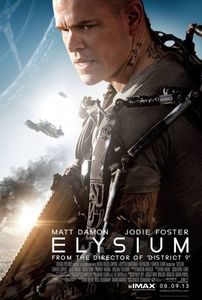
    (Video on Demand, December 2013) Writer/Director Neill Blomkamp made a splash in 2009 with his debut feature District 9, an exceptional blend of kinetic thrills and thematic wit.  Elysium may not benefit from the same element of surprise, but it certainly operates in the same vein: Drawing a clear line between impoverished Earth and privileged space station Elysium, the film tackles social issues in an explicit SF setting with gritty aesthetics and impressive action sequences.  Matt Damon is quite credible as a lower-class working man who is forced to become a hero through desperate circumstances while Jodie Foster is perfectly ice-cold as the orbital protector, but it’s Sharlto Copley who steals scenes as a crazed mercenary.  The film’s other unassailable highlight are the action sequences, shot a bit too close, but with a documentary-style dynamism that works pretty well.  In-between clever visual design and various bits of post-cyberpunk plotting, there’s enough here to keep true Science Fiction fans happy.  Unfortunately, Elysium has enough small problems that it seems somewhat less than solid as a whole.  The intention to discuss issues of class, wealth and privilege is laudable (there’s even a historical reference to the mercenary class taking over the rich elites when the barbarians come knocking), but it’s ham-fisted and riddled with inexplicable bits of world building.  Never mind the open-sky design of Elysium or the software-based plot to overthrow the station’s social order: the lack of a shown middle-class to keep the poor in line is historically strange (it can’t be explained solely by robotics), and it would have been nice to see a bit more nuance beyond the Manichean Earth-is-poor-Elysium-is-rich world-building.  The ending makes little logistical sense, and even less political sense –it med-beds are so effective, wouldn’t it be an effective instrument of social control to install them downside?  The problem with Elysium may not be that it’s as nonsensical as most Hollywood SF blockbusters, but that it’s so thematically and visually ambitious that it invites greater scrutiny, and that its world-building isn’t able to sustain more than surface-level contemplation.  (As an aside, I expect that as Hollywood Science-Fiction gets better and smarter -pushed along by, yes, people such as Blomkamp and movies such as Elysium-, the contrast between its stated sophistication and brute-force Hollywood-style plotting will be more and more apparent.)  Elysium is, all things considered, pretty good at what it tries to do.  But it’s missing the extra little bit of credibility that would have vaulted it from merely good to potentially great.