Sharon Stone

  • Police Academy 4: Citizens on Patrol (1987)

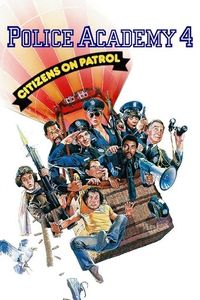
    Police Academy 4: Citizens on Patrol (1987)

    (Second Viewing, On DVD, November 2021) I somehow remembered Police Academy 4 as one of the high points of the series — but then again, twelve-year old me thought the series was terrific, so I wasn’t the best movie reviewer at the time. Suffice to say that this fourth entry is, by now, comfortably stuck in the confines of its own style — the jokes are as obvious as the characters, and the ludicrous climax shows that the producers had money to burn in order to deliver a final spectacle even when it didn’t really fit the tone of the series. I remembered just enough of the gags to feel a general sense of familiarity with the jokes, and some recognition from the dialogue. Steve Guttenberg, in his last appearance in the series, remains the randy straight-man cornerstone while, at the other end of the spectrum, Bobcat Goldthwait turns in a remarkably weird performance as an ex-con turned policeman. Everyone else gets their one-joke character stretched thin — with even the other characters telling them to cut it out. There are a few surprises in the cast list — Sharon Stone as a bouncy journalist, David Spade in his film debut, and even Tony Hawk somewhere in there. The memorable title song is stupid but fun, which is roughly the same thing we can say about Police Academy 4 as a whole — although I can’t quite tell how much of this appreciation is a residual feeling of the twelve-year-old critic who’s still part of me.

  • Scissors (1991)

    Scissors (1991)

    (On Cable TV, October 2021) There are roughly 45 minutes of an intriguing film in Scissors; alas, it leads to 45 minutes of a much worse film. Feeling a lot like a mellow de Palma film, it’s a psychological thriller (aka—weird stuff, not physically impossible) revolving around a young woman who gets assaulted in the elevator of her apartment, then sees things get truly weird. Talking to her psychologist doesn’t help much; speaking to her neighbours doesn’t help much (especially when one of them is definitely stalking her) and the strangeness doesn’t abate. Sharon Stone, in one of her pre-stardom roles, is actually quite likable as the eccentric lead even if it’s not a right fit for her later screen persona. The film is intriguing until it hits the midway part and abruptly switches gears by locking up its protagonist in a nightmarish apartment filled with animated objects, unsettling reminders of her past traumas and… a dead man, the same one who assaulted her in the elevator. Abruptly changing to a lock-up thriller, Scissors becomes less interesting and subjectively much slower-paced. It picks up again toward the end, as the explanations are given and our protagonist gets one final opportunity to strike back. While the film wants to be odd and unsettling, it settles for mere weirdness—director Frank De Felitta is not particularly gifted and his control over the results degrades the longer Scissors goes on. In the end, a potentially intriguing film has degenerates into mere mediocrity, barely worth remembering.

  • Deadly Blessing (1981)

    Deadly Blessing (1981)

    (In French, On Cable TV, February 2020) Writer-Director Wes Craven has had a very strange career. His filmography includes everything between horror-defining classics and some of the ordinary derivative filmmaking imaginable. Deadly Blessing is closer to the bottom of the barrel, although not quite the worst. The story is pure farmhouse horror, as a widow and two visiting friends have to fend off the aggressive behaviour of a local sect of totally-not-Amish farmers. It’s all quite unusual in terms of what passed for slasher horror back in the early 1980s (the rural setting is distinctive enough) and while Craven’s execution still had some young-filmmaker energy, the sum of it all doesn’t quite make up something worth remembering. Weird ending, too; when is a slasher not a slasher, it perhaps should foreshadow that it’s not a slasher. Amusingly, Sharon Stone stars (not very well) in a very early role, while Ernest Borgnine doesn’t cover himself with honours with a histrionic performance as a sect elder. Some individual moments are interesting (the bathtub-snake sequence strongly suggests another bathtub scene in Craven’s later Nightmare on Elm Street) but Deadly Blessing as a whole is more dud than success—although, as any Craven fan knows, there are far worse movies in his filmography.

  • Above the Law (1988)

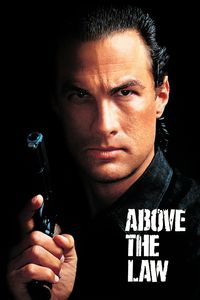
    Above the Law (1988)

    (In French, On TV, January 2020) Notable for being Steven Seagal’s movie debut, Above the Law is a bit of an odd duck in retrospect—Seagal is still his usual I-can’t-believe-he-was-an-action-star slimy self, but at least he’s younger and not yet calcified in his increasingly tedious screen persona. At times, we get sequences that would be very much out of character later on. It’s clearly a Seagal film that doesn’t know that it’s a Seagal film yet, so the formula’s not quite there. Alas, this means that the film is a somewhat bland 1980s action movie instead: the film built around Seagal’s star-making manoeuvre (let us be reminded that Seagal was, at the time, a protégé of super-powerful agent Michael Ovitz) is a generic vehicle representative of the era—slick and polished, like the middle-grade Hollywood movies of the time, with a plot that blends a cop protagonist with an overstuffed plot made of drugs, weapons dealing, CIA shenanigans, Catholic imagery and even a Vietnam flashback to round things up. At least things are better when it comes to supporting actresses, with an early turn for Sharon Stone and Pam Grier with such a presence that even the film itself seems awed by her. There are, eventually, a few decent-for-the-time action sequences once the narrative throat clearing is over, and even Seagal skeptics may find themselves intrigued by his turn here—before his ego took over and led to the career he had. Still, this isn’t much of a film—and so we come to the curious conclusion that if it wasn’t for Seagal, Above the Law would be better but utterly unmemorable.

  • The Specialist (1994)

    The Specialist (1994)

    (In French, On TV, March 2019) There is really no reason to watch The Specialist for what it delivers. At best (and that’s stretching things), it’s a mid-1990s action movie that suffers from comparison to the genre’s wilder and better entries. It’s about bombs, so exhaustingly so that much of the script’s slight ingeniousness has been put into showcasing as many situations as could be solved through a well-placed bomb. Naturally, credibility isn’t The Specialist’s strong suit, and it’s comfortably outclassed by the other “bomb” action movies of 1994, Speed and Blown Away. So, what’s left to justify a look at The Specialist? A few details, such as the charmingly quaint look at mid-1990s BBS technology. But mostly the acting—for all of its faults, The Specialist can still boast of a strong trio of lead actors: Sharon Stone could play a strong female lead like no one else at the time, while Sylvester Stallone’s boorish charm remains distinctive and James Woods still makes for a great villain. But that’s not much, and all three of these actors have been served by better similar roles in better similar movies. Despite the strong Miami atmosphere, The Specialist is almost entirely forgettable—you may enjoy a few things along the way (and truth be told, fast-forwarding from one explosion to the next may be the most entertaining thing to do with the film), but I’m not sure that it’s worth a look nowadays.

  • Sliver (1993)

    Sliver (1993)

    (In French, On Cable TV, November 2018) I’m old enough to remember Sliver as a Big Thing back in 1993—almost solely on the basis that this was Sharon Stone’s follow-up to Basic Instinct (1992) and people were wondering if she’d become the Queen of Erotic Thrillers (or something like it) based on how similar both projects sounded and given that both were coming from then-volcanic screenwriter Joe Eszterhas. Stone had quite a career afterwards, but Sliver itself sort of disappeared along the way. A critical disaster but a modest commercial success, it’s one of those very-1990s movies that show up on cable channels once in a while to remind contemporary viewers of the aesthetics of the time. They’re certainly not going to talk about plotting, considering that the simplistic story of the film has to do with a single woman moving into a high-rise with strange tenants and an unsolved murder mystery. After discovering that the owner of the building is a pervert who has installed dozens of cameras inside the building to spy on its residents, the story ends with the discovery of a different murderer only because preview audiences hated the original (and quite predictable) ending. Considering this paper-thin incoherent mystery and a Stone performance best characterized as adequate, aesthetics are the only thing left to discuss. (Not, not the sex scenes, which are comparatively tame.) The early 1990s were a weird time for movies, as the industry was beginning a switch to digital editing and post-production capabilities that allowed many more possibilities, many of them showy and awful. Much of Sliver is spent looking at TV screens, and lending that particular visual style to the film. It’s incredibly dated and not (yet) in a good way. As a result, Sliver isn’t much of a fun watch today, an experienced capped with a terrible ending that attempts to break through the fourth wall, only for the fourth wall to bloody the film’s nose.

  • Basic Instinct (1992)

    Basic Instinct (1992)

    (Second viewing, On TV, March 2017) I definitely remember seeing Basic Instinct a long time ago (in French, given that I remember the crude final lines as the ridiculous “… comme des castors”) but I’d forgotten enough of it to be mesmerized by a second viewing. Even today, it remains a pedal-to-the-metal borderline-insane thriller, rich in violence and a degree of eroticism seldom matched since then. I ended up watching the unrated version (on a basic-cable movie TV channel … go figure) and it features three of the most graphic sex scenes I can recall from a Hollywood film—the Jeanne Tripplehorn scene alone is worth the watch. Not that the rest of the movie is dull—under the combined daring of screenwriter Joe Eszterhas and director Paul Verhoeven, the film cranks up nearly every single exploitative dial to eleven. It throws in a car chase on twisty backroads because, well, why not? It throws another car chase through downtown San Francisco because, again, why not? When bisexuality and murder are the most ordinary elements of the story, that’s not even getting into the twisted psychos-sexual games played between the two characters. Michael Douglas is in peak form as a risk-addicted policeman, and while Sharon Stone is still remembered for the ice-cold danger she projects, I had forgotten how her character is balanced by some cute impishness. The interrogation sequence has been parodied endlessly, but remains no less effective today in seeing a lone woman defy half a dozen alpha males by sheer (or not-so-sheer) chutzpah. Basic Instinct is pure wilful exploitation, and that’s why it’s so remarkable. The murder mystery is almost besides the point—something that the double-ending practically dies laughing about. I still think it’s far too bloody … but that’s part of the film’s twisted fun. Morally reprehensible yet slickly executed, Basic Instinct almost looks even better twenty-five years later.

  • Lovelace (2013)

    Lovelace (2013)

    (Video on Demand, September 2013) The story of Linda Lovelace, first-ever porn star thanks to a starring role in the wildly popular Deep Throat, is a classic case of she-said-she-then-said: Lovelace (co-)wrote four autobiographies, and their content varied with time: The first two are very much pro-pornography at a time where she was riding Deep Throat’s popularity, the last two very much against it at a time when she was campaigning against obscenity and free to speak against her abusive then-husband. Lovelace unusually tries to grapple with this complex portrait by presenting Lovelace’s life twice: first as a success story, and then as the darker, more abusive version of it.  It may not completely work (the scenes become sketches rather than flow harmoniously from one another, and the simplification of Linda-the-victim is unfortunate given the complexity of her life after porn and after being used by feminist activism), but it’s an interesting attempt that brings an unusual twist to the usual bio-drama genre.  What is undeniable, though, is Amanda Seyfried’s performance in what may be the first truly adult role she’s played so far –far away from the post-teenage ingénues that fill her filmography.  As for the rest of the film, well, it convincingly re-creates the seventies, features a darkly amusing cameo by James Franco as Hugh Hefner and has a nearly-unrecognizable Sharon Stone in a maternal role (!) alongside a gruff Robert Patrick.  Lovelace may not be the complete story of Linda Boreman, but it goes further than could have been expected in presenting both sides of it.