Shelley Winters

  • What’s the Matter with Helen? (1971)

    What’s the Matter with Helen? (1971)

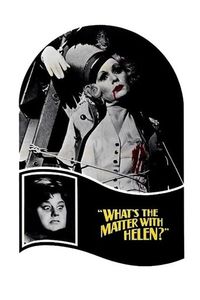
    (On Cable TV, July 2021) It’s really hard to watch What’s the Matter with Helen? and not notice the similarities with psycho-biddy exemplar What Happened with Baby Jane? : In both cases, we’re dealing with a bloody psychodrama, featuring female protagonists intent on doing harm to each other, played by actresses past their prime years. In this case, we have two women cleared of a murder in the 1930s, moving to Los Angeles to open up a dance academy but being pursued by a dangerous stalker intent on making them pay. Considering the delicate mental state of one of the women, however, the biggest danger may not come from outside! Debbie Reynolds and Shelley Winters star, with Winters being far more memorable in her unhinged role. (Reading about the film’s production history is wild, with Winters seemingly breaking up along with her character, and some weird business about a prop knife being replaced by a real knife.)  The script is suitably macabre all the way to an often-spoiled climax. What’s the Matter with Helen? is not an exceptional film, but like many films in its subgenre, it does offer up a few treats, especially for classic Hollywood fans looking to complete their filmographies of known actresses.

  • A Patch of Blue (1965)

    A Patch of Blue (1965)

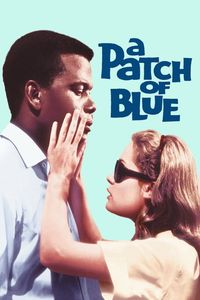
    (On Cable TV, April 2021) There’s a completely unsubtle romance at the core of A Patch of Blue — a literal illustration of “love is blind” in which a blind white girl falls for a black man. For 1965, this was courageous stuff, but what saves the film for modern audiences is the utterly likable performance from Sidney Poitier, who carries the film without missteps even at this early stage of his career. The cast around him is quite good as well—Elizabeth Hartman is suitably sympathetic as the blind girl, while Shelley Winters is striking as her incredibly unpleasant mother. The narrative isn’t much—and for all of its progressive intentions, the film isn’t allowed to go very far—but the acting is great and the individual scenes avoid hammering the already-unsubtle nature of the narrative. It doesn’t take much more than that to transform A Patch of Blue from what could have been an overbearing Oscar-baiting film into something quite watchable.

  • Wild in the Streets (1968)

    Wild in the Streets (1968)

    (On Cable TV, November 2020) You can often learn more about an era by looking at its middle-grade genre movies than its masterpieces: the id is closer to the surface, and the lack of even trying for timeless relevance can ground the work into the obsessions of the moments. So it is that American Pictures International’s B-grade Wild in the Streets spins one simple but mind-boggling statistic—that in the late 1960s, “52% of the US population was under 25”—into a wild satirical comedy in which a lowering of the voting age leads to the youth taking power. [Note: According to the data I could find, the share of the under-25 as a percentage of the total US population peaked at 45.8 in 1967, with the median age of the US population at an all-time low in 1970 at 28.1 years—in other words, take the film’s central statistic with a grain of salt.] It’s a film that starts out crazy with a capsule demonstration of a rotten family situation, and then wilder and wilder until the end. Clearly made to court the youth audiences, Wild in the Streets is unabashedly crammed with musical numbers, teenage heartthrobs and pointed barbs at older people: Christopher Jones is compelling in the lead role of a teenage rock superstar turned president of the United States, Shelley Winters is thoroughly detestable as the protagonist’s abusive mother, while Hal Holbrook is a likable actor in an ingrate role as a politician (also abusive toward his kids) who gets swept by the youth wave—and Richard Pryor has a small role as a teenage activist! Music is a big part of the film, and for good reason — “14 or Fight” is insanely catchy, far more than the film’s lead anthem “The Shape of Things to Come.” Given the film’s outright satirical aims, it’s no surprise if it ends up taking a real issue (the drive to lower the voting age to 18 across the United States during the late-1960s) and pushing it to extremes. You’re really not supposed to take it seriously: By the film’s last third, anyone over 30 is pushed in mandatory retirement, and sent to re-education camps where they are kept docile with a permanent done of LSD. And then the pre-teen set takes aim at the “older” teenagers… but I’ve said too much. In reflecting a funhouse version of the youth movement that peaked in the alte-1960s, Wild in the Streets does remind us of the incredible demographic forces that were such a strong engine for change in the Sixties—something often buried deep under the headlines and news clips of the era. It does have a good sense of humour about itself (as the coda suggests, the teenagers aren’t getting away with anything here), a really good energy (as per its Academy Award nomination for Best Editing) and enough craziness to make the satire worthwhile. It’s surprisingly fun and teaches us quite a bit about 1968 without the dourness of the then-emerging New Hollywood.
  • Executive Suite (1954)

    Executive Suite (1954)

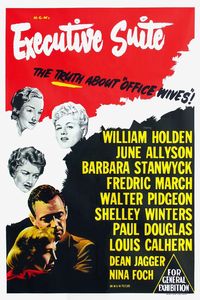
    (On Cable TV, October 2020) I am fascinated by tales of boardroom intrigue, a fascination that comes from my background as a white-collar office drone, constantly aware and at the mercy of senior management shenanigans. I also suspect that such high-level executive machinations are perhaps the closest modern equivalent to palace intrigue, what with the king having to deal with his scheming courtiers in modern attire. No matter the reason, I found myself very quickly drawn into Executive Suite’s steely-eyed depiction of the feeding frenzy that follows the death of a furniture magnate, as two visions of the company battle it out in a succession drama played in voting shares and personal grudges. The film’s opening moments are remarkable, as a first-person point of view of someone sending a telegram and going out to take a taxi turns tragic when the person dies and his wallet is stolen. It turns out that we’ve just seen the death of a company president, and the wallet theft means that no one (except for one executive using this knowledge for insider trading) will realize what happened for another day. The film settles down a bit after this fantastic opening sequence, but the sides are steadily described, what with a quality-conscious designer going up against a penny-pinching financial officer for control of the company. There are many similarities here with 1956’s Patterns, but Executive Suite is a solid drama of moves and counter-moves (with a seriousness underscored by, well, the lack of a score), with a likable hero played by William Holden and decent supporting roles for Barbara Stanwyck, Fredrick March and Shelley Winters. Director Robert Wise’s approach to the material is decidedly close to the ground, but there’s a decent understated flourish to the script, as it quickly sketches characters, and sometimes catches them in compromising positions. I don’t expect everyone to be as enthralled by Executive Suite as I was, but there’s something carefully balanced about its dramatic plotting and its almost realistic approach to the material.

  • A Place in the Sun (1951)

    A Place in the Sun (1951)

    (On TV, July 2019) I had reasonably high hopes for mid-period noir A Place in the Sun and found myself … underwhelmed. The story of a man pursuing both a working-class and a high-class girl but accidentally killing the less fortunate one when she announces her pregnancy and dashes his hopes of marrying the richer girl (whew!), it’s a film that pretty much does what it says in the plot description. Coming from the depths of the Hays Code era, of course he doesn’t get away with it. It’s a remarkably middle-of-the-road premise for a noir, and it executes it about as competently as you’d expect. The big draw here is a very young Elizabeth Taylor, always stunning, as the high-class girl and Montgomery Clift as the man at the centre of it all, with Shelley Winters as the poor victim. But the exceptional nature of the film stops there. While A Place in the Sun is still watchable, it pales in comparison with many of its more daring (or exploitative) contemporaries. The social commentary is tame, the pacing is incredibly slow and the film can’t help but throw in melodrama when good acting would have sufficed. Any respectable film noir would have lopped off the entire courtroom sequence, going right from arrest to the electric chair, and the film would have been substantially stronger from it: said courtroom sequence adds nothing to the plot and actually distracts from the fatalistic theme of the film, or (as suggested by the title) the perils of American greed. But no; A Place in the Sun is determined to parlay it off all the way to the end. It did do very well at the Academy awards for its year, so at least it’s of historical interest. Still, it could have been quite a bit better had it not tried to be so respectable or overly faithful to its literary source material.