Sidney Sheldon

  • The Bachelor and the Bobby-Soxer (1947)

    The Bachelor and the Bobby-Soxer (1947)

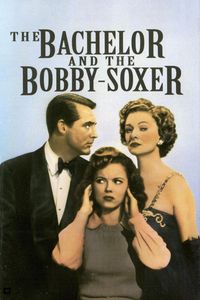
    (On Cable TV, March 2020) As the title suggests, there is one potentially troubling March-June relationship in The Bachelor and the Bobby-Soxer that would make any viewer apprehensive – especially considering that it’s a film from the 1940s. But fear not, enlightened twenty-first-century viewers: Even Classic Hollywood knew that thirtysomething bachelors (even one played by Cary Grant) should not mess around with 17-year-old girls with a crush. Much of the film’s comedy in this film is about the protagonist (Grant) trying to get together with an age-appropriate professional woman (Myrna Loy) while her younger sister (Shirley Temple) interferes. There’s just enough implied naughtiness to make things interesting—the rest is scene-by-scene comedy, as Grant plays both halves of his suave persona unafraid to be humiliated. Cleverly conceived (the script, penned by future potboiler bestseller Sidney Sheldon, won a Best Original Screenplay Academy Award), it’s unobtrusively put together by director Irving Reis and very easy to watch. Grant’s charm does most of the work, but there are also plenty of scattered laughs in the details—my favourite has to be a rapid-fire exchange about “The man with power of whodoo / Who do? / You do!” which sounds like the kind of period nonsense exchange immortalized on screen—and later quoted by David Bowie. While definitely a middle-tier Grant comedy, The Bachelor and the Bobby-Soxer remains a charmer despite a slightly suspicious premise, and a great showcase for its three stars.

    (Second Viewing, On Cable TV, January 2021) Cary Grant had the looks and the charm that could make any kind of creepy nonsense seem amusing, and there’s no better proof of that statement than watching The Bachelor and the Bobby-Soxer, a film in which (as it says in the title) he suffers through an unrequited crush from a flighty teenager. Shirley Temple plays the titular bobby-soxer, but it’s Myrna Loy who’s the prize here as the teenager’s older sister, a judge whose tangles with Grant’s character leads to romance. Before that happens, however, there’s got to be plenty of sequences of misunderstandings, comic complications, bone-headed movie psychology, attempts from Grant’s character to divert his teenage admirer to a more appropriate partner, and some physical comedy along the way. To its credit, the film knows that pairing Grant (who was 43) and Temple (who was 19) is a terrible idea—and if that seems perfectly reasonable to you, keep in mind that other similar Hollywood movies, such as the 1954 farce Susan Slept Here, weren’t even able to do that. There are a few good set-pieces and lines of dialogue here: While I’m ambivalent about the outdoors sports scene, the last restaurant sequence is very funny—even if it ends in a way that leads the film to another ten minutes of decreasing interest as the conclusion peters out rather than build to a strong finale. (Hollywood obviously disagreed, because the film won a screenwriting Academy Award.)   The call-and-response, “The power of hoodoo.” “Who do?” “You do!” is also quite amusing, and wisely used as closing lines to wrap it up. In between Grant, Temple and Loy, The Bachelor and the Bobby-Soxer is an amiable-enough comedy that manages to steer itself away from some pitfalls that befell other similar films. It’s worth a look, especially for fans of the three lead actors.

  • Nothing Lasts Forever, Sidney Sheldon

    Warner, 1994, 384 pages, C$7.99 mmpb, ISBN 0-446-35473-2

    There’s something to be said for trash, as long as it keeps me amused and out of trouble.

    I know, on some intellectual level, that Sidney Sheldon is a best-selling writer. That his name is (was?) mentioned alongside Tom Clancy, Danielle Steele or Stephen King as this model of a wildly successful multi-millionaire author. But in a classic illustration of how large the fiction publishing universe has grown, it’s entirely possible for even a voracious genre reader such as myself to go practically ten years without reading a single novel of his, nor have much of an idea of what he usually writes. The last book of his that I’ve read, The Doomsday Conspiracy, was by a significant margin the single worst attempt at Science Fiction by a non-genre writer until Robin Cook’s Invasion.

    I’m not a big reader of medical thrillers, but I believe that Nothing Lasts Forever does for them what The Doomsday Conspiracy did for SF: Barge into the genre with no affection and no refinement to develop a trite story featuring bad characters and entirely expected developments. But whereas The Doomsday Conspiracy‘s naive lack of sophistication seriously annoyed me, Nothing Lasts Forever ends up being… almost charming. I’m sure that my devotion to SF has something to do with my reaction (“How dare you make fun of my favourite genre?!”), but after this book, I suspect that there’s another element at play.

    Let’s briefly review the basics of the plot: Three new doctors, all women (and yes, discrimination still plays an important part in this 1990 novel), learning the ropes at one of San Francisco’s biggest hospitals. But, as the first page baldly states, “one of them almost gets an entire hospital closed down, the second one kills a patient for a million dollars and the third one is murdered.” And there we go. In a curiously sophisticated nod to storytelling structure, the first chapter of the book is a fast-forward murder trial that, of course, presents a cynical version of events that will be completely overturned by the latter “true” flashback narrative.

    If you’re used to daytime soap operas, Nothing Lasts Forever (a title that even sounds like a soap opera) will be instantly familiar. The shallow characterization. The casual evil inflicted by the tale’s villains. The twists and turns of fate (best described as “honking coincidences”). The way the story is pared down to its essentials in a series of short scenes. At the very least, no one wastes his time here, as the story races from beginning to end.

    And that’s just as well, because the plot jumps from one unlikely situation to another. Gainful murder is committed because that’s the first thing that comes to the mind of the villain. An incompetent doctor naturally turns to Kama Sutra-enhanced seduction as a palliative for her lack of knowledge. (Worse; her daily couplings always works in ensuring the cooperation of her superiors and colleagues. Surely she can’t be that good, right?) Reading pages of this novel at random is an exercise in preposterous plotting.

    But guess what? It’s so unsubtle, so unapologetic that it’s hard to resist. To quote the novel about the doctor with a specialization in Kama Sutra career-advancement, “There was a helplessness about her that they were unable to resist. They were all under the impression that it was they who were seducing her, and they felt guilty about taking advantage of her innocence.” [P.115] Bang on: This is such a fun novel, in its own skanky way, that’s it’s difficult to be harsh; it would be like spanking a mewling kitten.

    If this review sound awfully condescending, consider this hypothetical scenario: What if an unbelievably crafty writer learned after years of trying that general audiences don’t like to be challenged? What if he took secret delight in producing trash and actually agreed with his most severe reviews while lighting cigars with hundred-dollar bills? What if he consciously dumbed down his stories so they’d appeal to everyone, including self-styled hipsters reading for ironic value? Hmmm… Twisted? Unbelievable? Even more so than this particular novel?