Sigourney Weaver

  • My Salinger Year (2020)

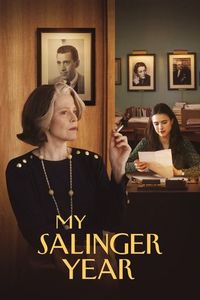
    My Salinger Year (2020)

    (On Cable TV, July 2021) While the contemporary filmmaking landscape is flirting with post-literacy (at least at the top of the box-office), we have recently seen a vigorous subgenre of dramas set in the literary world — I’m thinking of (among others) Can You Ever Forgive Me?, Genius, Trumbo, The End of the Tour, Tolkien, Wild Nights with Emily — and that’s only between 2015 and 2020. We can now add My Salinger Year to this boiling pot — an adaptation of a memoir from a young woman who momentarily became an administrative assistant in the agency representing Salinger, and who witnessed first-hand both the impact of the famously reclusive writer, but also the personality of the agency president in dealing with a client like Salinger. My Salinger Year is a modest Canadian production from writer-director Philippe Falardeau, but it clearly follows the precepts of Hollywood screenwriting: it’s about its main character’s voyage of self-discovery and only tangentially about Salinger. The look at the inner working of a creative agency is interesting but clearly subordinated to the requirements of filmed drama. Fortunately, a pair of good performances are at the heart of the film: Margaret Qualley as the young writer looking for a job and the courage to pursue her dreams, and Sigourney Weaver in fine form as the brassy agency owner who ends up teaching her many lessons. Salinger is a shadow here — often a voice, sometimes a silhouette. It’s all a bit mechanical, not really surprising, but still effective. The mid-1990s setting leads to a few cheap technology jokes, but the film itself does have a timeless quality. It makes for entertaining viewing, with additional bonus points if, like me, you’re invested in films about writers. The only problem? My Salinger Year is, like its title, something that passes and fades from memory.

  • The Year of Living Dangerously (1982)

    The Year of Living Dangerously (1982)

    (On Cable TV, March 2019) There are a few movies that make more sense when measured against an entire corpus, and while I’m not calling The Year of Living Dangerously an incomplete movie by itself, it does get much of its power when you oppose it to a corpus of adventure films in which a westerner performs heroics in a foreign country, either saving others or having an impact on the events. Here, we get a very young Mel Gibson as an Australian journalist assigned to Indonesia in the months leading to the 1965 attempted coup, learning about the dangerous country, befriending an eccentric character, falling for an English embassy worker, and trying to do his job during a volatile situation. Gibson is fine, Sigourney Weaver is quite good as the British woman but it’s Linda Hunt who steals the movie (and won an Academy Award) as an Asian male—an impressive transformation that adds much to the character. The Year of Living Dangerously may sound like a dull foreign drama, but it works wonders in immediately capturing viewers in its opening moments, thanks to an enigmatic character narrating and taking harsh notes on the protagonist. The atmosphere carries much of the film’s midsection despite a few lulls, with director Peter Weir doing well at showing how much our protagonist is still a neophyte at his job, how far out of his element he is and how he ends up paying for his mistakes. That starkly comes into play during the film’s last act, as the white saviour stereotype is completely defeated in the Graham Greene tradition. Our lead spends much of the film’s climactic events completely unable to do anything, unable to report on the biggest story of his career and having to abandon everything in order to make it out alive. It’s a measure of the film’s success that the film isn’t all that depressing despite the downbeat material, but your mileage may vary—you may have to be exasperated with an entirely different kind of film in order to get the most out of The Year of Living Dangerously.

  • Working Girl (1988)

    Working Girl (1988)

    (On Cable TV, January 2019) Now there’s a strong contender for the title of the most 1980s movie ever. Working Girl came at a time when Hollywood seemingly couldn’t get enough of Manhattan’s Wall Street ambience, in between Wall Street and The Secret of my Success and Baby Boom and many others released in barely a three-year span. Unlike many of those, however, Work Girl clearly has (from its title onward) a clear idea that it wants to talk about class issues in the United States, especially when the Manhattan office environment can be used to put the very poor right alongside the very rich. Director Mike Nichols approaches the topic with two ideal actresses at each pole of the story: Melanie Griffith as the heroic low-class girl whose smarts exceed those around her, and Sigourney Weaver as her high-class, low-morals opposite. The opponents having been defined, the rest is up for grabs: the job, the prestige, even the boy-toy (Harrison Ford, good but not ideal—the role is funnier than he is) will be given to the winner. Good performances abound, with some surprising names (Joan Cusack! Alec Baldwin? Oliver Platt!! Kevin Spacey as a lecherous pervert?!) along the way. Still, this is Griffith and Weaver’s show. Only one of them shows up in lingerie, though. Now, Working Girl is not a perfect film—it does use a few shortcuts on the way to a sappy romantic conclusion, and it bothered me more than it should that the characters would assign so much importance to the idea as having value—in the real world, execution is far more important, but it doesn’t dramatize so well. Still, that doesn’t take much away from Working Girl as class conflict playing out in late-1980s Manhattan. It’s not a complicated film, but it is very well crafted. (One more thing: Weaver’s character’s name had me thinking of evil Katharine Hepburn, which led me to think about how the two women looked like each other, which had me thinking about how they could have switched many roles, which had me thinking about Katharine Hepburn as Ripley in Aliens. Hollywood, if you’re listening, I know you have the CGI and lack of morals to make this happen.)

  • Dave (1993)

    Dave (1993)

    (On Cable TV, December 2018) There have been quite a few movies about the American presidency, but few of them as cutely romantic as Dave, in which a presidential impersonator gets the job on a long-term basis when the real president is medically incapacitated. The plot is familiar from there, but the real fun of the picture has to be seeing Kevin Kline in a dual role, with Sigourney Weaver as the wife who suspects that something is afoot, and Frank Langella as the villain trying to take over the United States through an unwitting patsy. Ving Rhames and Laura Linney also show up in smaller early roles. Oliver Stone has a funny cameo. Clearly, director Ivan Reitman is aiming more for a feel-good romantic fantasy than a hard-edged political thriller, especially given how the film plays with the idea of the everyday man replacement being better in all aspects of the job than the original. There’s an interesting comparison to be made here with near-contemporary The American President, but also with the classic idealistic films by Frank Capra, in which he took pleasure in scrutinizing the American political system to reveal the good intentions underneath it. Dave is a lightweight comedy, but a charming one, and certainly a welcome antidote to the kinds of heavier thrillers that the American presidency usually invites.

  • The Ice Storm (1997)

    The Ice Storm (1997)

    (Netflix Streaming, October 2017) In genre-literature fandom, there is this incredibly unfair cliché that the average “mainstream” literary novel is nothing much more than a college professor writing about upper-middle-class ennui, tawdry affairs, dysfunctional families and pretentious pseudo-philosophy. In this light, The Ice Storm hilariously become an example of the form despite a few references to the Fantastic Four comic books. It is about upper-middle-class ennui and tawdry affairs, as husband and wife from different couples have an affair that is exposed during the course of the film. It is about dysfunctional families, as the kids of those two families have their own experimental games. The pretentious pseudo-philosophy comes from contemplating comic books, unsatisfying lives and unusual weather events, with a side-order of communal swinging at seventies key parties. The film is sure to resonate with many viewers—the 1973 setting is convincing down to the awful fashion, Ang Lee directs with a sure hand, and the film has a strong cast of then-established actors (Kevin Kline, Sigourney Weaver, Joan Allen, all very good) with a miraculous near-handful of then-rising names that have since done much (Elijah Wood, Tobey Maguire, Christina Ricci, Katie Holmes). But it doesn’t take much distancing to find The Ice Storm slightly ridiculous even as the film reaches for grief in the face of a freak death and familial reconciliation after trying times. From a non-sympathetic perspective, the clichés accumulate at a furious rate, the dramatic heft of the death isn’t earned and the film concludes without having much, everyone still being the same flawed characters than they were at first. But hey—it got nominated for a bunch of awards, so it must be good, right?

  • Heartbreakers (2001)

    Heartbreakers (2001)

    (On TV, October 2016) Trying to convince someone to see this tepid crime comedy about a mother/daughter pair of con artists quickly takes us to the tawdry: How about twentysomething Jennifer Love Hewitt playing up her cleavage? How about Sigourney Weaver in a lace bodysuit? No? Yet Heartbreakers’ most playful moments are spent playing the naughtiness of its premise (entrap the mark in a marriage, then create an affair and get half his wealth in a divorce settlement), so it’s not as if this is coming out of nowhere. What’s perhaps most disappointing, though, is how restrained the film has to be in order not to offend the masses, play against its stars’ persona and avoid an excessive rating. As such, Heartbreakers often feels like a big compromise, torn between sexiness and prudishness. If it felt free to cut loose with more nudity and explicit references, it could have been better; had it restrained itself and refocused, it could have been better as well. In its weird middle-ground, though, Heartbreakers often feels as if it doesn’t know what to do. Much of the plot points are predictable long in advance, with the conclusion dragging on much longer than it should (past the point most people will care, actually). Weaver’s extended fake-Russian shtick drags on for much longer than advisable, while Hewitt’s prickly romance subplot feels like the same plot point repeated five times. Bits and pieces of the film are amusing: Ray Liotta isn’t much more than adequate, but Gene Hackman cuts loose as a frankly despicable man who falls prey to the protagonists. While the film is a bit too good-natured to be unpleasant, it’s not much more than a mediocre comedy. You’ll smirk a few times, but Heartbreakers could and should have been much better.

  • The Cold Light of Day (2012)

    The Cold Light of Day (2012)

    (On Cable TV, September 2013) The risk in relying on familiar thriller tropes is that while they can provide structure, they can’t, in themselves, substitute for wit and originality.  It’s not a bad idea to propose as a premise an American tourist in Spain getting caught in a complex web of espionage thrills and double-crosses, but it has to be handled with some competence.  Alas, The Cold Light of Day is a purely generic product down to its meaningless title, and a roster of familiar actors can’t save the film from by-the-number plotting, familiar plot points, murky motivations and tedious pacing.  Henry Cavill gets (and fumbles) a chance to prove himself a contemporary action hero as he finds himself alone and running in Madrid, but he’s easy to forget when sharing scenes with Bruce Willis (as a father with a hidden second and third life) and Sigourney Weaver (as an immediately-suspicious high-level intelligence officer).  Much of the film is straight out of the “man running for his life” thriller sub-genre, and while director Mabrouk El Mechri has the occasional good eye for filming action scenes, they feel overlong and perfunctory in the middle of such a familiar framework.  (The final car chase definitely has its moments, but it’s too long by at least half its duration)  While The Cold Light of Day will act as a pretty good showcase for Madrid’s tourist attractions, it’s not much of a calling card for anyone else involved: the characters are uninvolving, the narrative excitement is flat and nearly everything about the film seems wasted.  For a film produced with decent means and known actors, there isn’t much here to distinguish it from a run-of-the-mill TV movie.

  • You Again (2010)

    You Again (2010)

    (On-demand Video, April 2012) It feels churlish to criticize a film that’s not meant to be much more than a lighthearted comedy with a female-centric cast, and perhaps even ungrateful to do so when it does deliver a few laughs, but You Again simply isn’t as good as it could be.  While the idea of a decade-deferred vengeance between bully and bullied is interesting and definitely can be mined for comedy, this script seems confused between slapstick, retribution and reconciliation.  The first act is annoying in how it presents a relatively innocuous situation where an easy way out is dismissed through sheer dramatic inevitability: the main conflict of the film exists because the characters are self-destructive, and the ending doesn’t do much to send an anti-bullying or even anti-revenge message.  But, OK, fine: this is not a “message” movie, even though it shoots itself in the foot comedy-wise by trying to reach for a heartfelt moment or two late in the game.  It’s perhaps best to focus on Kirsten Bell’s physical comedy in the lead role, or the casting of Jamie Lee Curtis and Sigourney Weaver as dueling rivals, or the always-hilarious Betty White and Kristin Chenoweth in small supporting roles.  (There are also a few cute cameos.)  Meanwhile, the male performers all wisely take a step back in order to let the actresses shine.  It adds up to a film that’s not too difficult to watch, but goes through a number of fuzzy plot choices that do nothing to bring You Again out of average mediocrity.  Good casting; flat script: could have been much better.

  • Alien: Resurrection (1997)

    Alien: Resurrection (1997)

    (In theaters, November 1997) Given the near-classical status of the two first movies of the Alien series and the widespread loathing of the third segment, it won’t be a surprise if chapter 4 fits somewhere between those opposites. More of a film version of the Dark Horse comics than a satisfying extension of the series, Alien 4 manages to be relatively entertaining, but not enough to be fully liked. The biggest flaw of the movie is that it introduces a few new concepts to the saga, but does so in typical stupid Hollywood action movie fashion (where a character can use two right-angle ricochets to hit a villain through a helmet, and other assorted physically impossible antics). Oh, and the ending sucks… even though “sucks” here is as much a statement of fact than opinion.

    (Second viewing, On DVD, May 2005) When discussing the flaws of the Alien series, most will spend their time rehabilitating Alien 3. I’d rather champion this film, an uneven and disappointing entry that nevertheless contains ten time the action, interest and humour of the third entry. Director Jean-Pierre Jeunet would go on to write and direct Amelie, but his quirky sense of humour and his impeccable eye for style is already on full display here, as he plays around with the Alien mythology, brings it further in the future and generally has a good time. There are a number of terrific visuals in the film, and a few good dialogue scenes. It’s a shame, then, that the third act is so atrocious, that the action scenes are so improbable, that the humour isn’t a bit more reigned in or that Sigourney Weaver was allowed to have such an influence on the production. I was never able to shake the odd feeling that this was a live-action adaptation of a Dark Horse comics, but no matter; I still find something worthwhile in this film, warts and all. The “Alien Quadrilogy” box-set special edition includes a fair number of supplemental material, including a “special edition” with better bookends and a number of added dialogue lines. The documentary featurettes are a bit disappointing, failing to offer a complete overview of the film production. A fair audio commentary completes the material.