Simone Signoret

  • Room at the Top (1959)

    Room at the Top (1959)

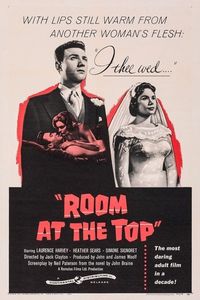
    (On Cable TV, October 2021) The taboos of one era are the snoozefests of later generations. While I’m aware of Room at the Top’s reputation as one of the first of the British New Wave, a taboo-breaking drama unafraid to go mundane and bitter in its conclusion, it plays like a dreary drama these days, considering how often it has been imitated and so thoroughly it has been outclassed by follow-ups. The story follows a protagonist of humble origins, as he deliberately pursues an heiress for social purposes. But wait! Things take a turn as he falls for a married woman of humbler origins. Of course, things don’t remain so simple for long, as the protagonist finds himself stuck in a trap partially of his own doing—all the way to the ending, which looks superficially happy but condemns him to a life of misery. Simone Signoret is reliably striking as the married woman (she earned an Oscar for the role). Compared to many other films of the time, Room at the Top was something unusual: dourly rejecting the pursuit of social status in post-war England, it took the glum worldview of noir and put it back into mainstream drama, leaving audiences without a clear-cut release. Even worse: it took a decidedly unromantic look at sex, marriage and affairs. Nominated for the Best Picture Academy Award, it does remain an effective drama, but twenty-first century viewers will have seen all of this, and better, in countless pieces of popular entertainment since then. That doesn’t make Room at the Top bad, but it does strip it of the distinction it enjoyed at the time.

  • Games (1967)

    (On Cable TV, July 2021) I had a momentarily double take in looking at Games’ TV log entry — talking about a 1967ish film featuring “A young couple who are into kinky mind games,” screams Who’s Afraid of Virginia Woolf? to me, but as a viewing attests, there’s a gulf of difference between the two movies: Games is a pure genre thriller, occasionally silly and ultimately quite glum. It does feature a couple into mind games (first shown as party tricks) but slowly sinks into a tangled web of deception and murder. Simone Signoret is the film’s most remarkable asset as a mysterious older woman who turns the tables on the couple, even if said couple is played by none other than Katharine Ross and a surprisingly young James Caan. For noted iconoclast director Curtis Harrington, Games is about as close to mainstream stuff as he did — there’s a pleasant lunacy to the overlapping plots that come to dominate the film, but it’s executed in relatively straightforward fashion for a twisty thriller. The colourful cinematography is very much of tis time, and now gives an interesting period patina to the result. You can slot Games squarely in the “solid movie” category — not a masterpiece nor particularly memorable, but well-made and entertaining enough to make up an evening’s entertainment.

  • Les diaboliques (1955)

    Les diaboliques (1955)

    (Criterion Streaming, November 2019) Mid-1950s French cinema isn’t exactly high on my list of favourite viewing attractions, but Les diaboliques is one big exception. Even after decades of imitators, ever-stronger thrills and jaded audiences, that pure thriller still has the power to shock and surprise. Much of the plot revolves around two women plotting to murder a man and what happens afterwards. But the plot is best kept under wraps, because there’s That Scene where the impossible happens, you jump in your seat and think that the supernatural has invaded the film. It hasn’t, and the film eventually delivers a Hitchcock-grade explanation for everything. It’s quite a shocker, and writer-director Henri-Georges Clouzot, working from a suspense novel by Boileau-Narcejac, here delivers one of his best movies. Simone Signoret is also remarkable in one of the main roles—as is the crisp black-and-white cinematography. I won’t say more—good movies speak for themselves, and Les diaboliques explicitly told me not to spoil it.

  • Ship of Fools (1965)

    Ship of Fools (1965)

    (On Cable TV, January 2019) There are many ways in which Ship of Fools reminded me of Grand Hotel—its 1930s setting, its ensemble cast with overlapping subplots, its black-and-white cinematography and its mixture of American and German characters. However, the comparisons only go so far and the crucial difference between the two movies is not that one is in a building and the other on an ocean liner, but that one was made in 1932 and the other one after World War II. As a result, expect a lot more Nazis in Ship of Fools than Grand Hotel, and the portentous veil that this distance casts over the entire film. As the film begins assembling its large cast of characters, it quickly becomes apparent that this isn’t just about people travelling from North America to Europe on a steam ship, but a message movie about the rise of fascism in Europe. (Contemporary viewers would have known that from seeing that it’s directed by Stanley Kramer, a renowned social issues filmmaker.) The foreboding feeling is accentuated by the characters opposing their views on the world, and the film sides squarely with the marginalized over more conventional heroes. (In addition to characters with terminal illnesses or mental conditions, there are Jewish characters, obviously, and the film’s most likable character, its narrator, is played by 3′10″ Michael Dunn in an Oscar-nominated performance.) The ensemble cast is impressive, what with Lee Marvin, Vivien Leigh (in her last film), José Ferrer and a terrific Simone Signoret. Ship of Fools is certainly preachy, but there’s a powerful sense of impending doom as the characters get closer to their German port of arrival. The last few moments are particularly hard-hitting, as the narrator delivers a bitterly ironic envoi.