Spike Lee

  • Da 5 Bloods (2020)

    (Netflix Streaming, October 2021) Don’t misunderstand me when I say that Spike Lee could have had an exemplary career as a pure entertainment filmmaker: He’s one of the most vital voices in American cinema and he wouldn’t be Spike Lee without constant engagement on social issues. But as many entries on his filmography suggest (25th hour, Inside Man, Oldboy), he could have made it solely on technical competence in delivering entertaining films. But his special genius lies elsewhere, in combining this entertainer’s instinct with works of social import. His latest two films, BlacKkKlansman and Da 5 Bloods, end up being among the best of his career in blending accessible narratives with pointed social issues. His latest film begins with exactly the right interview snippet: Mohammed Ali discussing how “I ain’t got no quarrel with those Vietcong,” thus putting the central idea of the film right up there: why would black soldiers serve a country that marginalized them so much? The way to illustrate this tension goes through a hard-to-resist premise: what if American soldiers went back to Vietnam fifty years later to find the remains of their commanding officer… and a crate filled with gold? The early moments of Da 5 Bloods present themselves as something of a romp, as our elderly veterans (led by Delroy Lindo) take in the sights of a westernized Saigon and head over to their adventure. But pay attention to the flashbacks and the foreshadowing about landmines because the film becomes darker in a single moment and its second half is a far more thrilling contemporary adventure in which, as usual, finding the gold isn’t nearly as difficult as keeping it. Jean Reno has a small but enjoyable role, while Chadwick Boseman makes a remarkable appearance (one of his last) and Hollywood newcomer Sandy Hương Phạm provides a remarkable emotional linchpin to the film. It gets overly violent at times (even though: hey, it’s a war film) but engrossing throughout even as it switches gears as it goes on. It’s a really good film, and doesn’t skimp on the American racial divide either. Da 5 Bloods is another success for Spike Lee, who seems to be getting a second or even third wind as a filmmaker.
  • Crooklyn (1994)

    (On Cable TV, August 2021) It’s not quite fair to call Crooklyn a kinder, gentler Spike Lee movie —it’s just as engaged as other films, but it turns its attention to domestic issues in presenting a semi-autobiographical tale about growing up in Brooklyn in the 1960s/70s. As a result, you won’t necessarily find as many guns as other Lee films (despite a title that promises crooks), as this one focuses on the pressures that a mother has in taking care of her five children in a cramped apartment. The surrounding neighbourhood is portrayed with a great deal of affection, and the period soundtrack is nothing short of terrific. It’s not as if Crooklyn doesn’t pack a punch of a different sort — much of the third act is driven by a sudden death. While I’m not always a big fan of when directors turn to autobiographical stories, I think it’s an essential part of cinema — unlike, say, a novel, films take so much money to put together that they rarely turn toward that kind of intimate biographical storytelling. It does show Lee being at ease in a different register, and does make a statement about a specific kind of black life in America. Not bad — but Crooklyn does ask viewers to switch gears and not necessarily expect the usual Spike Lee joint.

  • The Last Party (1993)

    The Last Party (1993)

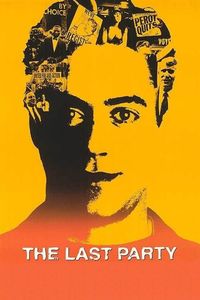
    (On TV, May 2021) Maybe incredibly self-indulgent, maybe a reflection of a specific time in American society, The Last Party follows a young Robert Downey Jr. as he pokes around the 1992 presidential campaigns, attends both the Democratic and Republican national conventions, and makes scattered social commentary. Maybe there’s an alternate universe in which Downey becomes a socially-conscious satirical filmmaker like his father rather than Iron Man — or turns to political commentary as an alternative to acting. What that would have been like can be glimpsed in this film, although Downey often chooses the role of a provocative dilettante rather than an authentic commentator. The documentary footage is a tour of American politics circa 1992, with both Bush and Clinton popping up alongside party establishment figures and showbiz rabble-rousers such as Spike Lee and Oliver Stone. It’s a strange mix of entertainment and politics from a time when we thought the two were separate. Downey clearly has democratic sympathies but takes potshots at both parties in questioning the status quo, although don’t expect much more than skin-deep aimless dissatisfaction as a guiding thesis. The result doesn’t have anything deep or new to communicate, but the time-capsule aspect of The Last Party can certainly be entertaining. We twenty-first century viewers aren’t necessarily smarter in looking at the film nearly three decades later, but we know how some things turned out and some never changed — Downey almost torched his entire career over addiction issues and re-became a superstar by an incredible fluke. One of the main American political parties went insane and dealing with that means that scant progress can be achieved. Everyone — literally everyone can now point a camera at themselves and spout inane platitudes that are accessible to the entire world. Are we better off? Let’s check again in thirty years.

  • BlacKKKlansman (2018)

    BlacKKKlansman (2018)

    (On Cable TV, April 2019) You can’t really tell a creator like writer-director Spike Lee what to do. But with BlacKKKlansman, there’s a feeling that he’s back at his activist best, delivering a ferociously engaged film that does not compromise on its entertainment value. Loosely adapted from a true story, it focuses on a black FBI agent (played by John David Washington, son of Denzel but on his way to a stardom of his own) who works with a Jewish co-worker (Adam Driver, also quite good) in order to infiltrate a local KKK group. The clear activist intent of the film is made even better through a considerable amount of comedy, suspense and scene-to-scene interest: this is probably Lee’s most purely entertaining film since Inside Man, and it’s a welcome return to form for him, as his last decade-and-change of filmmaking has been erratic or eclectic. The result is one heck of a movie—funny, compelling, heavily ironic, pulling no punches against racists and ending with a coda that really drives the point home that this may be a story from the past but not a past story. Great performances also show Lee working at his best—It’s hard to miss with Driver, but Washington establishes himself as a compelling lead, and we get a supporting performance from black activist legend Harry Belafonte (!) and an eye-catching turn from Laura Harrier. I really liked BlacKKKlansman, and its existence says much about the state of black filmmaking in the 2010s—telling its own stories, being matter-of-fact affirmative, processing ongoing irritation with the current state of American society and having the power to draw in large audiences to buy into its uncompromising message. The Academy make a mistake when it gave the Best Picture Academy Award to the inferior Green Book.

  • He Got Game (1998)

    He Got Game (1998)

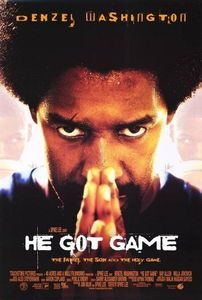
    (On DVD, October 2016) Denzel Washington and Spike Lee are a good match, and He Got Game is a great use of their combined talents. Washington is spectacular as the convict asked to convince his estranged basketball-prodigy son to sign up for a particular college. His usual mixture of swagger, danger, charm and grumpiness work well here, and I’m hardly the first critic to note the comforting blend of traditional traits that make up his persona’s masculinity. But even his character’s power as a man quickly reaches its limits when his estranged son rebuffs him, and how his example has to rival with the trappings of fame, sex and money. He may not even be the main character in the story, given how much of the film slowly slides over to his son’s character and the choice he has to make as the film progresses. Lee’s impressionistic directing flourishes work well in this context, and add a depth of complexity to the characters’ inner struggles. Good supporting performances by Ray Allen (an athlete playing the son), Rosario Dawson and Milla Jovovich also help, as does a good sense of street-level New York. It wraps up in a good conclusion, and leaves viewers satisfied—although finding out what happened to those character five, ten years later would be interesting.

  • Old Boy (2013)

    Old Boy (2013)

    (On Cable TV, December 2014)  I’m not going to be coy about my biases going into this movie: The original South-Korean Oldboy did not need to be remade for an American audience.  Seeing Spike Lee tackle the project is a bit of a waste, especially when the result seems to stick as closely to the original.  I suppose that the film would be worth a look for those who haven’t seen the original: It has an intriguing mystery at its core, an unconventional revenge story, enough icky plot points to make it memorable and a bit of style as bonus.  (It’s best not to think too long about the finer points of the plot, but so it goes.)  Josh Brolin is a solid protagonist, Samuel L. Jackson has a flashy short role and Sharlito Copley turns in another off-kilter performance as the villain.  Still, this American Oldboy runs long, never quite connects to the protagonist, somehow doesn’t earn its wilder plot points and doesn’t quite know how to control its tone.  This being said, nearly everyone who should have seen the original has seen the original, and comparisons are where much of this remake’s interest is about.  It does seem to beg comparison, so closely does it adhere to the original –there’s even a bit of a fake-out where it seems as if the most effective twist of the original has been neutralized.  And while much of the remake is less impressive than the original, its coda is more credible than the hypnotism mumbo-jumbo of the Korean version.  In the end, though, this Oldboy falls in-between respectable cinema and effective exploitation, satisfying no one –and annoying those who thought the (even flawed) original should have been left alone.