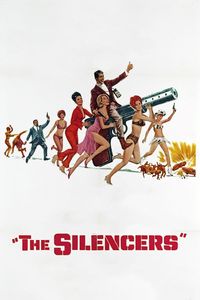
(On Cable TV, October 2019) No doubt about it: The Silencers is a trip through time. First in the Matt Helm series of films made to lampoon the Bond series and featuring no less than Dean Martin, it’s like an authentic 1960s version of what Austin Powers was going for. Not as farcical, but certainly playing up the most ridiculous elements of the Bond formula: the women, the gadgets, the women, the lavish lifestyle, the women, the ridiculous villains and, of course, the women. (“NOT FOR CHILDREN,” shouts the poster after stating, “Girls, Gags and Gadgets: The Best Spy Thriller of Nineteen Sexty-Sex.” But don’t worry—it’s tame by today’s standards.) Rat-packer Martin is near-perfect as the suave womanizing agent Helm, whose conquests multiply throughout the movie. The women all look great, although classic Hollywood fans will be overjoyed to see the great Cyd Charisse strut her stuff in two dance sequences—her legs still go up to there, and she looks fantastic with longer hair. Don’t pay any attention to the plot, though: It’s all familiar plot devices meant to string the gags in the correct order, including a car fully equipped with a driver-accessible minibar and switch-activated privacy drapes for, well, whatever spies do in this kind of movie. Alas, the villain is pointlessly stereotyped along Fu-Manchu lines. Still, The Silencers is a big broad caricature, fully capturing a kind of spoof that would later be re-imitated. I watched it on a whim, attracted by the casting of Charisse, but ended up liking it quite a bit.
(Second Viewing, On Cable TV, June 2021) I thought I’d have another look at The Silencers after only a few months… if only to verify that my wild memory of the film wasn’t an invention. It wasn’t. Revisiting suave Bond-like secret agents in a hyperbolic fashion, this film stars Dean Martin as (what else?) a top-notch special operative who serially romances a succession of beautiful women (for late-1960s definitions of “beautiful” – despite Stella Stevens doing her best as a redhead, contemporary viewers may be more intrigued by Daliah Lavi as the bad girl with the black-and-white hairdo). If you see nothing else, simply watch the first fifteen minutes, which begins with three successive dance/stripping routines by sultry performers (the third being none other than Cyd Charisse), followed by an introduction to the protagonist at home, surrounded by fancy gadgets and bedroom partners. It’s wild enough that Austin Powers fans will feel at home. The weirdness doesn’t stop after that, what with Martin singing some of his standards at the drop of a hat (even tuning in the car radio away from Sinatra to his own song), and the villain being a rotund white guy made up to look Chinese. It all leads (as it should) to a villain’s lair confrontation. Clearly, The Silencers doesn’t take anything seriously and neither should you: it’s intended as a spoof of 1960s Bond movies and if it works despite the obvious sexism and racism, it’s largely because of Martin’s charm and the excessive nature of the gags. When the protagonist (who became a fashion photographer in retirement) daydreams about the girls of his photoshoots and the film briefly pauses to allow them to prance a little on screen, its unabashedly retrograde nature almost becomes cute. Much of the middle section of the film can’t quite measure up to the wild introduction or the cranked-up final act, but the result is not without distinction. Keep watching until the end of the credits, if only to see what’s been identified as the first post-credit comic sequence in the history of movies. (Although be aware – weirdly enough, the version of The Silencers shown on TCM apparently does not include that post-credit sequence, even if it’s well-documented online.)