Steve Coogan

  • Greed (2019)

    Greed (2019)

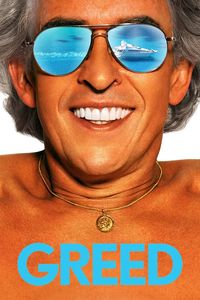
    (On Cable TV, January 2021) It takes much longer than expected for Greed to get up to speed. Much of that has to be blamed on the structure of the script, which initially feels as if it’s the result of an explosion involving three different screenplays: The life of a fashion mogul, the findings of his biographer, and the shenanigans surrounding his 60th birthday party. The film switches back and forth, not just in chronology, but also in treatment and focus, leaving viewers a bit unsure as to where to stand, and depriving the film from a clear narrative engine. Things settle down a bit in the second half, but Greed simply doesn’t manage to make the best use of the elements at its disposal. And what elements those are—Steve Coogan in his elements as a blowhard tycoon, Isla Fisher as a rich heiress, and iconoclastic writer/director Michael Winterbottom going after the ultra-rich by pointing out the immorality, illegality and illegitimacy of their fortunes. It should be fun, and with such added touches as David Mitchell as a socially uncomfortable biographer piecing together the truth, the very cute Dinita Gohil playing a pivotal part in the conclusion, some heartfelt social criticism, and a bit of aghast black comedy at the very end, Greed had the potential to be much better than it is. Winterbottom is no stranger to pointing out the flaws of the world, but this film is so inconsistent that he harms his message along the way. Still, there are laughs, some sharp character moments, decent-enough production values in portraying the demented lifestyle of the ultra-rich, and some crisp cinematography. It’s not what it should have been and it’s likely to leave viewers torn between mixed emotions, but Greed is still worth a look… if only for Coogan having another excuse to engage in long profanity-filled tirades.

  • Hot Air (2018)

    Hot Air (2018)

    (On Cable TV, November 2020) Considering the United States currently charged political climate, fomented by shameless media outlets for which truth takes a backseat to profits, it’s almost inevitable that we would get Hot Air, a dramatic comedy featuring a blowhard conservative radio personality challenged by the unexpected arrival of a hitherto estranged but very progressive teenage niece. The two best things going for the film are its lead acting duo—Taylor Russell is very likable as the niece, but it’s Steve Coogan who gets most of the attention at the radio host: he looks the part, but clearly wants to puncture the façade presented here. Much of Hot Air does poke at the “man who learns better” trope, while not going too emotional about it. The highlight of the film is a long screed from host to public that nods toward Network and does have its moments (among them “You elect a deranged conman just to see what happens!”) but does strip hollow the contradiction between the film’s premise and its execution. To put it simply, Hot Air wants to play with political divisions, but stops short of being political about it: it’s all platitudes and homilies disarming any attempt at taking a true position on its premise. It misdirects and brings the focus to personal epiphanies, while ignoring the uglier political climate in which it’s supposed to take place. The show goes on and still the film tries to make us believe in a context that no longer exists in American culture: Anyone outside US borders will recognize that the political conversation going on since 2016 isn’t between feel-good mushy notions of liberalism versus conservatism, but reason against full-blown authoritarian craziness. Your average American right-wing radio host appealing to a crazed base has nothing to do with the one played by Coogan here, and so Hot Air seems to be trivializing its topic to the point of having nothing to say—which would be completely acceptable for many kinds of films, but not one that explicitly courts audiences with a political premise. I may be part of the problem in ringing a five-bell alarm over what’s happening right now and wishing for more substantial denunciations of a toxic right-wing, but the current situation is not tenable, and I can point to hundreds of thousands of excess deaths to prove my point. Oh, I still liked Hot Air—Cooghan and Russell and Neve Campbell are giving it what they’ve got, and the film does everything that it wants to do in its carefully delimited audience-friendly way. But right now, in the gaslit interregnum between Presidents 45 and 46, I’m more irritated at anyone still claiming to be on the fence.

  • The Trip to Spain (2017)

    The Trip to Spain (2017)

    (On Cable TV, August 2020) If you’ve seen The Trip or The Trip to Italy, you know what to expect from The Trip to Spain… mostly. Clearly, it’s still about Rob Brydon and Steve Coogan, playing fictionalized versions of themselves, travelling, eating, impersonating and bickering throughout a few days of Spanish tourism. It’s exactly what they did in the previous two instalments, and it’s about as good and amusing as it was – provided that you have a tolerance for the same. The formula survives another bout pretty well: the scenery is usually magnificent, the food looks great, Coogan and Brydon each go over-the-top with funny impersonations, and the film’s dips into drama once again take the form of the two middle-aged men working out their insecurities and small-scale personal crises. The most distinctive element for the film involves a running theme about Don Quixote and Pancho Villa, leading to an ending that struck me as overdramatic. [November 2024: …and isn’t really followed up in the fourth-and-final instalment The Trip to Greece.] Still, The Trip to Spain is rather good fun in a comfortable way: If you like the shtick, take a look, and if you don’t, then don’t.

  • The Trip (2010)

    The Trip (2010)

    (On Cable TV, August 2020) So here’s this as a film premise: Two British comedians show up as themselves, going on the road in Northern England to eat at a few restaurants for a newspaper article, bickering all along the way. Their dialogue largely consists of put-downs, impressions, and put-downs of their impressions. All shot in constantly moving handheld camera. It sounds terrible in theory but The Trip works quite a bit better in practice, mostly because this is a film that can be listened to almost as well as watched, and both Steve Coogan and Rob Brydon can be really likable at times. Invented subplots include romantic troubles and Coogan’s nightmares about his career. Along the way, we get a glimpse at two men trying to argue their way out of their own psychological anxieties. The film originally consisted of six 30-minute episodes that were then re-edited in a single 2-hour feature film, presumably cutting out some dialogue and landscapes along the way. In all honesty, The Trip is not that good of a conventionally narrative film – even in its boiled-down edited form, it’s not decently plotted and somewhat limited in what it can do within the limits of its format. But it’s enjoyable to watch, and there’s clearly a successful formula here, as it was followed by no less than three sequels (so far).

  • Philomena (2013)

    Philomena (2013)

    (In French, On TV, November 2018) In fiction, searching for long-lost family secrets is fun and exciting and fruitful as the unlikeliest of thread lead to bigger and bigger revelations. In reality, those family secrets usually lead nowhere (as people don’t remember or are dead) or to unsatisfying places (as in terrible secrets, or conversely making much of what turns out to be mundane material). Occasionally, though, you do get real-life mysteries that end up like fiction, and that’s the story that Philomena ends up telling. It starts as a disgraced British journalist is contacted by an older woman with a story to tell about how her child was taken away from her and given up for adoption. Where is that child now? And who made this happen? Our two protagonists’ investigation eventually takes them to the United States, where they discover in rapid succession that the long-lost son was an influential closeted Republican, and that our journalist had met him years before. There’s a little bit more to the story, but Philomena is more than the result of the investigation: It’s about an unlikely buddy road movie, calling out injustice, discovering unfinished facets of history and very good performance from Steve Coogan (maintaining a grip on his showboating tendencies) and Judi Dench as the eponymous Philomena. Well-executed with a satisfying (yet tragic) mystery at its core, Philomena is a decent drama that may win over even skeptics.

  • Around the World in 80 Days (2004)

    Around the World in 80 Days (2004)

    (In French, On TV, November 2018) You’d think that a “remake” taking on not only a classic Jules Verne novel but also the legacy of an Oscar-award-winning 1950s epic movie would struggle to distinguish itself, but that’s not really the case with the 2004 version of Around the World in 80 Days, for reasons both good and abysmal. Let’s not pretend that this is a good movie: By taking the guts of the Verne novel as overlay on an unusually dumb kids’ movie featuring the “comedy” of Steve Coogan, it quickly and firmly establishes itself as a waste of potential from the very first few minutes. The accumulation of steampunk anachronisms and low comedy means that it’s hard to take the result seriously, and the various hijinks that follow only confirm this experience. The result is pretty much what we’d expect, the only flashes of wit being either upstream (Verne’s source material) or downstream (acting, special effects, set design) from the script. And yet, there is something to see here, mostly because Around the World in 80 Days is an exemplary representative of the big-budget bomb subgenre: so much money has been thrown on-screen that it’s hard to look away. Since the film co-stars Jackie Chan and features a bit of his classic blend of action and comedy, a few sequences still stand out as watered-down but still effective examples of what Chan could do in his prime. Then there’s the casting, which brings together western comedy and eastern action in combinations never seen anywhere else: Jim Broadbent, Kathy Bates (as Queen Victoria!), Arnold Schwarzenegger, John Cleese, Rob Schneider, Luke and Owen Wilson, but also Maggie Q, Karen Mok and none other than Sammo Hung as Won Fei Hung. That’s … amazing. The mixture is far less involving than the individual parts that form it, but the film is definitely worth a look if you want to see those actors and ideas thrown together. The result certainly underperforms, but it’s a ride.

  • Hamlet 2 (2008)

    Hamlet 2 (2008)

    (On DVD, July 2011) There’s a mess of intentions in Hamlet 2 that makes it hard to cohere as a purely enjoyable comedy.  On one hand, the film is generally more successful when it plays things broadly, taking advantage of Steve Coogan’s go-for-broke willingness to try anything, and an irreverent attitude that places no gags beyond the script’s reach.  The “Rock Me, Sexy Jesus” musical number is the highlight of the film, topping whatever risqué subject matter and foul language may not have reached.  There are a few good absurd touches and unexpected character reversals, such as starring Elizabeth Shue as herself, taking plot directions from a young drama critic, meeting the accomplished parents of a good kid posing as a gang-banger, and ultimately having the kids save their teacher’s self-esteem rather than the usual other way around.  As with most comedies, there are a few smiles here and there.  But Hamlet 2 is also saddled with a misguided intent to delve into humiliation comedy, to carry scenes too long after the point of the joke, and to attempt providing redundant emotional scaffolding to the comedy.  As a result, the film runs long even at roughly 90 minutes.  Coogan, playing a character often too dumb to live, is exactly the kind of actor who overacts when he’s not reined in: his performance is a symptom of a film that hasn’t quite mastered tonal harmony from beginning to end.  There’s enough off-kilter experimentation here to keep anyone interested, and the third act is successful enough to patch most of the early film’s laugh-free rough spots, but Hamlet 2 doesn’t quite manage to do justice to the kind of film it’s mocking.  The DVD contains a making-of featurette that tells us a bit about the writers’ intentions (parody the “inspirational teacher” movies sub-genre) and shows us that the film’s been fun to make.