Steve Guttenberg

  • Police Academy 4: Citizens on Patrol (1987)

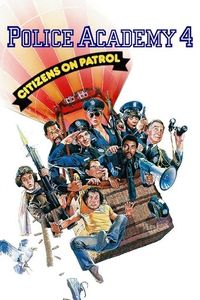
    Police Academy 4: Citizens on Patrol (1987)

    (Second Viewing, On DVD, November 2021) I somehow remembered Police Academy 4 as one of the high points of the series — but then again, twelve-year old me thought the series was terrific, so I wasn’t the best movie reviewer at the time. Suffice to say that this fourth entry is, by now, comfortably stuck in the confines of its own style — the jokes are as obvious as the characters, and the ludicrous climax shows that the producers had money to burn in order to deliver a final spectacle even when it didn’t really fit the tone of the series. I remembered just enough of the gags to feel a general sense of familiarity with the jokes, and some recognition from the dialogue. Steve Guttenberg, in his last appearance in the series, remains the randy straight-man cornerstone while, at the other end of the spectrum, Bobcat Goldthwait turns in a remarkably weird performance as an ex-con turned policeman. Everyone else gets their one-joke character stretched thin — with even the other characters telling them to cut it out. There are a few surprises in the cast list — Sharon Stone as a bouncy journalist, David Spade in his film debut, and even Tony Hawk somewhere in there. The memorable title song is stupid but fun, which is roughly the same thing we can say about Police Academy 4 as a whole — although I can’t quite tell how much of this appreciation is a residual feeling of the twelve-year-old critic who’s still part of me.
  • 3 Men and a Baby (1987)

    (Disney Streaming, August 2021) Perhaps the most noteworthy aspect of 3 Men and a Baby now is outside the film itself, as an evocative example of box-office irrelevance. Upon release, it became the highest-grossing Hollywood movie of the year, outclassing such films as Full Metal Jacket, The Princess Bride, Predator, Lethal Weapon, RoboCop, Spaceballs, Evil Dead II or Wall Street. Of course, the irony today is that any of those movies are significantly better-known than 3 Men and a Baby, and for good cause: they all still have a daring, distinctive quality, whereas 3 Men and a Baby was always meant as a common-denominator kind of comedy, the type of film that families grudgingly compromise on seeing together, especially at Christmastime, which was the film’s savvily-targeted release season. To be fair, it’s not a bad film: The plot seems custom-made for the Christmas season as well, as three bachelors are abruptly forced to take care of a baby, the result of one of their casual romantic trysts. Directed by Leonard Nimoy (a fascinating piece of trivia by itself), 3 Men and a Baby makes good use of the charms of co-leads Steve Guttenberg (in one of his best movies), Ted Danson and Tom Selleck, who’s particularly good at selling the emotional core of the story. The dynamic opening sequence sets the tone of a bachelor’s utopia with a great apartment and a wild party — but the real fun begins as a baby is dropped on their doorstep and they need to figure out everything with minimal female supervision. I’m not sure I ever watched the entire film before, because even if some elements were familiar, the entire criminal subplot felt newish (and unnecessary, even if something had to bring the film to 102 minutes). Otherwise, 3 Men and a Baby is predictable, with big plot strings seen well in advance, and a feeling of comfort amply fulfilled by the big happy finale. You can see why it made so much money… and also why it slipped away from the collective unconscious even as its contemporaries have shown stronger staying power. Here is something to consider when you see dull or terrible films rake in the money even as some fan favourites languish: you can’t always tell what will endure and what won’t.

  • Police Academy 2: Their First Assignment (1985)

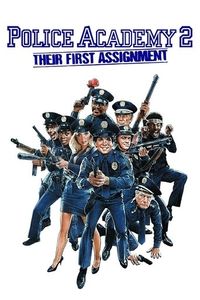
    Police Academy 2: Their First Assignment (1985)

    (Second or Third Viewing, On DVD, August 2021) There was a time (back when I was, like, nine) when I thought the Police Academy series was one of the best things in movies, only second to Star Wars. Well, that time is long gone, and watching Police Academy 2: Their First Assignment is now sometimes an exercise in teeth-gritting exasperation. The first film in the series still works, and if my memories don’t betray me too much, the fourth one has its moments. But this sequel has a harder time getting any respect. Loosely picking up after the training of the first film, this follow-up sees the motley crew of ridiculous police officers on their first assignment in a crime-ridden area of the city. Much of the cast is back alongside Steve Guttenberg, with some significant introductions, such as Bobcat Goldthwait in the role of a gang leader who would later become part of the police crew. The story is a loose frame on which to let all of the actors play their comic shtick. Some of it is more successful — anything with David Graf’s Tackleberry is usually fun, for instance, whereas anything to do with Art Metrano’s Mauser isn’t. What’s perhaps most frustrating about the result is not necessarily the juvenile repetitiveness of the jokes as much as uneven levels of absurdity. The good absurd sequences are funny (such as the various security systems deployed in the opening sequence, or the “disrobing guns” scene), but they come sandwiched between long stretches of very mild jokes. Coupled with the generally low-brow humour level, it doesn’t completely work, and leaves viewers asking for more. Now let’s see if my memories of the third instalment are similarly destroyed…

  • Diner (1982)

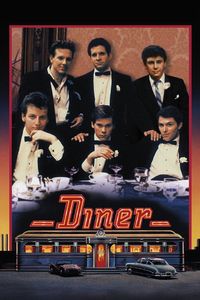
    Diner (1982)

    (On Cable TV, May 2021) Generally aimless but amiable, Diner is the kind of film that plays well but doesn’t leave much of an impression. The first of writer-director Barry Levinson’s “Baltimore Tetralogy,” it’s a slice-of-life piece of nostalgia set in 1959, as a close circle of friends deals with the impending marriage of one of them. Intimate and minimalist, it’s more a series of conversations about 1950s young men mulling about sex, love and marriage than anything else. Today, the film is perhaps more remarkable for a truly surprising cast — young Steve Guttenberg (who never played in a better film), Daniel Stern, Mickey Rourke, Kevin Bacon, Paul Reiser, Ellen Barkin… geez. The production design is convincing yet not overpowering, but this is the kind of film you can almost listen to as a radio play — it’s heavily dialogue-based and very playful. Perhaps more interestingly, it’s not flashy dialogue — you’re not meant to be amazed at the wittiness of it, simply recognize that it’s how people talk. Over the past forty years, Diner has grown to be a bit of a classic — up to and including being made part of Turner Classic Movies’ regular rotation. There are flashier movies out there, but there may not be many more comfortable movies.

  • 3 Men and a Little Lady (1990)

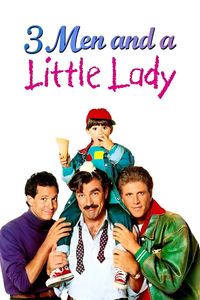
    3 Men and a Little Lady (1990)

    (In French, On Cable TV, April 2020) If you’ve seen 3 Men and a Baby, get ready for the contrived sequel 3 Men and a Little Lady—a big gloppy 1990s-vintage comedy that barely cares about how ludicrous it is. Despite a capable cast, the film suffers from a bad case of sequelitis in which everything is bigger, crazier and yet less interesting than this original. In this case, our three titular men are shocked out of their poly-conjugal arrangement when the mother of the little lady abruptly announces that she’s getting married and moving to England. (Don’t ask why. A sequel is why.) Contrivances piled upon contrivances are this script’s idea of plotting, and there’s no other choice than to ride along until the predictable ending. Nothing in this film feels real, from the absurdly manipulated situations all the way to a marriage that piles clichés on top of another. This is not necessarily a bad thing as long as we know what we’re in for: A script that milks all potential jokes out of a situation before moving on to the next one. While 3 Men and a Little Lady hasn’t necessarily appreciated much in the past thirty years, it does feature some performances from actors whose star power has considerably dimmed since then. Tom Selleck does get a good role, Ted Danson hams it up in a variety of costumes and roles, while Steve Guttenberg doesn’t get much to do… and circa-1990 Fiona Shaw gets insistently coded as unattractive, which is very much up for debate for anyone away from Hollywood. Still, the film is generally watchable, even if it loses a bit of its way in the England-set second half and its madcap wedding comedy antics. But then again—afflicted with such a severe outbreak of sequeltis, where else could it go?