Steven Seagal

  • Hard to Kill (1990)

    Hard to Kill (1990)

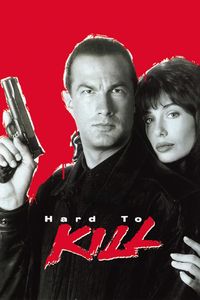
    (In French, On Cable TV, September 2020) As much as it’s easy to laugh about Steven Seagal these days now that he’s an obese shadow of his former self, his first few films weren’t that bad. An example of this is Hard to Kill, a straightforward revenge action movie in which Seagal is surrounded by competent filmmakers, is in fairly good shape, and has an acceptable script. (Well, one that doesn’t dwell for a long time on physical rehabilitation after seven years of coma—Seagal is always ready to go!) It’s still not that good a movie, but at least it’s competent. Seagal, on the other hand, is still as stiff and downright strange here at the top of his screen persona—playing an action hero more than a character, and not doing it with any style or grace. Kelly Lebrock is a welcome addition to the package, but let’s be clear—as orchestrated by Bruce Malmuth, it’s an efficient action movie first, and then all sorts of Seagal-infused weirdness second. Anyone wondering what the fuss was about Seagal in his glory days could always watch Hard to Kill: they’ll at least get an accurate idea that Seagal could be better but, even at his best, wasn’t that much of a superstar.

  • Marked for Death (1990)

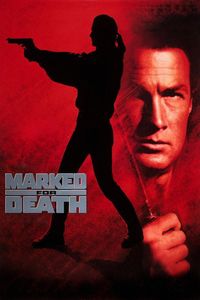
    Marked for Death (1990)

    (On TV, April 2020) In his third movie Marked for Death, Steven Seagal takes on Jamaican drug dealers because, hey, the endless body count has to come from somewhere, right? Dating from the time when Seagal’s films were still professionally made and theatrically released, this is still a somewhat average circa-1990 B-movie action thriller: don’t get your hopes when people will tell you that “it’s better than average Seagal” because the floor on those movies as a whole is incredibly low. Considering that the film takes on Jamaican voodoo-dealing criminal gangs shooting up an all-American city, it’s about as stereotypical as you can imagine, and occasionally even more so. Seagal eventually takes the fight back to the entire island of Jamaica for good measure. The Seagal persona is almost, but not completely solidified at this point of his career—although, amusingly, there’s a point when he gets in a tight spot and is still slim enough to slip through. It’s not all boring, but the rewards are rare and slight—the decent car chase midway through is notable largely because it’s a break from Seagal stone-facing his way through endless fights.

  • Above the Law (1988)

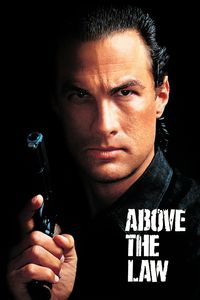
    Above the Law (1988)

    (In French, On TV, January 2020) Notable for being Steven Seagal’s movie debut, Above the Law is a bit of an odd duck in retrospect—Seagal is still his usual I-can’t-believe-he-was-an-action-star slimy self, but at least he’s younger and not yet calcified in his increasingly tedious screen persona. At times, we get sequences that would be very much out of character later on. It’s clearly a Seagal film that doesn’t know that it’s a Seagal film yet, so the formula’s not quite there. Alas, this means that the film is a somewhat bland 1980s action movie instead: the film built around Seagal’s star-making manoeuvre (let us be reminded that Seagal was, at the time, a protégé of super-powerful agent Michael Ovitz) is a generic vehicle representative of the era—slick and polished, like the middle-grade Hollywood movies of the time, with a plot that blends a cop protagonist with an overstuffed plot made of drugs, weapons dealing, CIA shenanigans, Catholic imagery and even a Vietnam flashback to round things up. At least things are better when it comes to supporting actresses, with an early turn for Sharon Stone and Pam Grier with such a presence that even the film itself seems awed by her. There are, eventually, a few decent-for-the-time action sequences once the narrative throat clearing is over, and even Seagal skeptics may find themselves intrigued by his turn here—before his ego took over and led to the career he had. Still, this isn’t much of a film—and so we come to the curious conclusion that if it wasn’t for Seagal, Above the Law would be better but utterly unmemorable.

  • Under Siege 2: Dark Territory (1995)

    Under Siege 2: Dark Territory (1995)

    (Second Viewing, In French, On TV, March 2019) One wouldn’t expect Under Siege 2: Dark Territory to have a special place in movie history, but it does! Back in 2005, SFX trade magazine Cinefex printed a long roundtable article discussing the state of the industry, and one SFX luminary mentioned the film as the first one in which “invisible” digital special effects were used to simulate a film being shot aboard a train, launching a now-commonplace technique. Re-watching Under Siege 2 today, most of those “invisible” effects hold up—it takes a conscious effort to realize that they’re shooting on a studio set. More spectacular effects are noticeable later in the film, but by that point we’re already onboard. Alas, while Under Siege 2 remains enjoyable on a purely 1990s action movie way, it could have been much better. The main problem, as usual for a Steven Seagal movie, is Steven Seagal himself. His limitations as an actor (emotionless, devoid of personality) aren’t as big a problem as his pride preventing his character to ever be made vulnerable: The Seagal style is to never acknowledge that the protagonist can be put in jeopardy, and that ends up taking away a lot of audience sympathy. The result is an action movie that’s literally on rails, whether we’re talking plot or narrative approach. It’s very much an exemplar of the mid-1990s Die Hard imitators, although better than many. The rhythm and premise of the film is very much of its era, with director Geoff Murphy playing with military technology, regularly scheduled action sequences, and a rather good over-the-top villain played by Eric Bogosian. You can spot Katherine Heigl in an early role as a sullen baby-faced teenager. The action climax of the film is actually pretty good, but it would be much better if it wasn’t for Seagal jogging through it without a care in the world, confident that nothing will dirty his suit or muss his hair. But as I said—no one expected this film to be anything more than a footnote in movie history.

  • Machete (2010)

    Machete (2010)

    (In theaters, September 2010) When a trailer for then-fake film Machete appeared attached to Grindhouse three years ago, the joke worked pretty well.  But would it survive being turned into a feature-length film?  As it turns out, Machete the film is what Machete the fake-film trailer had promised: A fully entertaining mixture of exploitation filmmaking, populist indignation and self-aware cinematic winks.  Bolstered by one of the most amazing cast in recent memory, Machete finally gives a much-deserved featured role to the mesmerising Danny Trejo, with fun parts for such notables as Robert De Niro, Steven Seagal, Lindsey Lohan, Jessica Alba and Michelle Rodriguez.  Everyone looks like they’re having fun, which is in keeping with the film’s mexploitation theme: if you’re going to make a movie that plays to the audience’s bases desires for nudity, action and revenge, why not do it well?  Writer/Director/Editor Robert Rodriguez certainly knows what he’s doing: the editing lingers on the nudity, stays long enough on the action and flashes past the goriest violence so that we can enjoy the film’s dark humour without being repulsed by its excesses.  (Rodriguez may not have been the film’s sole director, but it’s unmistakably his film.)  It’s a terrific piece of grindhouse cinema, but it comes with quite a bit of populist decency.  The Latino diaspora is colourfully represented by food, more food, Catholic symbolism and a distinctive aesthetics: Add to that a striking case for respecting immigrant rights, and Machete becomes a film that speaks loudly about basic human rights while still delivering a hefty dose of disreputable entertainment.  In short, it’s a film that works on a number of levels, not the least of which is a considerable amount of sheer movie-going pleasure.  Knowing Rodriguez’s considerable personal charm and fondness for explaining the movie-making process, I can’t wait until it comes out on video.

  • Seagalogy, Vern

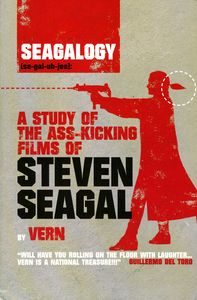
    Seagalogy, Vern

    Titan, 2008, 396 pages, C$16.95 tp, ISBN 9781845769277

    A quick look at this book’s cover blurbs confirms that I’m not the only one surprised that Vern’s Seagalogy: A Study of the Ass-Kicking Films of Steven Seagal even exists.  For so-called serious cinephiles, Steven Seagal has stopped mattering about ten years ago, when his movies stopped showing in theaters and started going straight to DVD.  Even before then, Seagal’s movies were usually B-grade action films, the occasional exceptions (Under Siege, Executive Decision) often being hailed in spite of Seagal’s presence.  Somewhat savvier filmgoers can point at 1994’s poorly-reviewed On Dangerous Grounds as the film that broke the back of Seagal’s reputation as an actor/director, highlighting its earnest environmental monologue awkwardly inserted as a coda.

    That’s the conventional wisdom, anyway.  For Vern, though, all of Seagal oeuvre is worth scrutiny.  His thesis, quickly stated, is that Seagal’s influence on his own roles and films has been markedly stronger than many other contemporary action stars: That most movies featuring Seagal are, in fact, best considered as “Steven Seagal movies” rather than belonging to their screenwriters or directors.  Vern highlights Seagal’s pet themes and obsessions, and then charts how they are reflected in the vast majority of his work.  To top it off, he also reviews Seagal’s music CDs and energy drink.

    Everyone’s first reaction at a 395-pages book covering all things Seagal is likely to be similar to mine: No, really? Is there a subject of more trivial importance?  Couldn’t this be settled in a quick and cheap blog post?  Aren’t we wasting time, energy, paper, etc, even contemplating such matters?  Go ahead and wonder the same things.  I’ll wait for you to realize that in the end, the only valid appreciation of this book is based on results, not intent.

    Because the damning thing is that Seagalogy is a lot of fun to read.  It even convincingly proves its thesis: By the time we reach 2008’s Pistol Whipped, there’s little doubt that Seagal returns again and again to themes of official corruption, blowback and environmental degradation.  His characters are largely cut from the same clothes, featuring the same taciturn attitude, fascination for other cultures and fleeting family ties.  His methods frequently include improvised weapons, bars fights and people being thrown through glass.  No matter his screenwriters or directors (who range from video-directing pseudonyms to Oscar-nominated Hollywood veterans), Seagal remains Seagal.  For an actor often dismissed without a thought, he has shown remarkable resilience at a time where other actors simply disappeared: More than half of Seagalogy covers his direct-to-video (DTV) films, with as much attention as his theatrical releases.

    This means that Vern has gone through each movie with a fine comb, unravelling the shaky plotting of incoherently-made DTV features and telling us about scenes that barely make any sense on-screen.  He doesn’t review those films as much as he rebuilds them to see how they work (or don’t).  His commentary on DTV features is enlightening in that he has seen far more of them than most of us, and he can spot production flaws that set them apart from their more respectable theatrical brethren.  Even in structure, the book shines by its clear sections, careful interludes, meticulous appendices about minor and never-seen projects, with a poignant ending in which the author finally meets Seagal.

    It helps that Vern’s style is a straightforward mixture of straight-ahead writing, well-chosen details, self-deprecating humour and a keen understanding of the action film genre.  I’ve known of Vern ever since he started writing for aintitcool.com almost a decade ago and while I have often suspected his “Writer who is trying to go clean after a life of crime, alcohol, etc.” shtick to be indulgent performance art by either a bored film student or a struggling screenwriter, I still treasure in my archives an in-character email from him acknowledging my congratulations for a piece he’d written.  I’m not sure I would ever want to know the truth behind the pseudonym.  Much of his profane, consciously-illiterate online style is barely reflected in Seagalogy, though: At the exception of a consistent mistitling of “The Ain’t It Cool News” that plays as an in-joke, the entire book is scrupulously written and edited to the usual standards.  This isn’t a complaint: As much as I want you to read outlawvern.com on a regular basis, a book written and designed like his site would be practically impossible to read at length.

    Because, oh, yes, Seagalogy eventually becomes addictive reading even if you haven’t seen a Seagal film in a decade: For a book with a less-than-respectable subject, it quickly becomes an intelligent trip throughout the clichés of action cinema, and a fascinating discourse on all things Seagal.  It may even make you respect him for the first time.
  • Exit Wounds (2001)

    Exit Wounds (2001)

    (In theaters, May 2001) Well, I really didn’t expect that: One of Steven Seagal’s best films. No, we’re still not talking about compelling drama or even moderate originality: this remains an action B-movie, but a really enjoyable one. (There’s even a touch of fun in seeing all of the expected plot developments taking place.) The direction is snappy and moderately dynamic, the plot mechanics are amusing and the man Seagal allows himself some latitude. The result won’t knock the socks off anyone, but constitutes a decent cheap rental.

  • Fire Down Below (1997)

    Fire Down Below (1997)

    (On TV, November 1999) Just when you thought that Steven Seagal couldn’t do a worse movie than On Deadly Ground if he tried, here comes this astonishingly boring “action” film. It’s not that I don’t like the guy (hey; Executive Decision, Under Siege) but anyone who picks a script like Fire Down Below to be his next film really has no other option except quitting show-business. Come to think of it, wasn’t this Seagal’s last film in theatres before straight-to-video? Hmmm…

  • On Deadly Ground (1994)

    On Deadly Ground (1994)

    (On TV, October 1998) What happens when idiots get money, power and guilt? This. Starring, produced and directed by Steven Seagal himself, On Deadly Ground is an inferior action picture wrapped (smothered might be a better word) in insipid environmentalist drivel, outright glorification of primitive lifestyles -with assorted mysticism- and belief in the urban legends of “Big Business suppressing clean technology”. This is the most hypocritical movie in ages, where Seagal beats up people to make them understand, destroys an oil rig to save the environment and doesn’t even kiss the girl. On Deadly Ground has little of the campy fun so pleasant in cheap action movies: here, we sense that Seagal is earnest and the result is more pitiful than fun. There are only one or two good action scenes. Don’t (or rather, do) miss the final five minutes, which may be the single most incompetent attempt yet to include a message in a movie.

  • Under Siege (1992)

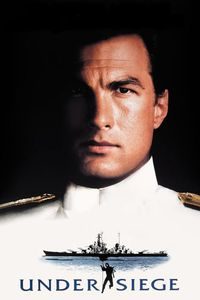
    Under Siege (1992)

    (On TV, September 1998) Not bad. Not very good, either, but what can you say about Yet Another Die Hard clone, this time with a lone cook (Steven Seagal) battling terrorists on a ship (the battleship USS Missouri)? It’s actually decent entertainment as long as you don’t expect much from it. Tommy Lee Jones makes an interesting villain, we get a totally gratuitous nude shot of Miss-July-1989 Erika Eleniak and the battleship scenery is original. On the other hand, there’s scarcely any suspense for anyone (Seagal is never in any kind of real disadvantage) and the story isn’t really innovative. Still, not bad.

  • Executive Decision (1996)

    Executive Decision (1996)

    (Second viewing, On TV, September 1998) I first saw Executive Decision in theatres the first week of its release, and kept a fairly good impression of this tense techno-thriller. I was surprised to see, watching it again on the small screen, that it still held up pretty well upon a second viewing. The terrorist-take-over-plane plot is serviceable, but given a kick in the pants by the screenwriters’ originality. The craftsmanship of the tension is obvious; so is the director’s portrayal of the characters and the superb casting. (Never mind Kurt Russell’s charming everday man: This is Steven Seagal’s best movie, y’know?) The abrupt tone change of the last few minutes, which had annoyed me a lot the first time, didn’t seem to grating on second viewing. Not only one of my favourite movies of 1996, but one of the best thrillers ever made.