Susan Hayward

  • Adam Had Four Sons (1941)

    (On Cable TV, December 2021) No one will ever mistake Adam Had Four Sons for anything but the straight-up domestic romantic thriller it aimed for — with a lovely governess (Ingrid Bergman, looking gorgeous) filling in for a dead mother and sniffing out a gold-digging harridan putting her claws into an easily flummoxed son. The story stretches over a few years, although much of the second and third act settles down in a shorter period after an extended opening featuring a great-looking Fay Wray as the soon-to-be-deceased mother. Then Susan Hayward takes centre stage as the adulterous, deceiving, booze-swilling, money-grubbing outsider who comes to steal the family fortune and seduce whoever she can to fulfill her role. (Meanwhile, our heroine is utterly chaste — but she does, as expected, ends up with the family patriarch once everything has been cleared up. The three lead actresses are unusually attractive here, but even that doesn’t do much to make up for the rather obvious script. This being said, there’s still some fun to be had even when knowing where it’s going: Hayward is deliciously evil here, and anticipating the melodramatic (melodomestic?) plot beats is almost as much fun as being surprised. Adam Had Four Sons is all rather pleasant in the end, with the bonus of seeing Bergman in an early Hollywood role—playing a Frenchwoman!

  • They Won’t Believe Me (1947)

    They Won’t Believe Me (1947)

    (On Cable TV, May 2021) There’s a fascinating backstory to the way They Won’t Believe Me will be seen from 2021 onward — originally released in 1947, the film made it to theatres missing fifteen minutes of crucial material, and that’s the version that was in circulation for more than sixty years before it was restored to its pristine state with missing footage added in 2021. What’s more remarkable is that the film is actually pretty good — cleverly playing and the strengths of film noir, it shows a tale of romance gone wrong, of passionate crime and tragic ironies. Our protagonist tries to juggle a not-so-nice wife and a far-more-pleasant girlfriend, but just as he seems to be making headway with his life, tragedy strikes and motivates a far less noble crime to get everything he ever wanted, all the way to the courtroom framing device. Robert Young does well as an increasingly evil protagonist, even if viewers may be more compelled by Susan Hayward and Jane Greer in strong supporting roles. It’s an easy, fun watch and while the added material is not always essential, it does flesh out the story in interesting ways. At 95 minutes, has a strong propulsive forward rhythm, and makes for a perfectly satisfying bit of second-tier noir. It’s films like They Won’t Believe Me that make a strong case for film restoration, unearthing hidden gems and polishing them until they remain shiny even for twenty-first century audiences.

  • I Want to Live! (1958)

    I Want to Live! (1958)

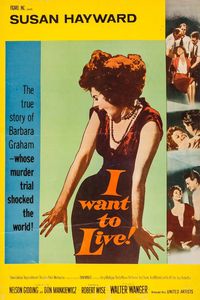
    (On Cable TV, April 2021) If you’re surprised at the I Want to Live’s downbeat conclusion, then you really haven’t been paying attention to the film’s opening moments, which scream and insist that this is a true story based on the author’s reporting and the letters of its protagonist, a woman on death row. A 1950s issue movie, this is about a woman (Susan Hayward, in a very good performance) who falls on the bad side of the law and is eventually convicted of murder. The flip side of her story is the journalist who comes to believe her innocence and fights for her release. Again—it’s not much of a spoiler to say that it doesn’t end well—but you don’t have any idea how cruel the film becomes in dangling one shred of hope after another before taking it away. There’s a reason why I Want to Live is often considered a late-period film noir — there’s a built-in fatalism in the way our protagonist goes from one bad break to another, getting herself deeper into a situation she can’t escape. (But keep in mind the difference between movies and reality — there’s plenty of evidence, elided from the screenplay, to suggest that the accused was guilty. Of course, this doesn’t excuse anything about the use of the death penalty.)  Hayward is very, very good in the lead role, and she received an Oscar for her portrayal. The procedural aspect of the film is definitely grounded in mid-century California to good effect. I Want to Live may not be fun or pleasant to watch, but it’s certainly memorable.

  • I’ll Cry Tomorrow (1955)

    I’ll Cry Tomorrow (1955)

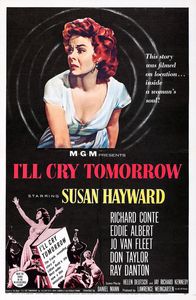
    (On Cable TV, April 2021) As far as musical biopics go, I’ll Cry Tomorrow is a blend of showbiz drama and addiction memoir, with our protagonist (Singer Lillian Roth, played by Susan Hayward, in a script based on Roth’s own memoirs) first suffering as a child prodigy controlled by her mom, then suffering as her fiancé dies, then suffering as a married woman whose sole shared interest with her husband is alcoholism, then suffering again as she tries to kick all of the bad habits in her life. In other words, this is not a pleasant film — for each mildly entertaining musical number, there’s one ugly scene after another. Unusually enough for the 1950s, alcoholism is portrayed from the inside as a destructive but appealing force, and the film ends up being one of the first depictions of Alcoholics Anonymous. I’ll Cry Tomorrow plays according very familiar lines for modern viewers, but the vintage aspect of it can be interesting. Of course, the film’s best asset has to be Hayward, holding nothing back in a tough depiction of someone familiar to audiences at the time. It’s not necessarily a bad watch even at its most conventional.

  • Top Secret Affair (1957)

    Top Secret Affair (1957)

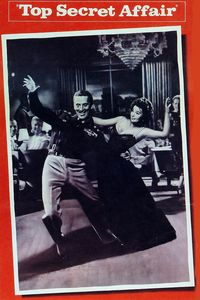
    (On Cable TV, November 2020) You can often best see the star quality of lead actors in their most mediocre films, and while Kirk Douglas was known for being an incredible leading man, Top Secret Affair will demonstrate it to you as well as his turn in masterpieces like that year’s Paths of Glory. Clearly cast as a superstar, Douglas here plays an American general targeted by a media mogul played by Susan Hayward. She wants to take him down through her outlets, but she hasn’t counted on him being a near-perfect human being, smart and athletic and incorruptible. There’s a lot of fun to be had in seeing Douglas play a character that measures up to his square jaw and impeccable frame—the film feels like a misogynistic throwback, but it does have quite a bit of charm and grace at how it goes about it, and even the way it half-canonizes its military character is a bit of a breather after so many villainous high-ranking officers elsewhere in later Hollywood history. I’m not going to try to convince anyone that Top Secret Affair is a particularly good movie, but it’s an easy watch, and it has its shares of smiles along the way. Plus, you get to see what Douglas was able to do in a movie where he clearly outshines everyone else… including his co-star. Amazingly enough, the film was originally intended to star Bogart and Bacall — that would have been quite a different film.

  • Tulsa (1949)

    Tulsa (1949)

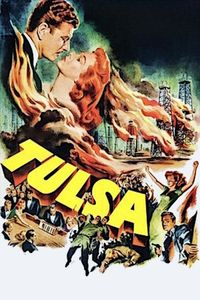
    (On TV, September 2020) If ever you thought that Cimarron didn’t spend enough time in the oil fields, then Tulsa is for you. Bombastically announcing itself as the story of how Tulsa became the oil capital of the world (no less!), it takes us in the early days of the American oil industry by examining the life and loves of a daughter of a rancher who becomes an oil baroness through the years. Susan Hayward is quite good in the lead role, with no less than a young Robert Preston lending his presence and deep voice to one of her main relationships. I quite liked the result, but perhaps more for the procedural aspect of spending time drilling for oil than anything else. A spectacular blowout sequence caps the film (perhaps a bit too suddenly) and netted the film an Academy Award nomination for best special effects. Surprisingly or sadly enough, the TV broadcast I saw was grossly downscaled and presented in black-and-white, whereas Tulsa was originally shot and distributed in colour. But that’s what happens when TV stations start downloading public-domain movies to fill out their nighttime slots. I’m not complaining as much as I should—if nothing else, it will give me another excuse to watch the film later under better conditions. Tulsa is not a great movie, but it’s interesting, and it’s not the paean to big oil that we could have feared from the opening narration when its second half delves so deeply into the perils of excessive greed when measured against the environment. There’s even a half-sympathetic representation of indigenous characters!