S.Z. Sakall

  • Tea for Two (1950)

    Tea for Two (1950)

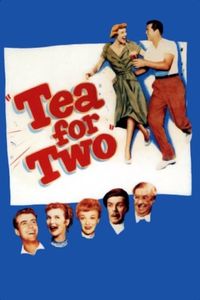
    (On Cable TV, October 2021) Let’s face it: most classic musicals have a touch of the absurd in them—it comes with a genre in which people burst into song, dance and a full-blown orchestral accompaniment. But some kinds of absurdities are easier to take than most, and it’s often the smallest stuff that does you in: When the heroine of Tea for Two accepts a condition to answer “no” to every question and then proceeds to clearly self-sabotage every opportunity she gets, that’s somehow even harder to accept that the song-and-dance. Even as a comic premise, it’s not all that funny: there’s far more amusing stuff going around the edges of the main plot. For instance, the picture noticeably grows brighter the moment S. Z. Sakall walks on-screen, with bonhomie and exasperation. As the lead, Doris Day (in her first leading role and first dancing role) is okay—maybe slightly bland, but still able to carry the film. The songs are sometimes fun but not specifically memorable, while the dancing numbers are fine—the highlight is a bit of staircase tap-dancing from Gordon MacRae. Tea for Two is in the honest average of 1950s musicals: not exceptional, not terrible, perhaps slightly more forgettable than it should but still an acceptably good time.
  • Thank Your Lucky Stars (1943)

    Thank Your Lucky Stars (1943)

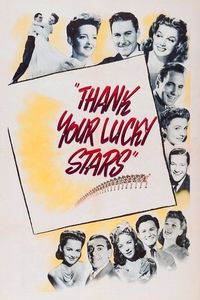
    (On Cable TV, July 2021) The more you learn about Hollywood history, the more you discover sub-sub-genres with maybe a handful of titles. Sometimes, they even prove to be a lot of fun… for the right audience. Thank Your Lucky Stars can be loosely included in the “wartime musical revue” subgenre, pleasantly overlapping with the “studio self-satire” one. In other words, here we have Warner Bros putting together a loose collection of sketches featuring their own stars, loosely connected with a slight and amusing plot. There’s one important caveat for twenty-first century audiences, though: This kind of satire, heavily based on screen personas, is completely dependent on audiences knowing quite a bit about what is being parodied. So it is that Thank Your Lucky Stars largely depends on audience knowledge of Eddie Cantor, as Cantor sends up his screen persona by playing a dual role as his self-obsessed self and a humbler look-alike. Much of the humour in the narrative is in the mistaken identities, but far more of the film’s laughs come from the various sketches and musical numbers scattered in-between — especially when they feature performers not known for singing, such as Ida Lupino (!) and Betty Davis (!!). Other highlights have S.Z. Sakall intimidating Humphrey Bogart, and Erroll Flynn as a blowhard soldier. Thank Your Lucky Stars served as a fundraiser for the Hollywood Canteen, which also spawned another film of the same name that is very much in the same genre. Cantor himself is fearless in sending himself up (and has a few good comic moments, such as when he finds himself on an operating table), while the sight of Davis crooning about the lack of eligible men is a sight upon itself. The caveat is that the comic revue is only a fraction as enjoyable if you’re not familiar with the names that are featured in it — but if you are, it’s a lot of fun. Like most movies of that subgenre, Thank Your Lucky Stars is worth revisiting regularly as you learn more about Hollywood History.

  • Christmas in Connecticut (1945)

    Christmas in Connecticut (1945)

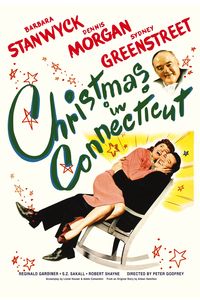
    (On Cable TV, December 2020) One of the central tenets of my evolving Grand Unified Theory of Christmas Movies is that for one to succeed, it must simultaneously depend on Christmas and yet be interesting outside of it. In other words, farther away from quantum uncertainty: The plot must be made possible by Christmas, yet be interesting enough to be watchable anytime from January to November. On those two metrics, Christmas in Connecticut succeeds admirably: It features a comic premise in which a single childless columnist having never set foot outside Manhattan is forced to pretend to be the exemplary rural housewife of her columns due to a Christmas publicity stunt. At the same time, it quickly becomes the kind of farce that’s well worth watching at any time of the year. It certainly helps that it features Barbara Stanwyck at her funniest, with capable character actors such as S.Z. Sakall and Sydney Greenstreet to keep things funny even when she’s not on-screen. The complications, deceptions and convoluted plans pile up as quickly as the romantic tension between the protagonist and a war hero targeted by the charade, leading to a climax in which everything is revealed. As a comedy, it’s quite good enough to satisfy even without the Christmas element, but removing it would make the film collapse under its own contradictions. (If the lesson here is that Christmastime makes people behave irrationally, well, I think that’s my point.) The depth of Hollywood Christmas movies is such that I hadn’t seriously looked at Christmas in Connecticut before this year, but now that I have, I can see it become a season favourite.