Tatum O’Neal

  • Little Darlings (1980)

    Little Darlings (1980)

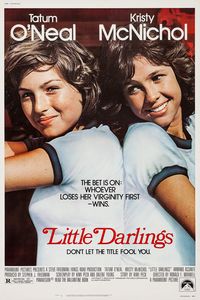
    (In French, On Cable TV, January 2020) There were a lot of summer camp movies in the early 1980s and most of them had something to do with losing one’s virginity, so you can be forgiven if you’re thinking of putting Little Darlings in the same category. After all, it’s about two teenage girls heading to summer camp and making an anti-virginity pack. But that’s ignoring some fairly important differences, starting with how the film was written by female screenwriters taking a decidedly female approach to the story. The emphasis here isn’t on the appeal of losing one’s virginity as much as the consequences following such an event. Our two protagonists (played by Tatum O’Neal and Kristy McNichol) are mismatched girls each from a different side of the track, and they allow the story to approach the issues coming at it from two different perspectives. The result is still very much in line with other coming-of-age films, but with a sufficiently different perspective that it still works—it’s not exactly a wholesome movie, but it’s a great deal less mindlessly raunchy than other comparable movies. In part, it almost feels considerably more modern at times—I was reminded of 2013’s The To Do List in trying to find comparable films. But only at times—in most ways, Little Darlings is definitely a film of its time, disco-era fashions included.
  • Paper Moon (1973)

    Paper Moon (1973)

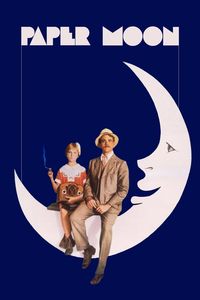
    (On Cable TV, December 2019) Considering writer-director Peter Bogdanovich’s fondness for Hollywood history, it really shouldn’t be a surprise how the opening moments of Paper Moon almost perfectly recreate depression-era filmmaking, down to the black and while flat cinematography and acting styles. Of course, this being an early-1970s film, this façade slowly crumbles as the film goes on, as it features a con artist and his daughter merrily scamming their way through the Midwest. Ryan O’Neill here holds one of his best roles, opposite his own daughter Tatum O’Neil. The tone is a semi-comic one with a big sentimental ending—although you have to be indulgent as our heroes scam widows and sell illegal booze back to their owners. The episodic structure of the film works relatively well as characters enter and exit the story—Madeline Khan is a welcome sight as an avowed gold-digger with no perceptible loyalty. It also builds to an emotional climax, as the film gradually makes its way from tragedy to comedy to drama. The interplay between father and daughter is quite nice, and Tatum may be more impressive than her father (who, should it be noted, rarely made an impression as an actor) in an Oscar-winning role. I’m not so sure that Paper Moon deserves its presence on the various best-of lists that I’ve seen, but then again, I’ve had worse movie-watching experiences.

  • The Bad News Bears (1976)

    The Bad News Bears (1976)

    (On DVD, October 2017) Either they don’t make kids movies like they did, or The Bad News Bears was an oddity even in its time. As we meet our protagonist day-drinking in the parking lot of a neighborhood baseball field, it’s obvious early on that this film goes for hard-luck gritty life lessons. Fortunately, it works even as it’s horrifying by 2017 standards: Seeing kids tag along an adult drinking beer while driving a convertible is the kind of thing that register as a very different kind of funny these days. Walter Matthau is pretty good as the initially reprehensible protagonist—a washed-up failure who learns lessons from coaching a team of early-teen misfits who shouldn’t even be playing in their league. Good character work (especially by Tatum O’Neal as a tomboy with a history and Jackie Earle Haley as a teenage hoodlum) helps a lot, and The Bad News Bears’ fondness for its oddball characters remains endearing even today. The various slurs aren’t so much fun, but given that the film is forty years old at this point, it’s not entirely unexpected. The ending remains a case study in how to transform defeat into a moral triumph. The score is also noteworthy, taking bits and pieces of opera Carmen for inspiration. There’s also an interesting, very American atmosphere to this bicentennial film—the emphasis on baseball helps ground it into a depiction of suburbia circa 1976.