Tennessee Williams

  • The Fugitive Kind (1960)

    The Fugitive Kind (1960)

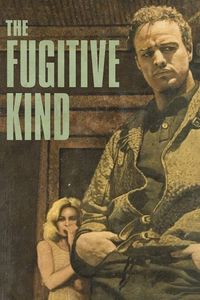
    (On Cable TV, July 2021) It’s not hard to see how The Fugitive Kind was an envelope-pushing film back in 1960 — Tennessee Williams writing, Sydney Lumet directing and Marlon Brando in the lead role, with a plot that has a drifter arousing passions in the small town where he stops for a while. (That plot summary also covers Picnic five years earlier, which was also considered edge-of-the-envelope.)  If you’re familiar with films of the time, it does remain a bit shocking to see Joanne Woodward make her entrance, dishevelled, unmannered and quite possibly inebriated: while unremarkable by today’s standards, female leads simply didn’t do that kind of thing back then. As the film advances, malevolent undercurrents suggest that it’s not going to end well… and it doesn’t. Still, what was effective sixty years ago is not always as fresh now, and it doesn’t take a long time for The Fugitive Kind to show its limits. Brando’s acting almost feels like a parody of itself, and Williams’s writing isn’t among his best. As with many films of its era, its desire to push the edge of permissible subject matters in an environment where the Hays Code was holding back honest drama lands it in a weird demimonde of unsatisfying compromises. It amounts to a film that’s certainly interesting as a representative of its era, but not completely satisfying as a viewing experience these days.

  • Suddenly, Last Summer (1959)

    Suddenly, Last Summer (1959)

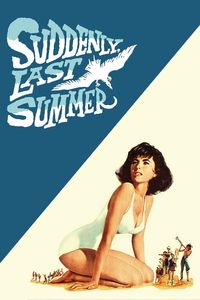
    (On Cable TV, June 2021) It strikes me that a good way to distinguish between new classic movie fans and veteran ones is to ask them about Suddenly, Last Summer: Novice film fans, not having seen the film, are likely to be astounded by the top talent assembled here: Elizabeth Taylor, Montgomery Cliff and Katharine Hepburn on the acting front, with Joseph L. Mankiewicz at the direction and none other than Gore Vidal and Tennessee Williams penning the script, how can it be anything than terrific? Then there are the veteran classic movie fans who, having seen the film, are simply shaking their heads while saying, “You should see it before getting excited.” The most important name here is probably Tennessee Williams, since his specific sensibilities dominate the film’s narrative in such a way as to influence everything else. True to form for Williams, the story he’s telling is a melodrama with a central (but faceless) character who’s as homosexual as could be at the time. If I understand the film’s production history, the Williams one-act play was then adapted for the screen by Gore Vidal, leading both to accuse the other of sabotaging the result. No matter who wrote it, director Mankiewicz went for maximal melodrama in executing it, with Hepburn being an enthusiastic participant in the result — her role as a family matriarch is heightened opera the moment she descends on-screen in an enclosed throne, and the flowery soliloquies she delivers would have been ridiculous from any other actress. Cliff does his best to keep up as the audience’s representative in understanding the profoundly dysfunctional family in which he’s been asked to intervene, but he routinely gets overshadowed by Hepburn’s arch overacting and Taylor’s ability to take her dialogue right up to eleven even with a heaving low-cut dress. The score is another intrusive participant, underlining every sordid revelation with a heavy note. It’s quite wild, and the narrative never stops one-upping itself, eventually reaching for a cannibalistic conclusion reinforcing the era’s prejudice against homosexuals. What’s more, I’m glossing over the rape, incest, and intended lobotomy as a way to keep the family secret — as I’ve said, it’s a wild movie, and one that’s more impressive for how quickly it becomes untethered from reality than for producing the results that the cast and crew would have preferred. By sheer happenstance, I followed up Suddenly Last Summer by the viewing of homosexuality-in-Hollywood-history documentary The Celluloid Closet, and I’m fortunate that this was the order I watched both films because The Celluloid Closet’s description of Suddenly Last Summer’s ludicrousness would have been too wild to believe if I hadn’t just watched the film. There are plenty of landmark movies in classic Hollywood history, and if Suddenly Last Summer is really not one of them, I still feel as if I just graduated to another stage of understanding Hollywood history simply by having watched it. Incredulously.
  • Period of Adjustment (1962)

    Period of Adjustment (1962)

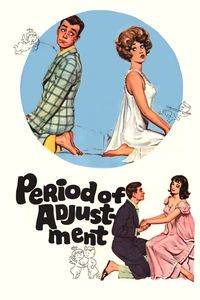
    (On Cable TV, April 2021) Tennessee Williams left quite a mark on American cinema of the 1950s–1960s, but one thing he wasn’t known for was comedy—his focus was more on hard-hitting dramas, gay subtext and explosive confrontations. (Even at his most bowdlerized, modern audiences can still watch films like Cat on a Hot Tin Roof and wonder, “Hey, is this character supposed to be…”)  While Period of Adjustment can’t very well be called an outright comedy with its focus on two couples having marital problems, it is considerably lighter than many other Williams adaptations. Featuring Jane Fonda and Jim Hutton, the story contrasts a newlywed couple with another with more mileage but different issues. It’s certainly atypical Williams — far looser and at least putatively funny. But even as a comedy, it’s a bit more serious than the norm, as it puts characters through a wringer they don’t especially appreciate (especially not in that typical-comedy fake annoyance way) before making it to the other end. On the other hand, there’s a happy ending and plenty of comic set-pieces, not to mention better-than-average dialogue for this kind of film and some interesting characterization in this tale of uncomfortable couples. Fonda is a southern doll here, which explains why this film is often mentioned as one of the ones that led her to stardom. The result is not exactly easy to classify — Period of Adjustment is not as intense as other Williams films, and it’s not as carefree as other romantic comedies of the era. But it’s got an interesting quality of its own, especially if (like me), you’ve started paying interest to Tennessee Williams through the films adapted from his work.

  • Sweet Bird of Youth (1962)

    Sweet Bird of Youth (1962)

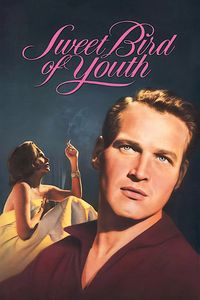
    (On Cable TV, January 2021) I really expected a film about a young man coming back to his small-town with a fading Hollywood star in tow to be more interesting than Sweet Bird of Youth. Despite the mixture of Hollywood bitterness and small-town politics, the film is a bit of a damp muddle. Paul Newman plays the kind of overly hard-headed semi-hoodlum that he did so well at the time, but somehow seems miscast. Geraldine Page does better as the drug-addled Hollywood star on the decline (although she still looks too young for the part), and so does Ed Begley as the powerful politician with mob boss habits. The theatrical origins of the film can be seen in the small scales and restrained locations—and knowing that the film was adapted from a Tennessee Williams play automatically leads one to look for the way in which it was softened from the original. (And this one is a doozy.)  Still, even with the happier ending, Sweet Bird of Youth isn’t much of a sit: it drags, it meanders, it gives us the yearning to escape back to Hollywood by the nearest available bus out of town. Newman fans may want to have a look, but even they may overdose on the obnoxious persona that he had at the time.

  • Cat on a Hot Tin Roof (1958)

    Cat on a Hot Tin Roof (1958)

    (On DVD, December 2017) There’s something oddly satisfying, in theatrically-inspired movies, in seeing the way the script piles on a series of interpersonal conflict in the first half, only to detonate them all in the second. Cat on a Hot Tin Roof does it better than most, helped along by terrific dialogue from playwright Tennessee Williams, the dramatic intensity of Paul Newman and Elizabeth Taylor in the lead roles, and some able assistance from Burl Ives as the patriarch whose impending death forms the catalyst of all conflicts. Despite some surprisingly comic moments, this is a fairly heavy film, especially when all the emotional bandages are removed at the big conflicts within the small cast of character are allowed to explode. Despite some glaring coyness (the homosexual themes of the relationship between the lead male character and his mourned friend hay not be expressly mentioned, but they’re glaringly obvious), Cat on a Hot Tin Roof hits its dramatic peak in time for its third act, punctuated by a thunderstorm. Taylor is in fine form here, showing the extent of her dramatic range even as illness and personal tragedy befell her during the film’s shooting (her husband died in a plane crash midway through production, which had to be halted to accommodate her grief). The result is still worth a look sixty years later as a good example of what fifties dramas could be, even when hobbled by the Hays Code and social conventions of the time.