Terrence Malick

  • Days of Heaven (1978)

    Days of Heaven (1978)

    (On Cable TV, July 2019) It’s entirely possible to think that a film achieves its objectives, yet be almost completely cold to those objectives. So it goes with Days of Heaven, a well made but somewhat soporific period drama that places a lot more emphasis on visuals than plot. It is what it is—a cinematic poem, perhaps, or a series of 1910s nature images with meditative narration loosely connected by a lovers-on-the-run plot. Which is a way of saying that it’s a very Terrence Malick film, bridging the gap between Badlands and The Thin Red Line two decades later. The plot is perfunctory, and if you read just a little bit about the film’s production, you will hear about how the film spent two years in editing, only making it out when Malick used a new voiceover to give some structure to the result. I’m not particularly fond of those kinds of meandering movies, to the point of calling them pretentious at the earliest opportunity, but even I have to admit that Days of Heaven is well done. The reliance on golden-hour rural cinematography makes for good images (although we’ve seen quite a bit of the same since 1978, somewhat dulling the impact of the film forty years later) while the sometimes-intrusive narration reinforces the dreamlike impact of the result. Richard Gere stars as a killer on the run who hatches a plan for his wife to seduce a wealthy farm owner in the Texas panhandle, but that’s making the entire film sound far more urgent than it is. Still, there are highlights—a shot here and there, a compelling locust sequence, and so on. The film, despite its tone and atmosphere, is surprisingly short, clocking in at barely more than 90 minutes. I didn’t quite dislike Days of Heaven as much as I expected given my experience with previous Malick films, but now that I think of it, I’m actually becoming lukewarm on his movies as I age. Hmmm.
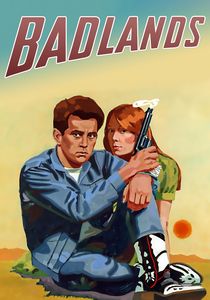
  • Badlands (1973)

    Badlands (1973)

    (On Cable TV, March 2019) There were a surprising number of high-profile “romantic criminal couple on the run” movies during the New Hollywood period, with seemingly everyone (including Spielberg!) taking a shot at it. Badlands is Terrence Malick’s debut feature and it fully embraces the subgenre, while being perhaps a bit more entertaining for Malick completists than the impression left by his later features would suggest. A summary of the story sounds like genre material: a girl meets a guy who ends up killing his dad and then go on the run together, killing more people along the way. From Gun Crazy to Bonnie and Clyde to Natural Born Killer (and others!), this is an American archetype. But Malick makes everything sophisticated rather than trashy by using voiceovers and a kind of languid pacing that never abandons the small-town atmosphere even as the bodies pile up. Badlands spends a lot of time in rural America in ways rarely seen in other movies, adding credible 1950s details in ways that stick in mind, whether it’s recording physical records at coin-operated machines or filling up a car from leaking gas stations. Sissy Spacek and Martin Sheen both star, with Sheen looking uncannily like his sons would two decades later. I really expected to dislike the film, based on my reactions to later Malick films, overall lack of appreciation for New Hollywood and familiarity with the subgenre… but I didn’t. It eventually won me over slightly, thanks to the period detail and flourishes such as a climactic car chase. It certainly helps that Badlands isn’t as bleak as other films of the subgenre, most of which can’t be bothered to be more imaginative than to have their leading couple go down in a hail of bullets. Malick is definitely after something else here, and the film thrives on that intention.

  • The Tree of Life (2011)

    The Tree of Life (2011)

    (On-demand video, March 2012) I’m not a good audience for non-narrative films that boldly seek art-house cinema credentials, but even I have nice things to say about The Tree of Life.  Non-linear, certainly non-conventional, arguably nonsensical, it wraps up a chronicle of life in 1950s Texas in broader questions about our place in the universe.  It may challenge viewers who prefer every narrative arc nearly wrapped up in a bow, but it certainly rewards those who are willing to let the film wash over them without grasping at explanations.  (Just accept that this is a 1950s nostalgia film with modern skyscrapers, dinosaurs, a meteor impact, a depiction of Tipler’s Omega Point, and children running into a DDT spray.)  Brad Pitt portrays an unusual role as an overbearing father of three boys, holding up the “ways of nature” over his wife’s “ways of grace”, but the real star here is writer/director Terrence Malick’s elliptical film-making and the astonishing quality of the footage he’s been able to include in the film.  The mind may rebel at trying to piece together every shot of the film, but there’s something beautiful to see every five minutes, and the atmosphere created by the minutiae of life as experienced by the characters is all-encompassing.  It’s hard not to be moved by certain moments, or let the film’s hints at meaning lead us to flights of fancy.  This, in other words, is a film to savor for mood and meditation far more than narration and entertainment –you’ve been warned.