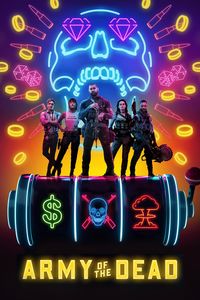
Army of the Dead (2021)
(Netflix Streaming, May 2021) On paper, Army of the Dead sounds pretty good: blending a casino heist film with a post-apocalyptic zombie-infested setting is reasonably newish and certainly a great fit for writer-director Zack Snyder’s filmography. Unfortunately, there’s always a “but…” or two to any Snyder project, and this one is certainly no exception. The core of the film is fine — present Las Vegas as a zombie-infested zone on the verge of being nuked, assemble a team hyped to be able to do the heist, drop them in the zone, have them fight out various dangers, suffer the inevitable betrayal, whittle their numbers down and have the survivors narrowly escape the impending nuclear explosion. Good bones on that story, and Snyder sometimes knows how to make it look great. It’s the rest that doesn’t quite work. After a dynamite opening sequence cramming an entire film’s worth of exposition (and two or three low-budget movies’ production expenses) in five minutes, Army of the Dead gets down to business and almost immediately gets weird. And I don’t mean weird as in quirky, atmospheric or eccentric, but weird as in indulging in excess, puzzling tangents, extraneous bits of worldbuilding and elements that are far less interesting than they should have been (namely, the “Alphas” smart zombies). The most charitable explanation that has been provided for all this is that Army of the Dead is the first chunk of a more expansive imaginary universe that may expand to include aliens, robots, time-travel, parallel universes and (depressingly, once again…) a complete zombie takeover of the Earth. Maybe. [October 2021: First spinoff Army of Thieves, which I preferred to Army of the Dead, offers some support for this theory.] But it does make the film a bit vexing to watch, as its overinflated running time keeps diverging in tangents. (But not all tangents are bad: the tiger zombie? Terrific.) Other areas of the film are disappointing for more familiar reasons: Snyder likes gore a lot more than I do, and his sense of story is often deficient — witness the dumb ways team members are taken out. But at least we’re on more familiar ground with those issues. At least things are handled with a decent amount of energy and some appropriate actors in key roles. Dave Bautista is rarely less than charismatic and this time is no exception, Matthias Schweighöfer is a bit of an audience stand-in between obvious action heroes, and while Tig Notaro was added to the film during post-production (replacing a problematic actor via CGI and careful editing), she ends up being one of the clear highlights. It all adds up to a film that delivers the goods, but is held back in many ways from going beyond that. Worse than that is the feeling that Army of the Dead, like far too many corporate products of the 2010s and beyond, is incomplete by design — we may get the full story later if the vagaries of the market allow for it, or we may never do. (Or by the time it’s delivered, it may have mutated into something else.) But so it is in today’s mass-market movie industry: have a bite now, stay hungry for more. Just once I’d like a story with a resolution, a zombie film where they’re all destroyed in the end, a Snyder film I could just enjoy without going “but…”