Timothée Chalamet

  • Dune: Part One (2021)

    (Video on Demand, January 2022) All right, let’s put a few cards on the table. I last read Frank Herbert’s Dune about a quarter-century ago, but I still think it’s one of the greatest Science Fiction novels ever written—a wonderful blend of space opera elements, strong atmosphere, great characterization and grander-than-life ideas. I haven’t seen the 2000 miniseries, but I really liked the glimpses we got from Jorodowsky’s Dune and I’m curiously partial to the wild baroque approach of David Lynch’s 1984 version of Dune, which I revisited last year and found much more enjoyable than expected—not to mention its quasi-iconic elements. My expectations for Denis Villeneuve’s new version were high—I really enjoy the fact that a French Canadian is the reigning king of Hollywood Science Fiction, and while I don’t necessarily love all of his earlier films, they’re easy to respect. Is he the right choice for Dune, however? I’m not sure. Oh, I liked this Dune: Part One all right—it’s immensely respectful of the original, fleshes out some of the things glossed upon during Lynch’s version, is so slickly directed as to be wonderful and manages some great casting coups. My initial disappointment at how it only adapted the first part of the novel was mollified by how the film’s success led to the greenlighting of the second half. On the other hand, this Part One does have a number of built-in issues. Some of them may disappear in time, once Part Two is here and delivers on all promises. Until then, however, we’re stuck not only with the first half of a story but an austere, slow-moving first half. Villeneuve’s approach is not wild and baroque: it’s ponderous, massive, more concerned with awe than pacing. It’s an approach all right, but there were a number of times that I found myself missing the wilder style of the 1984 version. (Ironically, this Dune is dumber when it does give in to the grandiose—its ornithopters make no sense at all.)  As much as I’d like to like it, I’m stuck waiting for the second half to make up my mind. I did like a lot of the casting—Timothée Chalamet grew on me as the protagonist, which is more than I can say about Rebecca Ferguson. But Oscar Isaac, John Brolin, Dave Bautista, Jason Momoa and Javier Bardem all make for great characters. Sharon Duncan-Brewster gender-flips a rather dull role into an interesting character, and I guess we’ll get a lot more Zendaya in the next instalment. I’m not entirely happy with the pacing: the already laborious task of presenting a complex new universe is further slowed down by a slow pace, something that becomes increasingly irritating in the last act of the film, as what should have been a climax (the attack and exile) is drawn out into a too-long half hour meant to set up even more of the material. (It’s also a sequence that sees many of the most compelling and diverse characters die so that our duller Caucasian protagonist survives.)  Still, generally speaking, I am cautiously optimistic about the upcoming Part Two based on this incomplete Part One—much of the groundwork is done, and now we’re ready to see the day where “the eyes of the galaxy turned toward Arrakis.” (Second Viewing, On Cable TV, May 2024) A second viewing of this Part One in close proximity with Part Two leaves me with one conclusion: I do respect Part One better now that I’ve seen its conclusion, but I don’t like it much more. Villeneuve’s epic style is synonymous with interminable (something that the last half-hour of Part One highlights all too well), and his iconography isn’t particularly memorable—especially if you compare it to the Lynch version. Oh, he does understand and execute the novel better than any version so far, but there’s clearly little concision to it. Even individual shots are easily twice as long as they need to be. But now that both parts of the film are out, don’t watch one without the other. Set aside the five hours and watch both—you’ll be awed, but maybe not as entertained as you’d like.
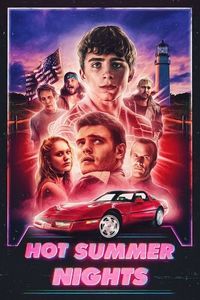

  • Hot Summer Nights (2017)

    Hot Summer Nights (2017)

    (On Cable TV, August 2021) Anyone hearing “coming of age film starring Timothée Chalamet” may be forgiven for recoiling in dread of another snoozefest along the lines of Call Me by Your Name, but it turns out that Hot Summer Nights is quite different. Also quite incoherent, which begins early on, as the film shows us our protagonist being sent to live for the summer of 1991 with his aunt in Cape Cod, MA. Neither townie nor part of the rich hordes descending upon their summer houses, our protagonist soon hooks up with a local drug-dealing celebrity hoodlum, and somehow gets close to the local dream-girl. That nagging voice you’re hearing is not so much the sound of multiple clichés crashing into each other (namely: coming of age meeting drug kingpin tragedy) than a narrator who has no business being in the movie. While our narrator is the link between the film’s fast-paced opening and the film’s epilogue (especially considering that nearly everyone described by the narrator ends up dead a few years later, portending nothing good about our lead characters), he also immediately and ultimately blurs the film’s narrative viewpoint — are we following the adventures of an aimless young man sent to Cape Cod for the summer, or are we following those of this outsider coming to town and becoming a legend to the locals? When the narrator gravely intones, at the end, that “we never saw [the protagonist] again,” you just want to slap him behind the ears and say HE WENT BACK HOME, YOU SMALL-TOWN YOKEL. But such fuzziness is endemic to Hot Summer Nights — our lead character is both a young troubled man and someone who picks up the local weed trade in a matter of days. He’s a shy outsider who somehow gets the attention of the local hottie. He’s coming of age, but also starring in a teenage version of all drug kingpin movies ending with the inevitable consequences of organized crime. The coming-of-age thing doesn’t work when they’re selling hundreds of thousands of dollars’ worth of drugs on a weekly basis. The criminal narrative is squarely stolen from Scorsese and al, barely scaled down to fit in Cape Cod. The third act is an overly familiar blend of personal tragedies, climaxing just as a hurricane makes it to the town, destroying everything as everyone kill each other. The period soundtrack is similarly used as blunt instrument. If none of this sounds subtle, you have no idea — even the film’s hyperactive opening (in which local legends are discussed) seems poorly imitative of better movies. It does end up with a mildly crowd-pleasing film (well, as long as you have the capacity to cheer for juvenile drug dealers), but it’s a film that dies the moment it stops moving, because that’s when the questions emerge, and the longer you question Hot Summer Nights the faster it falls apart. I did like it better than Call Me by Your Name, but I’m not fooling myself: this is really far from being as good as the other coming-of-aged film featuring Timothée Chalamet.

  • The King (2019)

    The King (2019)

    (Netflix Streaming, December 2020) It’s been scant hours since I’ve seen The King, and the film is already a blur of fuzzy memories, largely undistinguishable from other similar films. Telling us about Henry V’s first years in power, it’s dirty, grimy and thoroughly not fun. The acting talent is fine (what with such notables at Timothée Chalamet, Joel Edgerton, Robert Pattinson and Ben Mendelsohn) and the script relies equally on loose adaptations from historical facts and Shakespearian plays. But the result, ugh – you may want to get out on the next cold rainy day, roll yourself in the mud and spend a few days without electricity and have a more entertaining experience. It does get a bit more interesting late in the third act with a depiction of the Battle of Agincourt, but even a film as dull and gritty as The King can’t escape substantial deviation from historical fact – it’s almost as much fun to fact-check the film than watch it in the first place. It’s as featureless and generic as its title suggests – I was barely reminded of 2018’s Outlaw King (also released via Netflix), and it’s not a favourable comparison.