Tobe Hooper

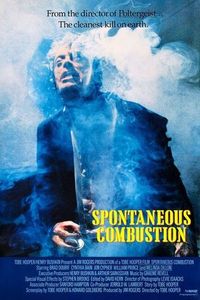
  • Spontaneous Combustion (1990)

    Spontaneous Combustion (1990)

    (In French, On Cable TV, December 2021) It’s a shame that the inherent goofiness of Spontaneous Combustion doesn’t translate into much more than an average horror film, especially considering that it’s written and directed by Tobe Hooper — it clearly announces the bad later half of Hooper’s career, where the spark of his earlier films was blown out and never came back. You can actually see some of that creativity at work early in this film — the prologue sets up a love story between two test subjects that logically leads to a very special child, but the film loses steam from that point, becoming nothing more than an incoherent blend of plot points that, taken together, end up making a very dull film. (Comparisons to Firestarter are obvious and not complimentary to Hooper’s film.) Brad Dourif doesn’t do much in the lead, and the result ends up being a strong disappointment considering the elements involved. Spontaneous Combustion may be worth a look if you’re trying to piece together how Hooper’s career degenerated over time, but there isn’t a lot there for sheer entertainment.

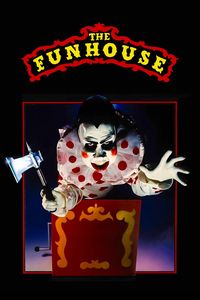
  • The Funhouse (1981)

    The Funhouse (1981)

    (In French, On Cable TV, March 2021) At long last, it finally comes together. Twenty years ago, I read a Dean Koontz book called The Funhouse, and now that I’ve seen the film, I can track how Koontz’s novelization, published before the film came out, remains almost more famous as a Koontz novel than a movie tie-in. While the film is helmed by horror legend Tobe Hooper in a style somewhat reminiscent to his earlier Texas Chainsaw Massacre (most notably the reuse of deformity in deep-America horror context, or am I jumbling the Chainsaw Massacre sequels together?) that makes the result a cut above the usual slasher films of the era, by modern standard it’s a humdrum horror film that sticks close to the codes of the genre. The monster-in-a-fair motif is familiar, and not even a better-than-average execution can quite make it shine. What I remember of the novel is substantially more detailed than the film — a surprisingly common occurrence once real genre writers get to work on a novelization (Also see: Asimov’s Fantastic Voyage and Card’s The Abyss). As for The Funhouse itself, it’s just interesting enough to be worth a watch today if you’re a horror fan (something that’s not necessarily true of the glut of horror films in the early 1980s), and a slightly better-than-median entry in the Hooper filmography. Otherwise, though, there isn’t anything spectacular to see here.

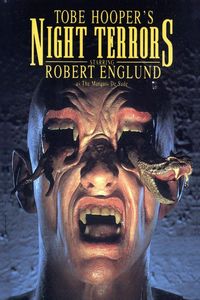
  • Night Terrors (1993)

    Night Terrors (1993)

    (In French, On Cable TV, February 2021) The downfall of writer-director Tobe Hooper remains one of the sad stories of horror filmmaking (“drugs” are often mentioned as a contributing factor), and you can take a look at featureless films such as Night Terrors to show how quickly he fell off the map after his early successes. Nominally a horror film in which a woman is swept up into a cult led by a descendant of the Marquis de Sade, the result can never quite find its footing despite decent production values and concepts that could have led to more. Setting the film in the Middle East doesn’t add as much as you’d think, and the parallel historical timelines don’t lead anywhere. Robert Englund in the lead role(s) doesn’t have much to do (Sade ends up feeling like a pretentious emo guy rather than a force for erotic horror), and the lighthearted touch shown by Hooper in earlier projects is nowhere to be found. The result is an intensely generic and forgettable 1990s horror film that barely deserves any discussion except as one of many illustrations of how far Hooper had fallen.

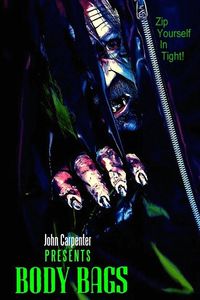
  • Body Bags (1993)

    Body Bags (1993)

    (In French, On Cable TV, September 2020) Clearly a film by and for horror fans, Body Bags can best be described as another horror anthology movie (patched together from a failed proposal for an episodic TV series), with a moody framing device (John Carpenter playing a morgue worker messing around for the audience) setting the stage for three twenty-some-minute-long segments. The first is “The Gas Station,” featuring Alex Datcher as a student taking up a gas station attendant job in the middle of the night, and (rightfully) feeling scared when a killer is identified as prowling around. Directed by John Carpenter, this a rather straightforward action thriller segment is well-executed but familiar in its topic matter. The second segment, “Hair” (directed by Tobe Hooper), is somewhat more comedic, as a middle-aged Stacy Keach takes increasingly drastic steps to reverse his increasing baldness. It ends in creepy-funny material, although the abrupt end once the joke is explained seems unsatisfying—at least it takes the time to properly dissect the various reactions of its characters to encroaching baldness. The third segment, “Eye,” lands us in straighter horror territory as a baseball player (Mark Hamill with an unfortunate moustache) who lost an eye in a car accident is the recipient of a transplanted eye… who belonged to a serial killer. The eye predictably takes over with disastrous results. As an anthology film, Body Bags is not all that bad—but its most distinctive feature is its unapologetic appeal to horror audiences: There are tons of cameos from horror director here, and the tone is the kind of horror/comedy that reaches as far back as the early EC comics. It’s not world-changing entertainment, but it’s a chance to see a few familiar names having fun, and one of Carpenter’s last good films.

  • The Texas Chainsaw Massacre 2 (1986)

    The Texas Chainsaw Massacre 2 (1986)

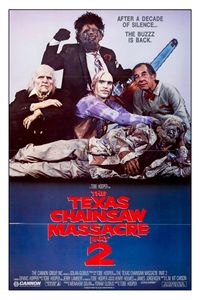
    (On Cable TV, August 2020) A few people claim that the original Texas Chainsaw Massacre had some respectability. Despite its grand-guignolesque violence, their argument goes, it had stripped-down naturalistic cinematography that did much, in the early 1970s, to take the horror genre forward and (also) into slashers. Well, that original respectability certainly isn’t carried over to its sequel, which was made on the other side of the slasher craze it helped create and as a result goes nuts on ludicrous gore while leaving any attempt at realism well behind. What was halfway believable in the prequel is now completely crazy in The Texas Chainsaw Massacre 2, taking advantage of heightened audience expectations and pumped-up gore effects. What saves the film (and earns begrudging respect from this slasher-hater critic) is director Tobe Hooper’s willingness to indulge into satire of the slasher genre itself. What is over the top is deliberately over-the-top, highlighted in so many ways that the film almost thinks of itself as a comedy. It doesn’t exactly endear me to the result, but it does raise The Texas Chainsaw Massacre 2 above the copycat nature of many of its mid-1980s slasher equivalents.

  • I’m Dangerous Tonight (1990)

    I’m Dangerous Tonight (1990)

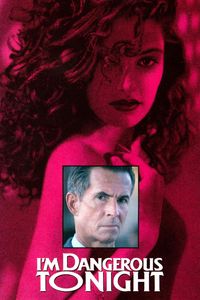
    (On Cable TV, July 2020) Inconsistent director Tobe Hooper gradually sank into mediocrity as the 1980s advanced and he was never quite able to recapture the spark of his early films. Even moderately successful movies like I’m Dangerous Tonight would become increasingly rare as he kept working to diminishing returns. Adapted from a short story, the film takes place on an American campus where a murderous cloak (taken from a sacrificial altar) can take over the body of anyone wearing it. Made for TV, the film clearly doesn’t have a large budget but still manages to have a few strong moments, including a better-than-average car chase. Lead actress Mädchen Amick doe a fine job going from mousy to murderous under the influence of the evil artifact. While I’m Dangerous Tonight does match a certain level of directorial competence (especially for a 1990 TV movie), there isn’t much to the script to make it more than a mildly entertaining horror film in a familiar vein. It does get better as it goes on, as it partly becomes about the fight against evil (culminating in the famous Nietzsche quote) in addition to the evil itself. I saw I’m Dangerous Tonight largely because I was checking off my Hooper filmography, but the film itself is solid enough if your expectations are reasonable.

    (Second Viewing, In French, On Cable TV, March 2021) As a made-for-Cable movie, it’s not that surprising if I’m Dangerous Tonight isn’t as unleashed as it could have been. It does start with a good premise and acceptable characters, as an ancient relic shaped in the form of a red cloak causes anyone wearing it to behave murderously. After the requisite initial incidents to mean that the dress means business, things kick in high gear when our sweet nerdy heroine (the cute Mädchen Amick) gets ahold of the fabric, sews it into a dress and the dress gets ahold of her. It escalates all the way to the wood chipper, although the gore remains blissfully restrained due to its made-for-TV status. Anthony Perkins shows up for a few scenes as a surprisingly non-evil character, while the atmosphere of an American campus does much to keep the film grounded in a familiar movie reality. The script is not that good and the execution feels restrained, but director Tobe Hooper still knew how to keep things hopping, and so I’m Dangerous Tonight remains watchable without being all that memorable.

  • Lifeforce (1985)

    Lifeforce (1985)

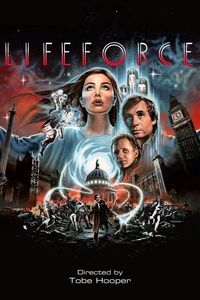
    (On Cable TV, March 2020) There’s a surprising mixture of elements at play in Lifeforce, an erotic apocalyptic horror-SF hybrid featuring alien shape-shifters laying waste to Earth. It starts in somewhat convincing science fictional mode, as an expedition discovers an alien ship and brings back a suspiciously well-preserved (and naked) “human” woman. Then it shifts into laboratory horror as the alien wakes up on Earth and starts sucking off the life-force of its human victims, often doing do in the nude. Much of the middle portion of the film is about scientists racing to find answers, discovering that aliens have originated the vampire mythos, and unsuccessfully trying to prevent an epidemic-like contagion of vampires-created zombies. The third act, remarkably enough, presents a portrait of London devastated by the turning of much of its population and gets back to the SF-horror hybrid in its climax. It’s all pleasantly watchable and perhaps the last unimpeachable film from director Tobe Hooper. A young Patrick Stewart has a supporting role, the special effects are pretty good for their time, and the echoes of Quatermass and the Pit are not unpleasant. While not a great film, nor a flawless B-movie, Lifeforce is nonetheless a big thrill ride with enough unusual twists and turns to warrant a look.

  • Poltergeist (1982)

    Poltergeist (1982)

    (On Cable TV, April 2016) I sat down to watch Poltergeist with some apprehension: Horror movies often don’t age well, and this one had a reputation for being heavy on special effects, which don’t always age very well either. I had dim memories of being scared of parts of the movie as a young kid (enough so that without quite remembering why, I started feeling queasy when I saw the steak moving across the kitchen counter…) but otherwise approached the film fresh. Fortunately, Poltergeist still works splendidly today. It’s suspenseful, funny at unexpected times and crazy when it needs to pull all the stops. The special effects are not bad, and if the film feels familiar (it probably codified half the story beats we now associate with haunted-house stories), it’s also just quirky enough to feel fresh. The early eighties setting now has a definitive charm, as do some of the special effects limitations. Interestingly enough, modern technology now arguably enhances the film’s sense of dread: When I was intrigued enough to wonder what a hand-drawn 1988 Super Bowl poster would be doing in a 1982 movie, I immediately used my phone to Google my question … and really did not expect the answer I got. (Also: That steak crawling on the kitchen counter scene? Still gross after all these years.) On a more light-hearted note, I was impressed at the unexpected humour shown in the film as a family playfully accepts the presence of paranormal forces in its house (before a family member disappears, that is), and even more impressed at how the movie pulls out all the stops when it’s time for stuff to get completely crazy, either at mid-movie or during the all-out finale. Never mind that the various scares don’t really amount to something cohesive given the premise of the film: it’s thrilling enough to paper over any objections. The directing helps: Tobe Hooper may be listed as the director, but there’s a definitive early-Spielbergian quality to the result that practically makes the movie a full entry in Spielberg’s filmography. Of the actors, Craig T. Nelson is very good as the fatherly anchor of the film, with young Heather O’Rourke being iconic as the young Carol-Anne. Poltergeist is still fairly well-known today for a good reason: it has aged very well and even its competent 2015 remake makes it look even better.

    (Second viewing, On Cable TV, October 2022) I wasn’t really planning on re-watching all of Poltergeist: given that TCM was giving it a prime-time spot, I was only planning on checking out the host presentation. But with Halloween around the corner and a few chores to do within TV distance, I let the beginning of the film play… and gradually found myself seduced all over again by the results. Say what you want about some dated effects and the greater familiarity of horror movies these days, there’s something simply hypnotic to the way director Steven Spielberg Tobe Hooper handles a rather good script. I still love, perhaps even more than upon first viewing, the humour that permeates the film from beginning to end, especially as we get a span of reactions of our ordinary suburban characters to the escalating weirdness. I like how the script skips over some obligatory-but-dull moments to show us the more interesting results of those plot-mandatory moments. I especially still love how crazy Poltergeist gets at times, with an audio-visual chaos testing modern HDTV-broadcast compression algorithms. That last aspect is enough to get me wondering — hmmm, is it time to get a 4K disc copy?