Tom Cruise

  • Going Clear: Scientology & the Prison of Belief (2015)

    Going Clear: Scientology & the Prison of Belief (2015)

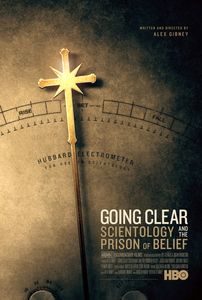
    (On Cable TV, September 2015) Documentary filmmaker Alex Gibney takes on the church of Scientology in Going Clear, and the result is as fascinating as any of his other movies.  Adapted from Lawrence Wright’s book Going Clear: Scientology, Hollywood and the Prison of Belief, it’s a highly critical look at the inner workings of Scientology, featuring a number of disillusioned former high-ranking members of the organization.  After a look at the colorful life of Scientology founder L. Ron Hubbard, Going Clear spends time detailing the recent and current activities of the organization and the reasons why several of its former members have left it.  Along the way, the relationship between Scientology and its star members John Travolta and Tom Cruise is detailed in ways to make us understand how they all benefit from the association.  It’s a slick documentary, although the “dramatic recreation” segments meant to illustrate some of the material is overdone: the interview alone are compelling enough.  Going Clear is builds to a highly critical portrait of Scientology, packaging together a lot of material that has been available for years but seldom presented in such a self-contained form.  Read the film’s Wikipedia article for more details on the ensuing controversy.

  • Edge of Tomorrow (2014)

    Edge of Tomorrow (2014)

    (On Cable TV, February 2015) As a director, Doug Liman’s been hit-and-miss, but Edge of Tomorrow is a definite hit.  You could crudely summarize the film as “sci-fi Groundhog Day” (even though it’s adapted from a Japanese Science-Fiction novel) and grind your teeth at the dumb setup in which humans are somehow stuck fighting aliens in a European ground war.  But once the mechanics of the time-loop premise are laid out and the complications begin piling up for our protagonist, Edge of Tomorrow gains a strong forward narrative drive.  Tom Cruise is pretty good as a back-room officer thrust into bloody combat, especially when he has to relive the same events over and over again until he gets it right.  You can dig a bit into the film and come away with strong commentary on video-game playing and the consequences of choice, but it’s just as easy to be swept along by the fast-paced action and dark humor.  Emily Blunt has a terrific role as a battle-hardened veteran, and she sells it perfectly. (Although I would have liked an older female actress in the role, just to lower the age difference between her and Cruise) Edge of Tomorrow definitely hits its stride in its middle third as time-loop possibilities are ingeniously exploited, and the film’s editing is taught-tight.  It’s a bit unfortunate that the film’s third act seems so flaccid after such high notes: The night-time Paris sequence seem suddenly interminable and visually bleak, although I’m sucker enough for a happy ending that I won’t begrudge the sudden changes in the film’s rules in time for the coda.  Edge of Tomorrow is just different and playful enough to distinguish itself from other run-of-the-mill SF action films, although it’s flawed enough to make anyone wish for a few further tweaks.  Still: Not bad at all.

  • Oblivion (2013)

    Oblivion (2013)

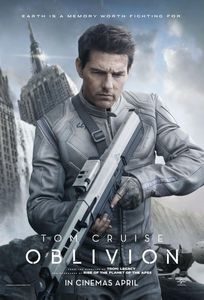
    (Video on Demand, September 2013) For all of the nice things I have to say about Oblivion, there’s something just… off in the way it comes together.  The first few minutes don’t quite establish the required suspension of disbelief required for it to work smoothly: The visuals it presents don’t make a lot of sense and the pandering to modern lowest-denominator audiences seems blatant (let’s see: Yankees cap, Football stadium, dog, motorcycle and a cabin in the woods.  Yup, just one regular guy, no wacky sci-fi to see here…)  For viewers used to prose science-fiction Oblivion seems to pivot entirely on a familiar cognitive breakthrough structure, and the way it self-importantly reveals its secrets is a bit annoying, as if it expected audience’s minds to be blown apart by fairly obvious reveals.  The plot doesn’t quite seem to hold together the longer you look at it, and the visuals it shows (combining a ruined New York with what looks like epochal landscape alteration) are so nonsensical as to make anyone’s head hurt.  But let’s focus on the positive for a moment: It’s a science-fiction film that’s not explicitly based on existing intellectual properties, it features relatively original imagery (the “house in the clouds” is particularly nice) and it has the willingness to combine familiar tropes into a somewhat cohesive whole.  For writer/director Joseph Kosinski, it’s certainly a step up from the pretty-but-vapid Tron: Legacy.  Tom Cruise is overbearingly Tom Cruise-ish in the lead role (see “Yankees cap, football, motorcycle” above), but the supporting performances by Morgan Freeman, Andrea Riseborough and Olga Kurylenko bring a bit of balance in the film.  While there’s little that’s objectionably wrong in Oblivion, it doesn’t click either, and that’s a more crucial problem in SF movies than in other genres due to the required suspension of disbelief.  While it certainly looks nice and feels more original than yet another sequel of a comic-book movie adaptation, it doesn’t seem to have enough heft to it, and given the nature of the film’s revelation it’s hard imagining watching this a second time for fun.

  • Jack Reacher (2012)

    Jack Reacher (2012)

    (Video on Demand, May 2013) Let’s get something out in writing right away: As a confirmed fan of Lee Child’s Jack Reacher series, I still have issues in seeing Tom Cruise cast as Reacher.  It doesn’t have to do with Cruise’s diminutive frame trying to occupy Reacher’s hulk of a character –it has to do with the way Cruise never plays less than a superstar, whereas my mental image of Reacher has always been about the way he tries to be inconspicuous in order to better do his job… at least until being conspicuous best serves his purpose.  But you can safely ignore this kvetching as another in an infinite line of book fans moaning about movie adaptations, because taken on its own and not as an adaptation of Child’s One Shot, Jack Reacher is a fairly strong thriller, with better-than-average plotting, efficient dialogues, solid direction and an unobtrusive sense of style.  As with the novel, it takes a while for the true nature of the plot to emerge, and there is a satisfying amount of complications along the way.  Cruise is his usual mister-megawatt-smile self, gamely hoping that his charisma will forgive the series’ built-in lack of character development and launch another franchise under his name.  Well, I, for one, hope it goes forward –I may not love Reacher as much on the screen as I do on the page, but I would certainly go see other films in the series.

  • Rock of Ages (2012)

    Rock of Ages (2012)

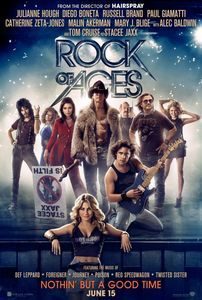
    (On-demand video, November 2012) I’m a forgiving fan of movie musicals and as such I’m pretty happy with Rock of Ages, which grabs eighties-rock songs and re-shapes them into a straightforward musical about finding love and success in 1987 Hollywood.  Julianne Hough and Diego Boneta do well as the dull young couple anchoring the story, but the rest of the cast shines.  Alec Baldwin is hilarious as an aging rock-will-never-die club owner, Paul Giamatti is perfect as a slimy impresario and Catherine Zeta-Jones is amusing as a socialite with a revealing past.  Still, they’re not the best of what Rock of Ages has to offer: Russell Brand steals his scenes with lines that sound tailor-made for his personae but even he takes a step back whenever Tom Cruise chews the scenery as rock god Stacee Jaxx.  Cruise-as-Jaxx transposes and perverts his movie-star status into a related realm, and if Cruise seems more accomplished than unleashed as a self-destructing icon, it’s still a great performance in a pivotal role.  Music-wise, Rock of Ages will have you humming “I Wanna Rock”, “Wanted Dead or Alive” and “Don’t Stop Believin’” (among others) for days, even though the movie’s soundtrack may not compare to the original versions of the songs.  I’m told that the movie’s plot is considerably happier and simpler than the original musical, (although it keeps the vexing two-act structure leading to a mid-movie lull) but director Adam Shankman’s adaptation is also able to weave song medleys around characters doing their own things separately –at best, it’s an exhilarating example of the creative freedom offered by well-produced cinema.  While Rock of Ages may be a fluffy fantasy loosely connected to the anthem-rock era, it’s bouncy and fun and just as entertaining as it wants to be.  But I did say that I’m a forgiving fan of movie musicals.

  • Mission: Impossible – Ghost Protocol (2011)

    Mission: Impossible – Ghost Protocol (2011)

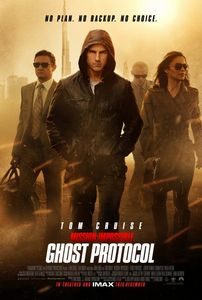
    (In theaters, December 2011) The Mission: Impossible series has never been about realism, and this fourth entry continues to deliver the kind of spying-fantasy action that the franchise does so well.  While it would be correct to bemoan the series’ lack of real-world themes or relevance, it’s also missing the point: Mission Impossible is about featuring visually dynamic action directors, giving Tom Cruise a rock-solid star vehicle, and having just enough plot to run through a series of action/heist set-pieces.  It works pretty well: Brad Bird’s live-action debut as a director show his skill in handling complex sequences mixing together wide-screen locales around the world, high-tech equipment (which, hilariously enough, always seems to be failing), movie-slick stars and a good sense of rhythm.  The series has been good at showcasing innovative action sequences and Ghost Protocol does well in setting a chase inside a sandstorm and then later on a fight in an automated parking garage.  What’s somewhat new is a tenuous amount of continuity with the previous installment: just enough to give the actors something to do during the dialogue scenes, but also in terms of visual continuity, much stronger between the third and fourth film than any of the previous entries.  While Ghost Protocol doesn’t have a villain as strong as Philip Seymour Hoffman in the third installment, it’s good enough to give a little bit more of what has been good about the series so far.  While Cruise is now pushing credibility as an action hero (the next ten years are going to be tough for him as he’ll have to let go of his boyish grin), the Mission: Impossible series is still his most reliable, most audience-friendly franchise.  Expect another installment within a few years… and expect it to be decent.

  • Knight and Day (2010)

    Knight and Day (2010)

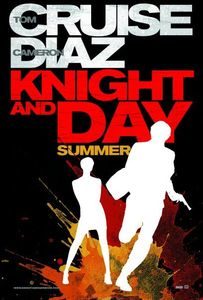
    (In theatres, June 2010) A breezy summer action comedy doesn’t have to do much to charm me, but the mess that is Knight and Day tests the limits of my indulgence when it comes to those kinds of would-be summer blockbusters.  It’s not that the film isn’t enjoyable: It’s good-natured, leaves its stars free to grin madly and does present an enjoyable escapist fantasy.  There are interesting things to see in the action sequences, and a few laughs here and there.  But something feels off about the way the film is directed and edited: Director James Mangold has an intriguing way of showing (or rather, not showing) what happens in the film, but this kind of experimentation doesn’t fit with the far more conventional thrust of the movie and is hampered by some fairly obvious CGI work.  Furthermore, the editing is so choppy that it feels as if crucial connective tissue has been left out of the script or the final cut: Knight and Day feels rushed and borderline incoherent, in-between zippy changes of scenery, abrupt shifts in tone and characters whose unhinged nature seems more forced by dialogue rewrites than anything like psychological complexity.  (Even the title almost defies explanation, and you have to squint really hard at the last lines of dialogue to figure it out.)  So far removed from the moviemaking process, it’s tough for viewers to know where to assign blame: the script was reportedly re-written almost a dozen times, passing through a number of proposed stars before settling on Tom Cruise and Cameron Diaz.  Neither do too badly, although Cruise overdoes his preening while Diaz seems happy to squeal dizzily through much of the film.  The result is about a third good, a third charming and a third mystifying: not exactly the ideal mixture for a formula movie that should have been an easy slam-dunk.

  • Mission: Impossible III (2006)

    Mission: Impossible III (2006)

    (In theaters, May 2006) Sure, Tom Cruise is a loon. But now that we’ve disposed of the obvious, let’s look at Mission: Impossible 3 as a movie rather than a star vehicle. It’s certainly a different film from the first two movies in the series: Here, the team is back in action, leading to a number of crunchy heist sequences that don’t just bask in the glory of Tom Cruise. Similarly, we can sense that some care has been given to the script underlying the entire film: Director J.J. Abrams is a veteran of such TV shows as Alias, and this go-for-broke intensity is one of the most pleasant aspects of Mission: Impossible 3. As the often-ludicrous twists pile up, the film speeds up and acquires a pleasant velocity. It brings some of TV’s best tricks to the bigger-budgeted world of action movies and at least gives the illusion of doing something new. Seymour Philip Hoffman’s villain is a case in point: a role that may have been ridiculous in the hands of another actor is here exploited to its most vicious extent by an Oscar-winning actor seemingly having some fun. Even the dramatic underpinnings of the story make sense (though that’s not always the case with the details) despite overly-maudlin romantic moments and some eye-rolling twists. From the electric opening sequence to some of the best action scenes of the year (that Chesapeake Bay Bridge action sequence, complete with armed UAV and palpable desperation, is a piece of art), Mission: Impossible 3 is a crowd pleaser that delivers exactly what it intends. Heck, it even has the potential to revive a moribund franchise.

  • Mission: Impossible II (2000)

    Mission: Impossible II (2000)

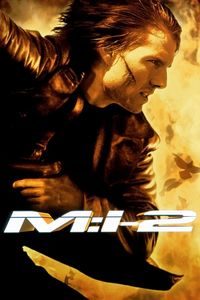
    (In theaters, May 2000) Frustrating because it is, at the same time, so bad and so good. The script is one of the sorriest excuse for an “action” film I’ve seen in a blockbuster for a long, long time. Say what you want about Armageddon, at least it had pacing on its side. Not so with Mission: Impossible 2: If the first fifteen minutes are pretty enjoyable, the following hour drags on like molasses, with a complete lack of any action. That dreadful hour is further drawn-out by nauseatingly trite dialogue, obvious “surprises” and bland scripting. But, forty-five minutes before the end, Ethan Hunt finally gets to act like the James-Bond clone he has so obviously become, and only then does Mission: Impossible 2 become a thrill ride. That’s when characters stop speaking and start shooting, all sumptuously directed by John Woo. Slow-Motion bullet ballet, a wonderful motorcycle chase worth the price of admission in itself and a superb hand-combat sequence complete the film. A shame you have to slog through so much… emptiness in order to get to it. Tom Cruise is irreproachable -as is Anthony Hopkins’ cameo- but the rest of the actors get short thrift and Thandie Newton’s character is atrociously written. So much good stuff, so much bad stuff… and Hollywood suddenly asks itself why we think its summer blockbusters suck.

  • Mission: Impossible (1996)

    Mission: Impossible (1996)

    (Second viewing, On TV, November 1998) Pure and complete nonsense, but intentionally so. Going from set-piece to set-piece, this thriller never pauses long enough to allow viewers to realize that what they’ve just seen is not complex, but senseless. Still, it might be foolishness, but director Brian De Palma has too much experience to let it be anything but good-looking foolishness. Tom Cruise makes a convincing action hero, and the superb action sequences are simply remarkable. (Even knowing where special effects were used didn’t diminish the enjoyment one bit) Disclosure: A previous viewing had prepared me to accept the lousy script and enjoy the good bits.