Tom Wolfe

  • The Right Stuff (1983)

    The Right Stuff (1983)

    (Second or third viewing, On DVD, September 2017) I’ve been on a semi-streak of American space program movies lately and revisiting The Right Stuff was practically mandatory as a bookend to Apollo 13. Adapting Tom Wolfe’s superlative docufiction book, writer/director Philip Kaufman’s film is epic in length (nearly three hours) and clearly in myth-making mode as it draws a line leading from cowboys to astronauts by way of test pilots. It’s a long sit, but it’s filled with great moments, enlivened by a surprising amount of humour and a joy to watch from beginning to end. It helps that it can depend on great performances, whether it’s Ed Harris as a clean-cut John Glenn to Fred Ward as Gus Grissom, among many other known actors in small roles. It’s an astonishing ensemble cast for a wide-spectrum film, though, and it manages to compress quite a bit of material in even its unusually long running time. As a homage to the space program, it remains a point of reference—even the special effects are still credible. Despite a generous amount of dramatic licence (including the infamous Liberty Bell 7 incident, now thoroughly debunked thanks to the 1999 recovery of the capsule), the film seems generally well regarded when it comes to historical accuracy. From our perspective, it credibly humanizes yet mythologizes the test pilots who were crazy enough to go atop rockets when they were known to explode shortly after launch. It’s a stirring bit of filmmaking for viewers with a fascination for technological topics and the history of spaceflight, and it has aged rather gracefully. I loved the movie when I first saw it (in French, on regular TV interspaced between ads) and I still love it now. As suggested above, The Right Stuff is an essential double feature with Apollo 13, and both movies even feature Ed Harris in pivotal roles.

  • Genius (2016)

    Genius (2016)

    (Video on Demand, February 2016) Even by the standards of Oscar-baiting historical docu-fiction, Genius seems tame and detached. It’s a problem that can’t be blamed on the actors—Colin Firth is good as legendary editor Max Perkins, while Jude Law is suitably unhinged as Tom Wolfe. Nicole Kidman is more disappointing as Wolfe’s one-time wife, but it’s not much of a role—and she gets to point a gun at the protagonist in the film’s most incongruous scene. The plot loosely talks about the working collaboration and tortuous friendship between Perkins and Wolfe over a period of a decade (two years go by in a blink during a montage) as they argue about Wolfe’s novels and the writer’s mercurial personality eventually leads him to paranoia. All well and good; as someone who’s fond of movies about writers; I particularly appreciated the editing humour and portrait of books as works to be rewritten rather than completed once THE END is first typed. Still, I could help but find the film long and meandering. Viewers may struggle to remain interested, and the film doesn’t help by taking occasional lengthy breaks in plotting. While well shot, with a convincing recreation of 1920s New York, Genius is a disappointment considering its source material. I’m glad it exists (what are the odds of seeing another major movie featuring a book editor as a hero?), but it could and should have been better.

  • The Bonfire Of The Vanities (1990)

    The Bonfire Of The Vanities (1990)

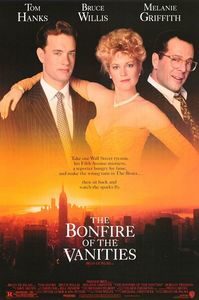
    (On DVD, October 2008) This movie was critically lambasted upon release, but if it’s not quite a success, it’s not the disaster that some reviewers have reported. As an adaptation of Tom Wolfe’s novel, it manages to hit most of the high points of the novel, and if Wolfe’s prose can’t be fully adapted to the screen, it finds an appropriate counterpart in Brian de Palma’s swooping direction and ambitious cinematography. The long continuous opening shot is a small marvel of the form, while other sporadic flourishes keep things hopping along. Things aren’t as slick regarding the script, which does an intriguing job re-casting Wolfe’s story into a satiric comedy mold, but falters in the film’s second half with a number of limp scenes that don’t advance the story as efficiently as they should. It’s too bad that the manic quality of the original is only half-finished here. The result isn’t terrible, but it certainly could have been better. The first-generation DVD, regrettably, doesn’t include any supplementary material about the film, which is a shame given that an entire book has been written about the film’s troubled production.

    (Second viewing, On Cable TV, August 2021) After enjoying TCM’s podcast adaptation/update of Julie Solomon’s The Devil’s Candy, which offers four hours of material on the making of The Bonfire of the Vanities, the mandatory next step was to watch the film itself. (Actually, I watched it between the sixth and seventh episode – the best possible timing considering that the seventh episode opens on the first public showing of the film.)  Once again, a rewatch had me protesting that the result wasn’t that bad, even enjoyable. Oh, it’s clear that as a film, The Bonfire of Vanities falls considerably short of its potential. The dark cynical humour is mishandled and neutered by a final speech that shouldn’t be in the film. It’s miscast from top to bottom – Tom Hanks is not bad in the last third of the film when he’s free to play up his comic persona, but he’s really not the right choice for playing a high-powered adulterous stockbroker. Melanie Griffith has never been much of a draw for me, so her casting as an irresistible femme fatale is wasted. Morgan Freeman’s not bad, even when saddled with the film’s most awkward dialogue. Surprisingly, I found Bruce Willis to be the most watchable, but only when he fully plays into the quasi-noir role of the crumpled journalist working hard for his bylines. (This is not, however, the character in the book.)  Visually, the film is far better than its script – The first ten minutes overpromise a film that’s not to be found later on, as a magnificent overhead shot of New York City leads to an astonishing steady-cam shot and then to the memorable image of Tom Hanks dragging his dog off to a sodden walk (and a misguided phone call that triggers everything that follows). Narratively, you have enough to keep viewers invested, but there is often a clash between the original intentions of author Tom Wolfe and the neutered execution that Brian de Palma ends up delivering. Part of it is clearly due to an attempt at mainstream filmmaking – I don’t think that major studios were ready back in 1990 to bet the bank on a highly cynical work, at least not as much as today. You can see the compromises all the way through, even as the atmosphere of a New York City divided along racial and class lines is still quite pertinent as long as you ignore the Bronx caricatures. It’s frequently (but intermittently) funny, at least enough to keep the film from being dull. I strongly suspect that The Bonfire of Vanities’ reputation partially comes from overinflated expectations considering the success of the original book, partially because entertainment pundits were (and are) always looking for a fall-from grace story from Hollywood, and partially because the gap between that the film aimed for and what it achieved is so visible. As someone who routinely watches near-unwatchable cinematic tripe made with only a fraction of The Bonfire of Vanities’ assembled talents, the circa-1990 hyperbolic pans of the film are embarrassing for those taking the potshots: The Bonfire of the Vanities is misguided, disappointing, even a case study in how even the best intentions can go wrong in such a complicated production as a Hollywood film, but there’s more than enough here to make viewers happy – even its problems can be entertaining once you get into them.

  • The Bonfire of the Vanities, Tom Wolfe

    The Bonfire of the Vanities, Tom Wolfe

    Bantam, 1987, 690 pages, C$6.95 mmpb, ISBN 0-553-27597-6

    I’m not sure what makes a middle-brow classic, but I think that The Bonfire of the Vanities qualifies on most counts. Let’s see: it was widely-reviewed, sold really well, was adapted in a big-budget Hollywood movie (which tanked spectacularly, forever earning another place in history) and has earned 155 amazon reviews so far, which it pretty darn good for a book published ten years before the whole Internet thing took off. Better yet: Tom Wolfe is still writing and commanding attention today, lending further heft to the importance of his first novel.

    The assignment, should we choose to admit it, is to read 1987’s The Bonfire of Vanities and see how well it holds up today. Once the novel has moved from contemporary headlines to historical context, does it retain the energy of the period, or does it fade away in irrelevance?

    The Bonfire of the Vanities certainly feels like it couldn’t exist anywhere but in mid-eighties New York. A pre-Guliani New York riddled with crime and racial tension, home to the poorest and the richest, playground of the self-styled “Masters of the Universe” ruling over Wall Street and, by extension, the rest of the world. Sherman McCoy is one of those men to whom everything is owed: He can make multi-million commissions by moving around billions of dollars in government bonds, eking out massive profits from razor-thin percentage fractions. He lives in a multi-million-dollars apartment that he can barely affords, owns the requisite Mercedes and has a just-as-requisite affair with another married woman. But a late-night tryst turns sour as he makes a wrong turn in the Bronx and his car ends up hitting a young black man. Outraged media reports quickly lead to an investigation and a very public trial of Sherman’s entire life. In the process, we get to study New York society in action, as Sherman becomes the focus of the media, is thrown to the wolves by his former acquaintances, tries to salvage his honor and loses everything along the way. Right, wrong, fair or unfair become distant considerations in the face of a hefty look at that society at that time.

    But beyond a modest crime story anchoring a rich study of characters in distress, The Bonfire of the Vanities is written with self-conscious verve. Passages are written in quasi stream-of-consciousness style, allow us inside the confused minds of the characters. Sherman is quickly exposed as an insecure man barely holding on to his social position. His latter passage through the New York prison system is as harrowing a sequence as anything written in a suspense novel. As flawed as he is, Sherman almost looks like a hero compared to the venal and petty characters that surround him.

    The novel is filled with terrific set-pieces, lucid explanations of the way things really work, from the stockbroking room to the justice system or the complexities of upper-society New York. Tom Wolfe may be a media-friendly self-promoter, but there’s a real interest in his prose, even when it becomes flashy and self-indulgent to the detriment of storytelling. It succeeds where other writers would fail miserably, and remains interesting even when it loses its way.

    So, yes, The Bonfire of the Vanities is still worth a read even today. It’s a terrific throwback to another era, and a novel that manages to combine ambitious literary goals with a clear and intriguing storyline. The set-pieces are terrific, and the prose is unique. Ah, if all mainstream fiction was just as good, I may never need to read genre fiction again…

    [October 2008: Amusingly, I ended up reading The Bonfire of the Vanities at the beginning of the Credit Crisis of 2008, a time where Wall Street finance salesmen ended up in the news again. Strikingly, a good number of the articles and news reports discussing the crisis (nearly 2000 as I trawl news.google.com in mid-October) referred to the brokers as “Masters of the Universe”, the expression coined by Wolfe in the novel. Now if that’s not a proof of an enduring classic, I’m not sure what is…]