Tommy Dorsey

  • Girl Crazy (1943)

    (On Cable TV, August 2021) As much as we profess to dislike film formulas, they exist because they work. Once you’ve found something that works, why bother changing it? Of course, staleness is the constant danger, and there can be a time where the most entertaining thing about a film series is the way it keeps reworking core concepts in ever-wilder situations. Girl Crazy is the ninth and last film to co-star Judy Garland and Mickey Rooney, and the amazing thing about it is how, despite taking its actors to an isolated western ranch campus in twentysomething roles, it still manages to cram in the “let’s put on a show to save the orphanage!” plot of most of their earlier small-town backyard movies. It’s quite impressive in a way… and it comes later enough in the film that we’ve had a fill of new stuff to tide us over. As is often the case, this is a film of moments and musical pieces rather than a sustained narrative — adapted from a Broadway musical, it does have a few snappy numbers and the presence of Tommy Dorsey’s orchestra — “Treat me Rough,” “Fascinating Rhythm” and “I Got Rhythm” are notable standouts, with that last number being a typical Berkeley Busby spectacle before he was replaced as a director by more mild-mannered Norman Taurog. Style and setting of the film bring to mind an appropriate double-billing with Too Many Girls. Girl Crazy is not that good of a musical, but it’s watchable and arguably more interesting than many of the Garland/Rooney films in which the backyard premise was repeated too often without variation even as they were growing older.
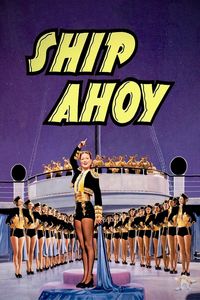
  • Ship Ahoy (1942)

    Ship Ahoy (1942)

    (On Cable TV, January 2021) The combination of Eleanor Powell’s tap-dancing talents and Red Skelton’s rubber-faced comedy must have been an irresistible commercial prospect in the early 1940s, and Ship Ahoy mostly delivers on that promise, with a few extras on top. The best of those, to me, has to be Virginia O’Brien in a strong supporting comic role, her deadpan singing being limited to one sequence. (But what a sequence: A romantic ditty first performed straight by a young Frank Sinatra, reprised with heartfelt romantic humour by Skelton, and then mercilessly skewed by O’Brien’s usual flat singing and sarcastic interjections: “Wow!”)  Surprisingly enough, Skelton keeps a lid on his worst tendencies, even conforming to the demands of a romantic lead role (as a hypochondriac writer) rather than overindulge in comic showboating. The plot itself gets ingenious at times, with Powell’s character being duped into taking a piece of high technology out of the mainland states to the benefit of foreigners, being kidnapped, then alerting US agents by tap-dancing Morse code. One more highlight is a substantial performance by legendary big-band leader Tommy Dorsey and his orchestra as the source of many of the film’s musical numbers. While I’ll agree with those who point out that Ship Ahoy is a lesser effort than the second Powell/Skelton collaboration I Dood It (a Skelton catchphrase that you can hear as a line of dialogue here), there are enough bits and pieces here and there to make it great fun to watch—I never get enough of O’Brien anyway, and this film does let her do more than just a novelty song.