Tony Randall

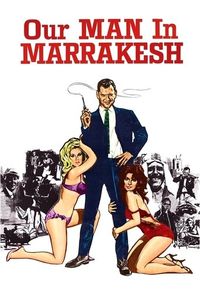
  • Our Man in Marrakesh aka Bang! Bang! You’re Dead! (1966)

    Our Man in Marrakesh aka Bang! Bang! You’re Dead! (1966)

    (On Cable TV, September 2021) James Bond derivatives were hot properties during the 1960s — as other studios tried to match the debonair secret agent, they went for imitations, comedic takes, parodies and outright Bondsploitation. The complement of that was the kind of thriller (often tragic) about innocent men abroad getting caught up in intrigue and discovering substantial inner strength. Our Man in Marrakesh stars Tony Randall playing slightly against type as an ordinary tourist getting caught up in a spy operation in (where else?) Marrakesh. Executed with a slightly comic tone that avoids veering into parody, the film is clearly meant for mass-market fun rather than moral lessons, and so we get the usual overlapping plots, romantic interest, action sequences and other standard components of the genre. Rather good Moroccan scenery is defeated by the not-so-good image quality of the version I saw. Surprising character actors fill up the cast, going all the way from the blonde menace of Klaus Kinski to the joviality of Terry-Thomas. I suspect that the film isn’t as remarkable today given decades of variations on similar approaches, but it does offer a touch of 1960s exoticism, Randall in fine form and enough adventure plotting to keep you busy until the end credits.

  • The Mating Game (1959)

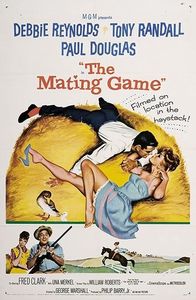
    The Mating Game (1959)

    (On Cable TV, September 2021) We don’t usually think of IRS agents as potential leads for romantic comedies, but if there was one actor who could make it work, it was Tony Randall — his strait-laced buttoned-down comic person being ideal for the role he was meant to play in The Mating Game. Here, he finds himself as an accountant sent on the farm of a man who’s never paid income taxes — and, worse, barters for everything he needs. Stuck there to assess how many back-taxes are owed, he can’t help but notice the farmer’s daughter, played by Debbie Reynolds… and there’s the rest of the movie, along with a few tax code shenanigans for comedy. (Yes, really.)  As far as 1950s MGM romantic comedies go, The Mating Game is fine without being particularly great. The rural environment is a change of pace, and the tax comedy angle remains distinctive, but the film seems stuck in this strange zone between a musical and a true comedy: Without songs nor strong jokes, it just comes across as middling. It’s amiable, with Randall and Reynolds being put to good use, but The Mating Game doesn’t get to the next level, where it would be genuinely funny.

  • The Alphabet Murders (1965)

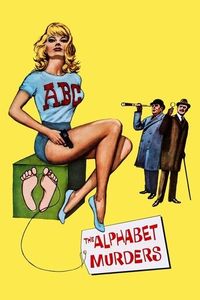
    The Alphabet Murders (1965)

    (On Cable TV, September 2021) Tony Randall is best remembered for strait-laced comedic foil roles, but as a leading man he could (and did) break out of that persona in various ways. 7 Faces of Dr. Lao is a case in point, but there’s a similar case to be made about The Alphabet Murders, which stars Randall in an overtly parodic take on Hercules Poirot, spouting bon mots and doing a bit of slapstick in service of a comedy that stops just short of cartoonish gags. Loosely adapted from Agatha Christie (who reportedly had issues with early version of the script), it transforms Poirot into a brilliant bumbler à la Clouzot, which was a hot property at the time. Randall’s French accent is far more tolerable, though. What’s more hit-and-miss is the comedy: It starts firmly in metafictional territory with Tony Randall introducing himself to the camera as Poirot, but the rest of the film is more hit-or-miss, sometime absurd and sometimes not. Director Frank Tashlin (who also led Randall in the much funnier Will Success Spoil Rock Hunter?) does try his best to keep things interesting, but he can’t quite patch up a lacklustre script. I’m not sure Randall’s the best choice either — he does better than you could expect from many of his other films, but to be blunt about it, Peter Ustinov was almost funnier than Randall in his turn in Murder on the Orient Express. Still, The Alphabet Murders isn’t a bad watch, especially for murder mystery fans… even if it doesn’t quite nail the absurdity of what could have been.

  • The Brass Bottle (1964)

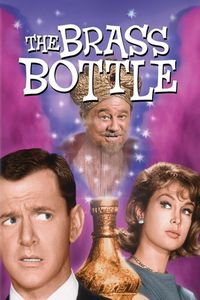
    The Brass Bottle (1964)

    (On TV, May 2021) I’ve arguably seen the best of the 1960s comedies, so now I’m watching the rest—and there’s plenty to like in the lesser-known movies that amused people at the time. They’re less polished, feature lesser-known actors, strike one-note premises until we’re wrung out and often display jaw-dropping attitudes, but they’re meant to entertain and some of the gags still land. In The Brass Bottle, troubles begin for an architect when he takes possession of an ancient bottle that contains… a genie. A genie who’s curious to understand the world after hundreds of years of solitude, very eager to help his master, not constrained by any law or science, and certainly not limited to a mere three wishes. Seeing Barbara Eden in a supporting role may have you reaching for the nearest I Dream of Jeannie summary and yes: Both works are adapted from the same novel, and it was Eden who played Jeannie in the TV show. But even with those common strands, The Brass Bottle stands as a distinct film. For one thing, the casting is really good: Tony Randall gets a leading role as the architect, the genie is played by a terrific Burl Ives (who reliably steals every film I’ve seen him in) and the beautiful Kamala Devi gets an amusing supporting role as another genie eager to please (but too summarily dismissed from the film). Much of the film’s comedy comes from confronting the unlimited powers of the genie with the moral reservations of the architect, and the very practical consideration in having a magic-using genie in the very rational world of the 1960s. Our genie eventually settles for residential development and stock market investing—to give you an idea of the film’s tone. But then the real world comes knocking, leading us to a cheat of an ending far too close to “it was a dream.”  Still, The Brass Bottle is not meant to be a particularly sophisticated film—I mean, the sequence with the donkey is ridiculous enough on its own—but it still has a few chuckles in the tank, and a rather amusing portrayal of a world fifty years gone.

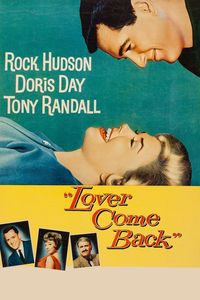
  • Lover Come Back (1961)

    Lover Come Back (1961)

    (On Cable TV, January 2021) For such an iconic screen couple, it’s interesting to realize that Doris Day and Rock Hudson only played in three movies together. As luck and DVR scheduling would have it, I ended up seeing all three in a matter of months, with Lover Come Back being the middle instalment sandwiched between Pillow Talk (1959) and Send Me No Flower (1964). All three films feature Tony Randall in a supporting role, mismatched personalities and plenty of lies, deceptions and dirty tricks to keep things interesting until the big romantic finale. In Lover Come Back, we see both of them as competing advertising executives—she’s a workhorse, whereas he’s a showman with dodgy morals. When the conflict between them escalates, he dons a beard and glasses and (of course!) passes himself as someone else, a member of an illustrious family whose achievements grow ever more numerous and outlandish the longer he talks. It’s really not meant to be serious at all—it’s absurd, funny and naughty in the way the most progressive comedies of the early 1960s could be (which is to say rather charmingly coy by today’s standards). There are plenty of good jokes and funny moments, most notably in seeing Hudson and Randall go to Canada to face off with a moose and grow big beards. You can have objections to how Hudson deceives his way into a romantic relationship but (deep breath) those were the things that were funny at the time—but don’t spend too much time on the rather offensive ending, which should have been rewritten on the spot. Despite this noticeable problem offered as part of a conclusion, Lover Come Back is still fun, especially when it goes on a satirical riff about the advertising industry or goes through the execution of its carefully crafted comic set pieces. I still prefer Pillow Talk, but Lover Come Back has its moments—as long as you don’t think too much about its other moments.

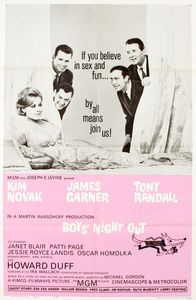
  • Boys’ Night Out (1962)

    Boys’ Night Out (1962)

    (On Cable TV, January 2021) What I like about 1960s sex comedies is the very specific tone that they have, sufficiently freed from the Hays Code to tackle more salacious topics such as the ongoing sexual revolution, but still unwilling to be vulgar about it—it’s naughty without being upsetting and while I wouldn’t want to see that tone everywhere, it’s a welcome change of pace. The premise of Boys’ Night Out is simple, what with four men pooling their money to rent an apartment in Manhattan. If you want to compare eras and tone, keep in mind that there’s a 2014 “erotic thriller” called The Loft (itself a remake of a 2008 Dutch film) that shares that exact same premise—but the later R-rated film goes all-in on graphic content and murder. Boys’ Night Out is arguably funnier to modern-day audiences, as we can clearly picture where the film could but chooses not to go—because while our four men (three married, one divorced) may tell the others that they’re in for the young blonde “housekeeper” inhabiting the apartment, things are very different (and much funnier) once the married men get their night out: One simply wants to eat more than the health food prepared by his wife; another wants to talk without constantly being interrupted; the third simply wants to repair things around the apartment. Meanwhile, our divorced protagonist (the very likable James Garner) falls for the housekeeper and gets jealous of the achievements made up by his three friends. It’s all slightly naughty but not really, and the film does hit a good rhythm during its second third, especially when the “housekeeper” is revealed to be doing field research on a sociology thesis exemplified by the three married men. Boys’ Night Out offers a comic take on the Mad Men-ish era of henpecked husbands living the commuter train lifestyle, blunt gendered stereotypes and all. It does become less effective during its third act, as the comedy wears out while the film desperately tries to wrap up everything in a way that leaves everyone happy, wives included—the pace slows down considerably, and by the time the last fifteen minutes roll by, there aren’t any surprises left—just a drawn-out execution of something entirely predictable. Tighten that third act and it would be a much better film—but it serves well as a time capsule comedy, as a showcase for Kim Novak playing broad comedy, or another very similar film featuring Tony Randall in a very familiar role. Boys’ Night Out is fun and practically plays as family-friendly entertainment despite the subject matter, so innocuous is it in presenting its then-risqué subject matter.

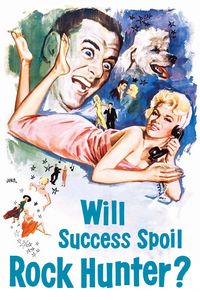
  • Will Success Spoil Rock Hunter? (1957)

    Will Success Spoil Rock Hunter? (1957)

    (On TV, July 2020) We often think of 1950s America as this unthinking haven of conformity, and that is nonsense—people back there were as smart as today, as skeptical as today, and as intent on satirizing the excesses of the day. From the get-go, with a scene in which Tony Randall addresses the audience and introduces the film (after a commercial break), Will Success Spoil Rock Hunter? is meant to be a satire of everything bothering the screenwriters about the then-modern era, and most specifically the burgeoning advertising industry. Midway through the film, it even stops its story for another interjection directly from Randall to the audience, this time lampooning the way audiences were increasingly turning to TV rather than the movies. It also, significantly, takes aim at materialism and corporate success at a time when such values were more likely to be championed, in Hollywood or elsewhere. As a social satire, Will Success Spoil Rock Hunter? is often hilarious—although some of the references can need a handbook of the era to be understandable—I mean, it’s amusing to have a character read Peyton Place in the bathroom, or see Groucho Marx in a long-awaited cameo. Randall is quite good as the lead, although the film is perhaps equally notable for being Jayne Mansfield’s definitive film, and showcasing why she was such a bombshell (even though her appeal may not be as obvious if you’re not into vapidly-portrayed blondes à la Monroe). Seeing an older Joan Blondell in a supporting role is one of those jokes you may need a handbook for. Still, the film remains quite funny—lines like “I’ll be a writer’s subplot!” have a lovely metatextual quality decades before spoof comedies. They help the film feel substantially more modern than it is—even Frank Tashlin’s direction gets into it with imaginary sequences that weren’t the norm at the time. Will Success Spoil Rock Hunter? does suffer a bit from a lack of a clear climax, and a rather flat ending, although some of it does play into the film’s comedy. It’s an utterly fascinating film for those who would like another look at the 1950s—I put it up there with A Face in the Crowd and Sweet Smell of Success (both also from 1957, as is Silk Stockings and its “Stereophonic Sound” rant-number) as an informal cynical trilogy showing that some people in the 1950s knew exactly what the decade was about.

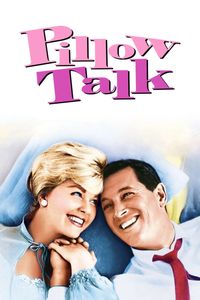
  • Pillow Talk (1959)

    Pillow Talk (1959)

    (On Cable TV, May 2020) Doris Day may now be known better for her late-career chaste and demure roles, but she was a feminist icon in many of her earlier movies—independent, feisty, with a good job, and not willing to compromise on her choices of romantic partners. Pillow Talk is somewhere between those poles, but closer to the female-empowerment side. Naughty then but almost wholesome now, it’s the story of a Manhattan career girl who falls in love with a fellow user of a telephone party line—an early precursor to the gentle sex comedies of the early 1960s. (If you liked Mad Men, there’s a bit of this in here.) The technological limitations of a party line clearly date this, but the Oscar-winning script remains compelling, with plenty of well-used voiceovers reinforcing the comedy of the plot. Pillow Talk’s biggest assets remain its lead actors, with Doris Day and Rock Hudson sharing the screen for the first of three times (you’ll understand why the fuss after watching the film), and supported by notables such as Thelma Ritter (nominated for an Academy Award) and Tony Randall in a very Tony Randallish role. Perry Blackwell is also a bit of a highlight as a sassy lounge singer. Pillow Talk also works well as a glorious Eastmancolor time capsule through comfortable-class late-1950s Manhattan apartments, with three-way split screens to further enliven things. There’s some uncomfortable irony in having Hudson’s character insinuate (with malice) that someone else is gay. Other than this slip-up, Pillow Talk is quite entertaining and its familiarity with various tropes certainly helps spruce things up. Meanwhile, Day gets a bit of a glow-up over previous roles and makes it work to her advantage.

  • 7 Faces of Dr. Lao (1964)

    7 Faces of Dr. Lao (1964)

    (On Cable TV, May 2020) Producer George Pal specialized in big special-effects heavy spectacles, and that’s how we ended up with SF classics such as Destination Moon, The War of the Worlds and The Time Machine. It’s also how we got the much stranger piece of western fantasy 7 Faces of Dr. Lao—and I here mean “western” as in “American west,” considering that the plot of the film gets started once the titular Dr. Lao stops by an Arizona town as it awaits the construction of a railroad. Lao isn’t a medical doctor—he’s a seven-thousand-year-old magician from the mysterious Orient (but played by Tony Randall under layers of makeup) with seven alter egos. All of them will be useful to untangle the romantic and financial complexity of the small town. Adapted from a fantasy novel by Charles G. Finney, 7 Faces of Dr. Lao ends up being another ideal special-effects showcase for Pal’s mixture of practical effects, heavy makeup, stop-motion animation and other visual effects tricks. Both the best and the worst thing about the film is that it’s almost chaotic in going from one special effect sequence to another. It’s definitely weird by the standards of Hollywood cinema at the time, and it clearly hasn’t aged particularly well in a CGI era. One can imagine 1964 audiences being wowed by the effects, although nowadays they’re often more grotesque than anything else. Randall is problematically cast as the Asian Dr. Lao but throws himself entirely in the seven (ish) roles required by the script. There’s something to be said about a “man comes into town” story in which said man isn’t a gunslinger but a magician with near-infinite wisdom. Sometimes, weird is a virtue in itself when it comes to Hollywood.

    (Second Viewing, On Cable TV, November 2020) Director-producer George Pal was always about spectacle, and it’s not because 7 Faces of Dr. Lao constrains itself to a small wild west town that it’s any less intent on wowing the rubes than Pal’s other more outlandish movies. Here, we have a one-man travelling circus rolling into town, what with a mysterious and desperately stereotyped Dr. Lao promising untold wonders to the local newspaperman while taking notes on the local controversy. It feels like small potatoes compared to the time-travelling, world-altering, lost-continent-sinking scope of previous Pal movies, but the draw here is still on the special effects as the circus springs up and multiple special effects are presented in episodic segments. Tony Randall is arguably the film’s central special effect, as he plays more than a handful of roles under heavy makeup. The film plays off spooky circus tropes, with a heavy dose of now-uncomfortable ethnic clichés. The result may be worth a look for visual purposes (it did well in Academy Award technical categories), but as an overall film or story, it’s scattered, offensive, dull and overdone in rapid intervals. 7 Faces of Dr. Lao is interesting because of its uneven tone and its special effects, but I will stop short of a recommendation.