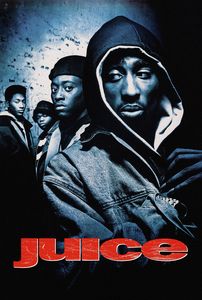
Tupac Shakur

  • Juice (1992)

    Juice (1992)

    (On TV, August 2020) The early 1990s were a great period for black crime dramas featuring teenagers stuck in proto-criminal lifestyles, and Juice is another fine example of the form. Set in New York City rather than the more common Los Angeles, it follows four young men as their lives become more dangerous than they expected. Petty shoplifting eventually leads to death, and it takes a lot to break out of the cycle. What sets Juice apart, at least for me, is the quality of the turntablism rap soundtrack. The other highlight is the cast – one of Tupac Shakur’s only roles is here, as well as early supporting turns for Queen Latifah and Samuel L. Jackson. Otherwise, the film does feel like many of its similar contemporaries – which is not a bad thing considering that I rather like the genre, but it might have been a good idea to space out its viewing a little bit farther away from previous similar movies.

  • Poetic Justice (1993)

    Poetic Justice (1993)

    (On Cable TV, March 2015)  For a concentrated dose of nineties ghetto-Los Angeles atmosphere, Poetic Justice is a blast from the past.  Starring none other than Janet Jackson (in an iconic performance) and Tupac Shakur (in a pretty good dramatic role), Poetic Justice plays with an unusual structure that marries ghetto drama with a road trip from Los Angeles to Oakland with numerous episodes along the way.  There’s a blend of genres and influences that’s hard to describe as romance clashes with comedy (the drive-in film excerpt is hilarious) and straight-up drama.  Writer/director John Singleton has made an unusual film here, and it’s that lack of formula that makes it work even more than twenty years later.  Part of the film’s eccentricity can be found in the small role given to Maya Angelou (whose poetry makes up a chunk of the film’s narration), but also in an unusually romantic role given to Shakur, who more than honorably performs.  The ending could have been a bit stronger, and more continuity in the episodes would have been appreciated, but this is definitely what Singleton wanted to show on-screen, and the off-beat nature of the result speaks for itself.