Vanessa Kirby

  • Pieces of a Woman (2020)

    Pieces of a Woman (2020)

    (Netflix Streaming, November 2021) Aaand this year’s entry in the “heartbreaking downer drama that lets actors act and earn Oscar nominations” is the very Manchester-by-the-Sea-ish Pieces of a Woman, which wows viewers with a single uninterrupted take of pregnancy, delivery and newborn mortality and then spends an hour wallowing in the ensuing grief. But is grief the right word, given that the lead character seems to keep her head while others lose theirs? Shot in sparse Montréal winter tones (passing itself off as Boston), Pieces of a Woman is a kind of low-key drama meant to solicit awards and critical attention, while leaving larger audiences to decide if that’s the kind of film that they really want to see. Nearly every actor does their best in navigating this nuanced drama, from Shia Labeouf’s take on a blue-collar bridge worker who can’t deal with losing his child, to Vanessa Kirby’s gradual acceptance of the situation, to Ellen Burstyn’s near-villainous take on a controlling mother. Kirby is particularly interesting here, as she switches from attention-getting performances in crowd-pleasing action blockbusters (Mission Impossible 6, Hobbs and Shaw) to the kinds of dramatic roles that lead to more than a flash-in-the-pan career. For cinephiles, the big draw here is the sustained drama of the childbirth scene that runs over 24 minutes of a single uninterrupted, very emotionally challenging take: a showy bravura showcase, but nonetheless an effective one. The rest of the film is far more conventional and even familiar: films about living in the shadow of a profound loss tend to run against the same lines, and while the lead character’s ability to move past at a faster pace than people around her is interesting, it’s still very much of the same tone as similar films. Pieces of a Woman is obviously the furthest away from an uplifting film as it’s possible to be (although the ending is thankfully not as bleak as it could have been), and not the kind of film that can be seen by anyone at any time.

  • The World to Come (2020)

    The World to Come (2020)

    (On Cable TV, August 2021) It would be fun to claim that I went in The World to Come completely ignorant of its nature, expecting a Science Fiction film along the lines of the classic Things to Come. But that would be a lie — I knew exactly what kind of film The World to Come would be because it’s not subtle about it. From the premise, poster and first few minutes, there’s no doubt about its nature: a “forbidden period romance” (i.e.: non-heterosexual romance in intolerant times) almost too eager to revel in the misery of its characters. Nothing that follows is surprising. Our narrating heroine is a young woman out of place and out of time: She’s living in a hardscrabble rural area of 19th century America, with her husband toiling the land as she keeps (pick one at random and repeat:) grieving her dead daughter; rebuffing her husband’s advances; bemoaning being stuck in the middle of nowhere; craving the companionship of equals; writing in her diary. You know — exactly like a twenty-first century urban lesbian would act in the same situation. But then, at long last in-between the deliberately spirit-killing scenes of rural farming, comes a new fiery-headed neighbour. This is followed by more waiting, as we wait for the same-sex relationship to blossom into a full-fledged love affair. (All during which the husband keeps toiling the land.)  Further playing along expected lines, our newcomer’s husband is clearly abusive and we all know what that means. Which the film obligingly follows. The ending was foretold from the start — especially considering the heavy-handed message of how unhappy the female leads are supposed to be except when each other. My sarcasm is puerile but not surprising: “forbidden period romances” are the new hotness in independent film and while I liked The Favourite, I’ve also seen Lady on Fire and a few others and can’t really muster up any more interest for a film whose main points have been done better elsewhere. You may be surprised, after the above, to hear that I did like some aspects of The World to Come: Vanessa Kirby is terrific as the object of fulfillment and desire, and she looks amazing in symbolic red curls. I’ve been wondering for a while if she’s about to become The Next Big Thing, and this is the kind of performance that nicely counterbalances a few striking turns in big-budget action films. I have some sympathy for the poor dumb hard-working farmer played by Casey Affleck, doomed to a perpetually unhappy wife/life and yet helping her out to get to the end of her journey. The cinematography is not enjoyable in its depiction of hardscrabble frontier living, but it is remarkably convincing. Despite being the furthest thing from The World to Come’s intended target audience, I still went into the film hoping that something would hook me. The result is not satisfying — sure, some fine acting and cinematography, but the rest is often obnoxious in its insistence on repeating an increasingly clichéd formula as if it was brand new. Given so, I’ll have a rewatch of The Favourite before I touch this one again.

  • Fast & Furious Presents: Hobbs & Shaw (2019)

    Fast & Furious Presents: Hobbs & Shaw (2019)

    (In Theatres, August 2019) The origin story of Fast & Furious Presents: Hobbs & Shaw sounds like a case study for an ambitious Hollywood studio executive: what if the two biggest stars of your biggest moneymaking franchise start squabbling badly enough that it makes headlines? The obvious answer is to spin off another series to specifically showcase one of the squabbling stars and hope that the box-office keeps churning in. So it is that there’s nary a Vin Diesel to be found in Hobbs & Shaw, as the film feels free to jettison much of the increasingly burdensome “Family” of the main series in favour of focusing on the antagonistic relationship between Agent Hobbs (Dwayne Johnson) and reformed terrorist Shaw (Jason Statham). This spinoff clearly takes bold leap into science fiction as the antagonist is a cyber-enhanced “Black Superman” as played by the always-incredible Idris Elba. But that’s not the least credible aspect of a film that has its protagonists escape a falling smokestack, pull a flying helicopter by their arm muscles or run down the side of a skyscraper. No, believability and physics aren’t the strong suit of Hobbs & Shaw—in keeping with the original series, this is more about quick quips, demented action sequences, celebrity cameos (including a very funny Ryan Reynolds and an amused Helen Mirren) alongside an exaggerated sense of fun. It generally works—while elements of the third act feel like a step back from the calculated insanity of the previous action sequences, the film as a whole can depend on great lead action icons and a rather cute Vanessa Kirby building on the good reviews she received in Mission Impossible: Fallout. It’s not as good or as involving as much of the mainline series, but Hobbs & Shaw does the trick in between other instalments.

  • Mission: Impossible – Fallout (2018)

    Mission: Impossible – Fallout (2018)

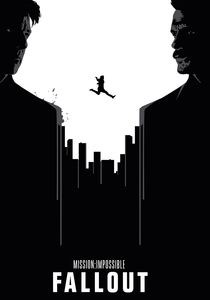
    (Netflix Streaming, May 2019) Enough information has emerged from Mission Impossible—Fallout’s chaotic production history (a 33-page outline in lieu of a script at the beginning of production, plot points being rewritten on the go to fit around the action sequences, Tom Cruise breaking his ankle on-screen and delaying production by nine weeks, three significant action sequences seen in trailers but cut from the film…) to make us aghast that this is what modern blockbuster production has turned into. But it’s hard to argue when the result is so successful. Building on top of great action sequences to deliver a fairly decent thriller with some surprising thematic depth, Fallout digs a bit deeper into the normally-ludicrous IMF mythology, brings back a surprising number of references to previous films in what had been up to now a very loosely connected series and builds upon the previous movie to provide the female characters with a greater role to play. Everyone’s getting older in this film (Tom Cruise in the first place, but also Ving Rhames and Simon Pegg) but the stunts are getting wilder and the plotting more convoluted. Alec Baldwin is a lot of fun to watch as a good guy, while series newcomer Henry Cavill does have a menacing presence and Vanessa Kirby makes a significant impression in a short role—beyond sheer looks, I suspect she has that elusive quality we’re looking for in a lasting star, but we’ll see what she can do next in Hobbs & Shaw. Still, this is Cruise’s show as he jumps, runs, shoots, dives and pilots a helicopter in a desperate chase as orchestrated by recurring writer-director Christopher McQuarrie. Much of Fallout’s fun is in the escalating action sequences that just keep going and going, their requirements driving the circumlocutions of the plot more than anything else. The Mission Impossible series has never been about real-world verisimilitude as much as audaciousness on how they play their ludicrous spy-thriller cards. Now that the series seems to be heading with a more tightly-plotted arc (using the terms as loosely as possible), it’s going to be interesting to see how long it can keep going: The series is still centred around the fifty-something Cruise, and while it now seems willing to keep bringing back its female characters for return engagements (Rebecca Ferguson and Michelle Monaghan here, so let’s hope for Thandie Newton and Maggie Q next) there’s an open question as to how much competition Cruise can tolerate in his own showcase series—we’ll note that neither Jeremy Renner nor Cavill are likely to be back for the next film. Still, the fact that we’re openly contemplating a seventh instalment is something of an achievement at a time when most series run out of steam at this point. If it’s going to be Tom Cruise’s playground, then let’s keep him playing.