Willem Defoe

  • At Eternity’s Gate (2018)

    (On Cable TV, July 2021) I’m frankly more annoyed than amazed about At Eternity’s Gate and its take on Vincent Van Gogh’s life. I can certainly recognize the irresistible impulse that led to the film being made — hard for Willem Defoe to resist playing the famously tortured painter, hard for Oscar Isaac and Mads Mikkelsen not to join the production, hard for writer-director Julian Schnabel not to get a chance to play with cinematography in the key of Van Gogh’s perception of the world. Alas, the result is not necessarily pleasant. I have mild issues about how the film puts forth a new theory about Van Gogh’s death (that it wasn’t suicide) — but then again, I’m wearying of seeing even artistic misinformation in movies. I eventually got over my dislike of the way the film handled English-speaking Van Gogh next to other French-speaking characters. (Van Vogh was Dutch, so it makes sense to have a language barrier there.)  I have much bigger issues with the way the film is directed, with a nausea-inducing handheld camera in nearly every single shot, and cinematography that sometimes goes for subjective perception effect. At some point, I just wanted the film to calm down for a few minutes and deliver something like a biopic before going on yet another shakycam flight of fancy. It doesn’t help, I suppose, that I have recent and favourable memories of Kirk Douglas as Van Gogh in Lust for Life — to the point where I was wondering why At Eternity’s Gate was even necessary. The one person I can’t fault is Defoe — he’s really not bad as Van Gogh, with his screen personas being unusually well-suited to eccentric roles like this one. Still, I grew more and more vexed at the film’s excesses and unnecessary deviations from a straight-ahead film. Dafoe’s performance is good enough that it did not need Schnabel’s added fillips.
  • The Lighthouse (2019)

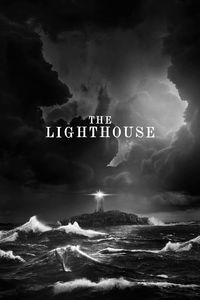
    The Lighthouse (2019)

    (Amazon Streaming, December 2020) I’m not necessarily unsympathetic to unusual cinema, but The Lighthouse clearly tested my patience through interminable lengths, sparse plotting, show-off atmosphere, uncertain genre affiliation and a downer ending. Granted, writer-director Robert Eggers has trained viewers to expect strange things from him with The Witch, and The Lighthouse is clearly in a similar genre: minimal cast, closed-off location, astonishing attention to period detail, and no happy ending in sight. Willem Defoe and Robert Pattinson star as two 1890s lighthouse keepers, isolated on an island off the coast of New England, whose rough-hewn camaraderie is tested by cabin fever, ominous portents, hallucinations and supernatural appearances. Or something like that: I use “supernatural appearances” as if this was a done deal when, in fact, this could all be a psychological drama. Naaah — movies are more fun when it’s supernatural, so supernatural is what we’ll call it. And trust me – you’ll need every bit of spare fun in order to make it through this intentionally interminable ordeal. Eggers seems intent on giving you the whole weeks-long experience, just so that you’ll sympathize with the character going stir-crazy. To be fair, Defoe and Pattinson are quite good in their roles (in fact, Defoe is absolutely terrific), their dialect is suitably thick, and the period atmosphere (even in a monochromatically shot hermetic universe like the lighthouse and its island) is so thick it’s almost oppressive. (The boxy aspect ratio certainly helps in creating confinement.) But in the end, and this despite a hefty dose of dark comedy, The Lighthouse leaves no bigger question than “So what?” Eggers clearly shot the film he wanted to, with scarcely any compromise to commercial appeal. I suppose that is something to be treasured in today’s cinematic hyper-financial obsession. But being weird and being worthwhile are not strictly aligned values. After seeing the extraordinary efforts made to make The Lighthouse off-beat and rebarbative, I’m just tempted to shrug and ask again – so what?

  • The Clearing (2004)

    The Clearing (2004)

    (In French, On Cable TV, September 2020) In between the dark scary forest of genre crime thrillers and the featureless plains of straightforward drama, there is a zone that is neither—a place where crime stories can be used to illustrate human concerns without necessarily becoming genre stories nor completely fall in the vast expanses of straight drama. The Clearing is in such a zone, as the kidnapping of a rich person becomes more of a dramatic vehicle for a good cast than a conventionally satisfying story. In this case, the cast is a trio of legends: Robert Redford plays the kidnapped, Willem Defoe the kidnapper and Helen Mirren the wife who must deliver the ransom. But writer-director-producer Pieter Jan Brugge (directing his first film after a long producing career) isn’t really aiming for a visceral thrill-a-minute kind of film. Instead, he spends his time ambling along with the characters, and even misdirects the audience’s attention to stretch the story for even longer than it is. The result of such shenanigans is not what he had hoped for: The Clearing, in the end, feels like a trick more than a movie. The misdirection hides an unsatisfying ending, and distances audiences from the characters. Neither ends up being a winning move considering the coldness of the film. Despite good work from the actors, The Clearing is not only a disappointment, but something that’s likely to fade away from memory far quicker than a conventionally entertaining genre piece would have.