William Castle

  • Bug (1975)

    (In French, On Cable TV, July 2021) The ghost of legendary writer-director-producer-huckster William Castle hovers cannily over 1975’s Bug — the final film he oversaw as a writer and producer, although directing duties fell to Jeannot Szwarc. The mercenary intent couldn’t be more obvious here, as the film is based on the fear of insects and does whatever it can to press that button over and over again. Fear of cockroaches? Not enough. How about fire-creating cockroaches unearthed from the underground thanks to an earthquake? No, better yet: By the time the film ends, we have sentient flying pyromaniac cockroaches! Thanks to the inches-big bugs playing the fire-starting roaches, the film is suitably gross (albeit not quite as much as Squirm) but there isn’t much more to it — the mad-scientist shtick is ridiculous, and the film doesn’t quite know what to do to take advantage of its own potential. It almost goes without saying that the whole killer-bug thing is badly handled and never believable, almost as if everyone involved in the film from Castle on down relied on the idea of bugs being scary and disgusting as being equivalent to doing the work in making them scary and disgusting. The paradox may be that however dull Bug is in execution, it’s still striking enough in bits and pieces and individual images (such as the woman set on fire in her kitchen) to be somewhat memorable even if the film itself isn’t so good. Why am I hearing a showman’s cackle from beyond the grave?
  • Mr. Sardonicus (1961)

    Mr. Sardonicus (1961)

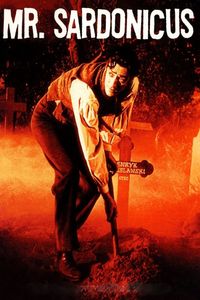
    (On TV, June 2021) Coming toward the middle of writer-director-producer William Castle’s better-known period as a horror film tycoon, Mr. Sardonicus is not usually recognized as one of his most famous films. But you can clearly recognize his huckster’s imprint on the material, from the film’s gimmick to his introduction to his gradual walking away from a familiar opening to something a bit weirder. Watching Castle in full frame introducing his own film, I suddenly started wondering how much inspiration he derived from Alfred Hitchcock as acknowledged auteur of his films — was he trying to make himself the trademark of his own films, spurred by Hitchcock’s own celebrity? No matter why — here he is setting the tone of the film, relishing the bloodthirstiness of his audience and clearly playing to those identifying with the macabre dark humour of the horror genre. The opening moments of the film have an over-familiar tone to them, aping Stoker’s Dracula as a young English doctor travels to mysterious rural East Europe and sets out to investigate a mysterious summons. But this isn’t about a vampire — it’s about a baron left disfigured in a horrible rictus after profaning his father’s grave. The supernatural is absent, leaving psychological foreboding in its stead. While the extended flashback is clunky in extending the film’s thin plot to a commercially viable length, Mr. Sardonicus does score a good shock in its revelation of the baron’s horrifying face — and preserves its effect by having the character wear a mask for most of the film. The film’s gimmick comes toward the end, as audiences are asked to “vote” on whether the grave-robber deserves further punishment: Castle comes back on screen as the film’s host, explains how to vote and pretends to count the votes while making comments to the theatrical audience. The outcome is predictably rigged in favour of more horror and punishment: After Castle commends his audience for its deviancy from the norm, how could it be otherwise? (Film historians agree that an alternate merciful ending was never filmed.)   As a horror film, Mr. Sardonicus is a curious thing — clearly patterned early on after Dracula, but swerving at the end of the first act, hobbled by an extended flashback that doesn’t do much to crank up the tension, then going into psychological drama territory for much of the third act. The ending gimmick does add interest, but it’s not in service of the film’s narrative — it’s another piece of evidence of Castle’s showman instincts and the fourth-wall-breaking lengths to which he could go to play with an audience expecting such antics. I liked it well enough, but then again, I’m more curious about Castle’s gimmicks and persona-grooming than the films themselves. At least Mr. Sardonicus holds attention — not always consistently nor all that well, but even more so than many comparable films.

  • The Old Dark House (1963)

    The Old Dark House (1963)

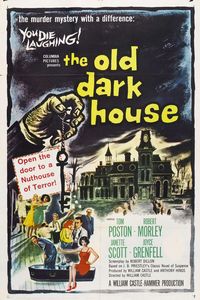
    (On Cable TV, June 2021) I don’t think that The Old Dark House is a perfect representation of the stiff-lipped macabre British black comedy, but it’s certainly a fine example of it. Adapted from a 1932 film I’m now curious to see, it’s an unusual collaboration between American director William Castle and the British production company Hammer films. As such, it does have an unusual tone — halfway between the showy flourishes of Castle’s other productions and the restraint of British black comedies. The story has to do with an American car salesman ending up in the middle of an isolated British estate and a murderous family feud, as the inhabitants of the mansion must return to the house every night or forfeit their inheritance. The Old Dark House gets wild with lurid murders, hidden identities, secret killers and unlikely coincidences-that-aren’t. It’s not the most memorable Castle film, but it does carry some of his endearing showmanship, coupled with a dreary atmosphere and some droll delivery. It’s not quite the film that it could have been, but it’s odd enough to be worth a quick look. At less than 86 minutes, The Old Dark House moves faster than you’d expect and doesn’t quite overstay its welcome. There’s something fun in the atmosphere of an isolated mansion in which people are being murdered one after another, and even if the results don’t come close to its full potential, it’s amusing enough even with average execution.

  • The Houston Story (1956)

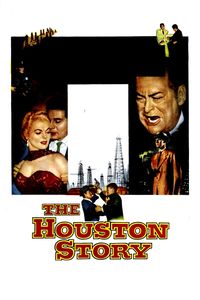
    The Houston Story (1956)

    (On Cable TV, March 2021) Taken at face value, The Houston Story is a mildly interesting crime thriller set against the then-unusual backdrop of mid-1950s Texas, playing up a mixture of crime tropes with slight noir elements. The plot has something to do with stealing oil, so at least that’s covered. The performances are fine, the story is fine and while the film tends toward dull mediocrity, it does work as an evening’s entertainment away from the usual urban landscapes of 1950s Hollywood. But the film gets more interesting once you start digging into its production. For one thing, it originally starred Lee J. Cobb — except that the oppressively hot and humid shooting conditions led Cobb to a heart attack that led to him being recast by Gene Barry! For another, more interesting element, the film is directed by William Castle — yes, that William Castle, but a few years before his claim to fame as a consummate horror film promotional showman famous for gimmicks such as The Tingler. He delivers a far more restrained film here, suitably moody with its shadows but otherwise really not as lurid as his later titles. If you’re protesting that the most interesting elements of The Houston Story are the elements that aren’t in the film, you’re right — and let that be your guide as to whether this is worth a detour.

  • 13 Frightened Girls (1963)

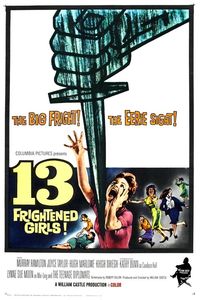
    13 Frightened Girls (1963)

    (On TV, November 2020) With a crew that includes the legendary William Castle as producer-director and a title like 13 Frightened Girls echoing Castle’s classic 13 Ghosts, anyone could be forgiven for expecting a horror film out of the deal. Surprisingly enough, though, what we get is a cold-war comedy, featuring an elite boarding school student who, out of a crush on an older man (ick), becomes an international spy by simply eavesdropping on her classmates, all from the multicultural London diplomatic set. The mixture of genres between teenybopper comedy and espionage thrills isn’t always successful: there are a few moments of unsettling violence in between the antics of our young protagonist, and I really could have dispensed with the schoolgirl-crush-on-a-grown-man angle. Still, there’s a characteristic early-1960s feel to the comedy that makes it feel all the more intriguing despite the curiously undisciplined script. There are many ways in which 13 Frightened Girls could have been better, but it’s quirky enough to be interesting as-is.

  • The Tingler (1959)

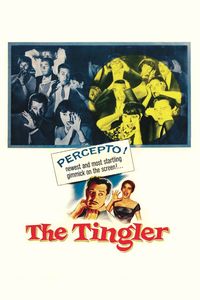
    The Tingler (1959)

    (On Cable TV, October 2020) With producer-director William Castle, the gimmick was the thing, and what’s most remembered from The Tingler isn’t as much the silly story as the tales of theatre seats rigged with small devices that would vibrate at carefully selected moments in the film, echoing the on-screen theme of sensing fear and screaming to drive the monster away. The gimmick is carefully set up in the film’s first two minutes, as Castle introduces himself on-screen and delivers a portentous monologue that sets the tone and the topic of the film. After that, it’s up to Vincent Price to take up the slack with his soothing voice, playing a mad scientist who identifies a parasite living near human spinal cords that kills from fear… unless the victims can scream themselves hoarse. The plotting is ludicrous (and that’s without even mentioning the then-legal use of LSD by Price’s character as an experiment to scare himself silly), but there is an undeniable body horror moment at the idea of having a fear-fuelled parasite inside our bodies, and by the time the film makes its way to an actual movie theatre, the fun of Castle’s gimmick is back in full force. There are a few jolts along the way too: Other than the disgust of seeing a rather good parasite puppet move around the set, there’s also a scene with bright red blood flowing in the middle of a black-and-white film. Price is terrific as usual, and the added social satire of having married couples plotting to kill each other adds a bit of thematic content to the blunt high-concept. The result may not be sophisticated, but if you’re already attuned to Castle’s brand of gimmicky horror (start with House on Haunted Hill and 13 Ghosts), The Tingler is good fun with a bit of an added kick to it.

  • 13 Ghosts (1960)

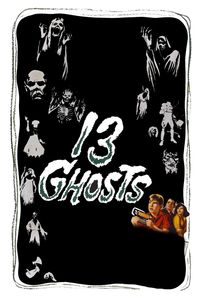
    13 Ghosts (1960)

    (On TV, May 2020) With legendary horror schlockmaster writer-director-producer William Castle, the gimmick was the thing—his films may not have been very good, but he had an uncanny instinct to meld movies with promotional stunts in a way that still sticks in mind even decades later. With 13 Ghosts, he turns the 3D gimmick upside down by introducing the picture himself and explaining the “special glasses” distributed to theatre patrons, the blue filter showing ghosts filmed in red (“For those of you who believe in ghosts”), and the red filter erasing the ghosts from the blue backgrounds (“For those of you who don’t”) The story is pure “must last the night in a haunted house” stuff, with inelegant integration of the gimmick in an otherwise black-and-white film. It’s ludicrous and clunky, doesn’t add much to the film (there’s no possible “psychological horror” interpretation from watching the film without the ghosts, for instance) and yet it powers the film with an undefinable, irreproducible charm. I did like the film’s ham-fisted narrative: Castle had a very approachable, audience-friendly style and while it lacked sophistication, there was no denying the approachability of the result—I do like House on Haunted Hill quite a bit more, but I’m not hating 13 Ghosts.

  • House on Haunted Hill (1959)

    House on Haunted Hill (1959)

    (On Cable TV, February 2019) By design, I programmed myself a haunted house double bill going immediately from the very respectable The Haunting to the rather far less serious House on Haunted Hill. The contrast was refreshing, and probably worked to both films’ advantage. From the very first moments, we’re clearly not meant to take this William Castle production very seriously: the opening sets the tone of an over-the-top horror film with ponderous narration and overdone characters. There is, for modern viewers, a deliciously comfortable feeling in watching this granddaddy of all “spend a night in a haunted house IF YOU DARE” plots: we think we know where it’s going, and the well-worn mechanics of that kind of story are great good fun. (The real fun of the movie begins when you realize that the stated plot of the film really isn’t its real plot—the other one is hidden and only revealed late after both collide.) Vincent Price has seldom been so deliciously overacting as he is here, and that only adds to the fun of it. The infamous skeleton sequence late in the film doesn’t make a whole lot of sense when everything is revealed and laid bare … but who cares? Some horror films have earned a legacy because they were utterly serious about what they’re doing (The Haunting being one of them) but House on Haunted Hill chose to go another way and improbably ended up being something of a classic in another vein. I know there’s been a remake already, but how about another good remake one of these days? On second thought, never mind: This film is good enough as it is, and no one will ever recapture its delicate campiness.