Yaphet Kotto

  • Friday Foster (1975)

    Friday Foster (1975)

    (On Cable TV, February 2021) Pam Grier is worth a watch even in the most terrible of movies, but Friday Foster greatly exceeded my expectations. A proud product of the blaxploitation era, this is a film that doesn’t even try to hide what it’s built for — Pam Grier in a shower, showing ample side nudity before being attacked by a knife-wielding hitman? Check. A random fashion show showcasing beautiful black women? Check. An activist plot dealing with the en masse assassination of black politicians by white agitators? Check. Friday Foster knows what it’s about, and it’s not afraid to show it. The steady forward pacing feels suitably modern, even as the mid-1970s atmosphere can’t be denied, and the great cast (Yaphet Kotto, Carl Weathers, Scatman Crothers, even Eartha Kitt in a too-small role) is a lot of fun. Still, the film’s single best asset is Grier in a role almost tailored to her strengths as an action heroine. For all of her reputation as an icon, Grier didn’t star in that many movies during the 1970s and Friday Foster was the last of the “classics” she did for American Picture International. It’s also a role that gives her a little bit more to do than running and shooting: she gets to play mom, photographer, investigator, seducer and sex symbol. It’s not exactly what we’d consider a well-rounded leading role these days, but it was still a noticeable step up for black female actors establishing a viable popular cinema for black audiences. What’s more, the thematic concerns of the film run a bit deeper than many of its contemporaries, notably in postulating a deliberate attack against black political leadership. I’m not going to pretend that Friday Foster is a great movie, but as a late-blaxploitation film, it’s fun and almost impossible to stop watching once it gets going. Grier still gets most of the credit, but the rest of the film almost meets her at level.
  • Across 110th Street (1972)

    Across 110th Street (1972)

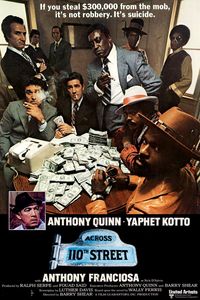
    (On Cable TV, November 2020) If you’re looking for a dark and grimy 1970s crime drama, Across 110th Street is a better choice than you’d expect. While it doesn’t have the gravitas of contemporary New York City thrillers such as Serpico or Death Wish, it’s considerably lighter on its feet, and its matter-of-fact trashiness is more a reflection of the times and place than a lack of ambition. Largely shot on location in Harlem (which wasn’t just a marketing coup, but somewhat risky at the time), this is a story about criminals hitting an organized crime cash drop, and the police trying to catch the murderers before the retaliation begins. The racial element is an integral part of the story, with a racist veteran cop (Anthony Quinn) paired with a younger black policeman (Yaphet Kotto) in order to get anywhere during the investigation. By modern standards, Across 110th Street is not that good of a movie—many familiar elements, unimpressive action sequences, a hackneyed message on racial reconciliation… nothing we haven’t seen elsewhere. But it does have a remarkably effective period feel, starting with its opening theme song, and it moves with a somewhat impressive pacing. Halfway in (or out) of the blaxploitation movement, it’s a bit more upbeat than most urban crime dramas of the time, and not quite restrained by the intentional aesthetic limitations of exploitation films. As a result, it has aged beautifully as a period piece, clearly of 1972 but enjoyable at other times.

  • Brubaker (1980)

    Brubaker (1980)

    (On Cable TV, February 2020) Making a movie about prison reform, inspired by real-life events, isn’t exactly the most compelling subject matter. But make sure that your hero is a two-fisted reform advocate, pit him against an entire corrupt prison/town/state and given the role to Robert Redford and suddenly Brubaker gets far more interesting. Redford’s legendary charisma is well suited to his role, as he takes on an establishment that actively profits from old-fashioned prison practices. A gallery’s worth of character actors (including Yaphet Kotto, M. Emmet Walsh, Wilford Brimley and very young Morgan Freeman—recognizable by voice rather than by sight) are united against him. This being from a true story, don’t expect a triumphant ending: at most, the character gets applause and an end title card explaining the scandal that erupted afterward. Still, much of Brubaker’s entertainment value comes in seeing an incorruptible character uncover the vast web of old-boys corruption that surrounds the prison, and defending himself against attacks. It does make for dramatic intensity and narrative interest. It also represents a good entry in Redford’s filmography as a progressive champion, a role matching his political interest with his megawatt charm. Plus, he gets to shoot a shotgun, which isn’t to be neglected.

  • Live and Let Die (1973)

    Live and Let Die (1973)

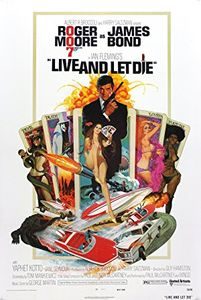
    (Second viewing, On Blu-ray, September 2018) And so the Roger Moore Bond years begin in Live and Let Die, without SPECTRE, but with tarot, voodoo and tons of Blaxploitation. The globe-threatening antics of previous films are reduced to a drug trafficking movie, albeit with a considerable amount of early-seventies flair. Moore’s performance is not quite Moore’s Bond yet: His approach is still more intense than debonair, his quips are restrained and he still feels like a holdover from the Connery era. The film around him, however, is a clear relic of its time: I happen to like Blaxploitation a lot, so it’s not as if its intrusion on Bond territory is not welcome—on the other hand, this is clearly a black-focused film written by white people, so the folkloric aspects of black culture are played up and character stereotypes abound. It’s also missing a lot of what made Blaxploitation feel fun—no funk, no going up against the man on behalf of the black man. Oh well; we couldn’t really expect much from such a combination. Elsewhere in the movie, the ludicrousness abounds: there’s an uncomfortable aura of supernatural floating around the film, even when you can explain most of it rationally through dramatic plotting, impossibly clever schemes and an impressionistic final shot. It does dovetail with the increasingly silly nature of the Bond series going into the Moore years, especially when tarot and voodoo are used as exotic window-dressing for the series’ globetrotting. Speaking of which: It does feel like an overdose to go back to America in back-to-back Bond movies, even if New Orleans isn’t the same as Las Vegas. (I saw Live and Let Die as a teenager, but I had forgotten all about Bond’s detour in New York City. I did remember the tricked-out card deck, though.) I’m not particularly impressed by the film’s action showpieces, especially the boat sequence which, while containing some spectacular moments, doesn’t seem to build to something as much as it just strings stuff along until it runs out of its budget. Jane Seymour is one of the most intriguing Bond Girls as Solitaire, but I’m not sure that she actually fits in the Bond universe. Yaphet Kotto is not bad as the villain, although one wonders how busy his agenda is in-between the ruling, the trafficking and the evil plotting. Among bit players, David Hedison is great as Felix Leiter, Geoffrey Holder is terrific as Baron Samedi, Madeline Smith is cute as the Opening Bond Girl and Gloria Hendry is welcome as the Bad Bond Girl. Alas, Sheriff Pepper is intolerable, Q is missing and the plot is a bit dull, suggesting once again that the Bond series is at its silly best when it goes bigger-than-big. Speaking of which, Paul McCartney’s title song is terrific, probably my favourite of the series. Otherwise, Live and Let Die is a formula Bond movie, perhaps more interesting as a period piece and as a transition point for the series rather than by itself.