ZaSu Pitts

  • Their Big Moment (1934)

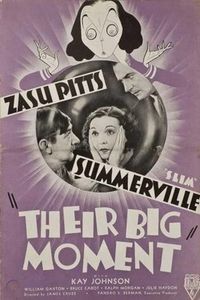
    Their Big Moment (1934)

    (On Cable TV, August 2021) We’re getting deep in the weeds of 1930s cinema with Their Big Moment, a 68 minute (!) mystery involving séances, revelations from the afterlife, a comic relief turn from Zasu Pitts (in a film not generally meant to be funny) and some murder shenanigans. It’s not great art — you can feel the perfunctory effort in how the film blends its elements, but there’s a charming period atmosphere to the way they take their séances seriously, how Pitts is being used for a few laughs (she’s really a supporting player here) and how the 1930s archetype of amateur sleuths is deployed without amazement or irony. Their Big Moment is certainly watchable, although not worth obsessing over.

  • Sing and Like It (1934)

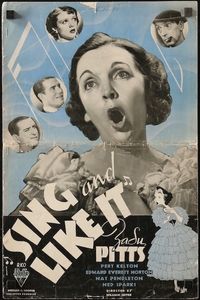
    Sing and Like It (1934)

    (On Cable TV, June 2021) As a mildly amusing showbiz comedy from the Pre-Code era, Sing and Like It doesn’t have much of a premise in mind — almost all of it revolves around its protagonist (played by the distinctive Zasu Pitts) and her inability to sing, even as events conspire to make her the star of a Broadway show. Organized crime plays an important part in the plotting, but all she really wants to do, in the end, is to go back to her farmer husband. Most of the jokes have the characters riffing on her awfulness, and yet despite everything her sole number “Dear Mother” becomes a bit of an earworm by the end of the film. Amiable throughout, Sing and Like It does get funnier as it goes on, all the way to a theatrical climax and a happy ending. The interplay between criminal thugs trying to make their way in Broadway society is amusing, and the Pre-Code nature means that a few subtle jokes with violent subtext are more audacious than what you’d see in movies for the next thirty years. As an unlikely Pitts fan, I was thoroughly satisfied here — it’s one of her biggest and best roles as a comedienne, and it’s firmly set within a film that has zingers going all around. Sing and Like It isn’t a particularly well-known film, but looking around for reviews, I see that nearly everyone who saw it liked it.

  • Life with Father (1947)

    Life with Father (1947)

    (On Cable TV, July 2020) When the point of an old film’s popularity is that it’s old-fashioned, I suppose it’s natural to react with very mixed feelings to the result. Life with Father is a film of the past in many ways—a 1947 adaptation of a long-running 1939 Broadway play looking nostalgically upon life in 1880s Manhattan, it’s triple-piled-up nostalgia even before we begin digging into it. As the patriarchal title suggests, it’s an examination of a family with a strong-willed father at the helm, a role that would have been unbearable without the considerable charm of William Powell, completely in his element here. He’s hard-headed, unwilling to listen and impervious to the damage he causes, but the saving grace of the film is how it shows the rest of the family subtly manipulating him into serving their own objectives, taking advantage of his own bluster in order to get what they want. Still, much of Life with Father is subservient to the 1880s and 1940s, all the way to a baptism subplot that seems inconsequential today, but somewhat harms the free-thinking nature of the protagonist. (Significantly enough, film historians tell us that the film’s final line, “I’m going to get baptized,” is a bowdlerization of the Broadway play’s punchline, “I’m going to get baptized, damn it.”) If you’re willing to let slide those things slide, the film does have its charms. In addition to Powell’s performance, we have smaller roles for silent film veteran ZaSu Pitts, a charming turn by a very young Elizabeth Taylor, great matrimonial dialogue between Powell and Irene Dunne, and a few comic set-pieces that still work well. There are times where a film’s appreciation hinges on how much you can surrender to an earlier era’s idea of feel-good movies, and Life with Father is definitely one of those.

  • Ruggles of Red Gap (1935)

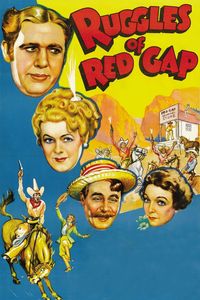
    Ruggles of Red Gap (1935)

    (On Cable TV, January 2020) I had a hard time staying interested in Ruggles of Red Gap despite elements that should have made it interesting. Blame mood if you want, but this story of an English butler going to America to eventually become a successful immigrant felt unusually turgid and dull. Coming from the first decade of sound cinema, much of the stiffness can be excused away—movies of the time aren’t always exceptionally dynamic, and the theatrical lineage of the story (first a novel, then a stage musical, then two silent movies) translates into a film that doesn’t move much. My lack of interest in the film is even more inexplicable given that it features the great Charles Laughton and one of my favourite early-Hollywood actresses Zasu Pitts. It’s a generally lighthearted comedy, and it ends on a somewhat stirring adoption of American freedoms by an immigrant who, until then, has always lived his adult life on other peoples’ terms. In short, Ruggles of Red Gap should have made much more of an impression but didn’t. I may revisit it under different circumstances to see if it works better.

  • Mexican Spitfire at Sea (1942)

    Mexican Spitfire at Sea (1942)

    (On Cable TV, November 2019) It’s one thing to have star vehicles, and it’s another to have a series of films tailored to your screen persona. Anyone unfamiliar with Lupe Velez’s brand of comedy as an attractive but stereotypically tempestuous Latina will know everything they need to know from Mexican Spitfire at Sea, the fourth in a seven-film series all featuring Velez and her “Mexican Spitfire” moniker. Here, we’re aboard an ocean liner as our heroine thinks she’s finally getting her honeymoon but instead gets tangled in a mix of social climbing, husband shaming, impersonations and rapid-fire dialogue often punctuated by comic rages from the protagonist. At 72 minutes, Mexican Spitfire at Sea has no time for niceties, and no appetite for subtlety: this is classic community theatre farce material with mistaken identities and misunderstandings powering much of the plot, with the actors mugging for the camera so that we don’t miss a single double take, confusion or lustful thought. The ending is a bit weak, but it actually works quite well if you’re in the mood for that kind of sitcom-level comedy … and it works even better if you like the “Mexican Spitfire” archetype that Velez plays so well. Added attraction may come from the easy-to-digest pace of life aboard an ocean liner (you can cut production costs by going through the same five sets), funny dialogue and a performance from veteran actress Zasu Pitts that’s far funnier than anything she did in Greed. What may limit the appeal of the film is that the series is focused so extensively of a specific screen persona.  I was curious about Velez and sympathetic to that kind of role, but I’m not so sure that I’d watch all seven movies back-to-back. As a small discovery, though, Mexican Spitfire at Sea is just good enough to make me happy.

  • Greed (1924)

    Greed (1924)

    (On Cable TV, April 2018) Diving into classic movies is often best done in stages: some of it is accessible to modern audiences, some of it takes a little bit more work and sympathy and some of it will frankly bore the pants off casual viewers. Knowing this, I’m convinced that I have seen the reconstructed four-hour-long version of Greed far too early in my development as a classic movie fan. The back story is worth explaining: 1924’s Greed is widely acknowledged as one of the finest dramatic films of the silent era and a masterpiece for screenwriter/director Erich von Stroheim. But the 140-minute version that has been shown on-screen since the 1924 is reportedly a mere shadow of the 462 minutes of the lost original director’s cut. In 2012, however, film experts reconstructed a 239-minutes version of the film using the original script and photos taken during the production of the film. That reconstruction was the version I saw and, well, it maximized all of my issues with silent movies: The pacing is mortally slow, the use of photos (zoomed, cropped, panned) as placeholders for missing scenes is jarring and the new material did seem extraneous from the bulk of the story. It takes a lot to convince me to sit down to watch a four-hour movie, and Greed did not match that level of interest. This being said, I can see why this version would be interesting to someone already fascinated by the movie. Alas, this strikes me as Greed 201 rather than the 101-level lesson I’m ready to digest at this point. All of this being said, there’s quite a bit that I liked about even this interminable version of the film. The story is complex and strong, being adapted from a novel, and it does explore its central theme with the cleverness we’d expect from more contemporary examples. The writing of the title cards is a noticeable cut above most silent films, being sometimes reprinted from literary material. Gibson Gowland makes quite an impression as the protagonist of the story: it’s not a good impression (“punchable face” comes to mind), but his is not a good character either. Meanwhile, ZaSu Pitts looks like an alien with her wide eyes and unusual hairdo—hers isn’t a good-natured character either, and the drama she creates is tragic. Strong actors, a strong script and some really interesting period detail make for a film with definite strengths, but I have the clear impression that I would have enjoyed the cut-down version more. Thanks, TCM, I guess, for providing more than I needed—but I’ll get more out of the reconstructed Greed whenever I’ll be more familiar with 1920s cinema.