Month: April 2019

  • La Bamba (1987)

    La Bamba (1987)

    (In French, On TV, April 2019) It happened more than a decade and a half before I was born, but I’m still surprisingly mournful about The Day the Music Died — The February 1959 plane crash that killed Buddy Holly, Ritchie Valens, and “The Big Bopper” J. P. Richardson. Much of the story has been told in another film (1978’s The Buddy Holly Story), but La Bamba focuses on the life of Richie Valens, who died just as he was gathering attention as a rocker. The film is thin but satisfying, spending a lot of time on the rags-to-fame aspect of Valens’s life, occasionally delivering a musical number along the way. From a story perspective, it’s not much and not particularly uplifting (the film, knowing that many viewers already know the end of the story, heavily prefigures its ending by focusing on Valens’s fear of dying in a plane crash even from the first scene), so much of the appeal depends on the film’s musical numbers. Fortunately, there are a few high-powered numbers along the way, not only from Valens (“Donna” but especially his rock-and-roll take on the until-then folk song “La Bamba”) but also other musicians from the early rock-and-roll era in its fun and carefree atmosphere. The centrepiece of La Bamba, of course, is Lou Diamond Phillips’s first on-screen role, a tough part that requires good acting and performing skills. Fortunately, Phillips nails it—his stage performances are very enjoyable once he hits the big time in the film’s second half, with some underrated support from Esai Morales as his brother and Elizabeth Peña as his sister-in-law. While La Bamba isn’t perfect (I would have liked to see more time spent with the musicians) and seems cut short just as dramatically as Valens’s own career, it does have a few strong moments and its credit sequence, after a sombre ending, ends by highlighting its biggest strength once more—an uncut shot of Phillips performing “La Bamba” one more time.

  • The Lost City of Z (2016)

    The Lost City of Z (2016)

    (On Cable TV, April 2019) Considering that I really liked David Grann’s non-fiction book The Lost City of Z when I read it shortly after its release in 2009, I was certainly looking forward to its movie adaptation. Alas, for reasons that I can’t quite figure out, the film itself simply fails to launch. There’s a faux-philosophical leadenness to it all that didn’t move me, a ponderous rhythm that doesn’t even come close to capturing the danger and adventure of deep-jungle expeditions. The film does itself no favour with a deliberately super-processed colour grading that actually takes away from the beauty of the natural wonders discovered by the explorers. The film lacks a clear buildup, going from one expedition to another, then off to war. Director James Gray is ambitious, but the result of his efforts doesn’t take off. Another underwhelming factor is Charlie Hunnam in the lead role—time after time, Hunnam proves himself to be one of the most uninvolving leads of the last few years and while I believe he could be fine as a character actor, he seems determined to somehow overwhelm audiences through sheer ubiquity. As with other cases where a film simply “didn’t do it for me” absent obvious issues, I can chalk my reaction to an unreceptive mood … but I don’t think it’s that simple. At nearly two and a half hours, The Lost City of Z is a serious sit, and one I’m not eager to repeat. I’d rather re-read the book.

  • Chaplin (1992)

    Chaplin (1992)

    (In French, On TV, April 2019) Considering the influence that Charlie Chaplin had on cinema, it’s obvious he deserved his own big-budget glossy Hollywood biography. Not the warts-and-all one, though: the mononymous inspirational one: Chaplin. It begins, at it should, with an enjoyable look at early Hollywood history, from filming Keystone Cops shorts to hanging at parties with Douglas Fairbanks to going backstage at the first Academy Awards. Robert Downey Jr. ends up being an inspired choice to play Chaplin throughout his adult years, along what feels like a who’s who of early-1990s actresses (including a very young Milla Jovovich). The flashback-heavy structure of the film keeps things interesting, but there’s no denying that this is an old-school, lavishly executed biography with the pitfalls inherent in trying to cram decades within two hours. The film very lightly touches upon Chaplin’s least savoury personality traits such as his fondness for younger women, infidelities and cruel treatments of past lovers, but shies away from a full understanding of the character, and barely mentions the business savvy (including re-editing silent pictures as audibly-narrated ones, or his co-founding of United Artists) that contributed to his enduring popularity throughout the following decades. Having spent the past few years diving head-first in the archives of Classic Hollywood and seeing many of Chaplin’s best-known films along the way, I got quite a bit more out of the film than had I seen it a few years ago. But despite the lavish production means and Downey’s incredible performance playing Chaplin (especially toward the end of his life), there’s something missing here. Especially in the second half of the film, increasingly focused on Chaplin’s legal problems, exile from the United States and creative slowdown. Chaplin tries to put on a happy face on a life that doesn’t quite fit the pattern, and the tension is noticeable. Perhaps a slightly better film would have stopped earlier.

  • Thinner (1996)

    Thinner (1996)

    (On Cable TV, April 2019) One of the most wonderful things about Stephen King is he has written so much that you can have yourself a weeks-long marathon of King film adaptations, with a wide variety of quality from the grotesque to the sublime. In that Stephen King Cinematic Universe, Thinner is likely to go unnoticed. Not that it doesn’t have a good hook on its own—what with an obese lawyer accidentally killing a gypsy woman, and her father putting a fatal thinning curse on him. But good hooks aren’t rare in the King oeuvre—what’s more important is the care with which they’re executed and that’s where Thinner loses points. Clearly looking like a mid-tier 1990s film, it’s a horror film made like a horror film, with little intention to aim for anything more. There’s also a very specific aspect to the story’s requirements—the makeup—that would at best be weird, and here feel simply grotesque. Simply put: any story that has a 300-pound man thinning down to skeletal proportions was a tough special effects assignment without top-notch 2010s digital wizardry, and there’s no going around that much of it looks unconvincing, especially in the later stage where makeup is applied to lead actor Robert John Burke’s face in order to create hollow depressions. Then there’s the script, noticeably sillier than other King adaptations even when it does a fine job adapting a weird story. But those things combine make Thinner feel like a minor work—an extended Twilight Zone episode with enough filler required to make it to the end, the point of the film being in the ironic ending. Not unlike the novel, really—King wrote it as Richard Bachman at a time when he was still aiming for airport-grade potboilers. I still enjoyed it, but as a B-movie with a number of excesses rather than a better kind of film. This being said, there’s a lot worse in the King Cinematic Universe—being forgettable isn’t all that bad.

  • BlacKKKlansman (2018)

    BlacKKKlansman (2018)

    (On Cable TV, April 2019) You can’t really tell a creator like writer-director Spike Lee what to do. But with BlacKKKlansman, there’s a feeling that he’s back at his activist best, delivering a ferociously engaged film that does not compromise on its entertainment value. Loosely adapted from a true story, it focuses on a black FBI agent (played by John David Washington, son of Denzel but on his way to a stardom of his own) who works with a Jewish co-worker (Adam Driver, also quite good) in order to infiltrate a local KKK group. The clear activist intent of the film is made even better through a considerable amount of comedy, suspense and scene-to-scene interest: this is probably Lee’s most purely entertaining film since Inside Man, and it’s a welcome return to form for him, as his last decade-and-change of filmmaking has been erratic or eclectic. The result is one heck of a movie—funny, compelling, heavily ironic, pulling no punches against racists and ending with a coda that really drives the point home that this may be a story from the past but not a past story. Great performances also show Lee working at his best—It’s hard to miss with Driver, but Washington establishes himself as a compelling lead, and we get a supporting performance from black activist legend Harry Belafonte (!) and an eye-catching turn from Laura Harrier. I really liked BlacKKKlansman, and its existence says much about the state of black filmmaking in the 2010s—telling its own stories, being matter-of-fact affirmative, processing ongoing irritation with the current state of American society and having the power to draw in large audiences to buy into its uncompromising message. The Academy make a mistake when it gave the Best Picture Academy Award to the inferior Green Book.

  • Passion (2012)

    Passion (2012)

    (In French, On TV, April 2019) I only watched Passion because I’ve been hitting the vintage Brian de Palma catalogue a lot lately, and had been wondering what he’s been up to in recent years. This happens to be almost exactly the best state of mind to tackle this film, as it eventually makes its way to classic de Palma grand-guignol with murder, lust, affairs, twins, nightmares (meaning no less than two catapult awakenings) and bad people doing bad things to each other. It’s quite a bit of fun if that’s what you’re looking for. The beginning can be deceptive, though: the introduction of two marketing agency executives feels a bit too clean, too modern, too fun to be de Palma, but just wait—it doesn’t take long for the ugliness to come out, and the silliness as well. Perhaps the standout sequence has to do with a ballet, split screen, three characters and a final murder. This may not be great de Palma, but it’s definitely de Palma and that will be enough to please its audience. Rachel MacAdams is fine here as a grown-up Mean Girl, whereas Noomi Rapace is good enough as her antagonist (or protagonist—it’s that kind of movie). The ending doesn’t make sense, but it’s a good cap on an increasingly demented ride. While billed as an erotic thriller, don’t expect too much of Passion on that front: it’s got explicit situations, but no significant nudity nor extended erotic sequences. While there’s a sense that de Palma is churning familiar material, who can fault him for one last go to the same sources of inspiration?

  • Adjust Your Tracking (2013)

    Adjust Your Tracking (2013)

    (On Cable TV, April 2019) Even though I have a sizable DVD collection, I never really collected VHS tapes: They were expensive at a time when I had no money, and their self-destructive nature made it a dumb investment compared to optical discs. Adjust Your Tracking is not for people like me: It’s a documentary about VHS collectors, who keep accumulating vast libraries of obscure films (most of them in the horror genre) in spite of the medium’s obsolescence. At its best, the documentary is good fun, touching upon the thrill of collecting and of rummaging through old and potentially unsafe shops in order to find the rare collectible. I particularly liked the spotlight on a collector who has transformed his basement into a credible recreation of a video store as a way to showcase his collection. Other highlights include a few minutes talking about The Quadead Zone, an obscure film that nonetheless established records for eBay VHS sale prices. Some of the segments are illustrated through rough comic panels. If you know the horror community (and I have attended enough several consecutive years of the World Horror Convention to qualify), you can recognize its rough humour and familiar call-outs (such as referring to “pre-sellout Craven”). The film does get much weaker when it tries to extol the innate virtues of VHS (as if computers can’t be set up to lower DVD resolution and insert scan lines); but stronger when it points out that a significant fraction of those low-budget VHS films have never been re-released in digital format. Writers-directors Dan M. Kinem and Levi Peretic do well when they delve into the collecting impulse, finding echoes of other hobbies in the pursuit. I’m really not a fan of VHS as a format, but my congratulations go to all of those interviewed in Adjust Your Tracking—and I’d be really, really curious to get an update on the various projects outlined here.

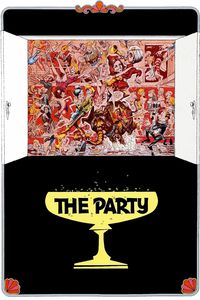
  • The Party (1968)

    The Party (1968)

    (On Cable TV, April 2019) Is it possible that the more I see of Peter Sellers, the more I find him annoying? The Party does him no favour, with director Blake Edwards letting him go wild with improvisation, and showboat in brownface with an Indian accent. The plot is paper-thin, and really an excuse to let Sellers run set-pieces into the ground through repetition and predictable execution. His character, a bumbling Indian actor, is designed to be as irritating as possible and it’s not an accident if the film improves the further away it moves from him. He is, of course, immensely destructive, with a climax of bubbling proportions. If you’re getting the feeling that I didn’t like The Party all that much, you’d be half-right—I couldn’t stand Sellers most of the time, but even I have to admit that there’s something magnificent in the film’s fantastic set, its ability to avoid relying on dialogue, and the sheer anarchy of the last twenty minutes. Still, The Party should have been a far more disciplined film, a less stereotypical one, and it would have been better with someone else in the lead role.

  • The Goodbye Girl (1977)

    The Goodbye Girl (1977)

    (On Cable TV, April 2019) A guy, a girl, and an apartment—what more do you need for a comic drama? If you’re playwright Neil Simon, not much more—and so The Goodbye Girl becomes a comedy about mismatched roommates, an examination of struggling actors, and a triangular drama about two adults and a young girl. Given that Simon is scripting the film (with direction provided by Herbert Ross), it’s clear that it’s a joy to listen to. Richard Dreyfuss and Marsha Mason do quite well with the material they’re given with specific highlights when they’re tearing into each other in a most loquacious fashion. (Dreyfuss would win an Oscar for his performance—with the film getting further Academy Awards nominations for best picture, its two other lead actresses, and Simon himself.) Compared to other Simon works, the mismatched roommate conceit in reminiscent of The Odd Couple, but the growing romantic attraction does add another dimension to the result. Dreyfuss couldn’t be better as the occasionally neurotic actor, his performance driving much of the charm of this romantic comedy. The look at the lives of struggling Manhattan-based actors isn’t unique, but it still works really well. The Goodbye Girl is not a hugely ambitious film, nor does it head anywhere unexpected. But it’s well executed in its chosen genre, and it’s very pleasant to watch.

  • The Human Comedy (1943)

    The Human Comedy (1943)

    (On Cable TV, April 2019) As much as I don’t like saying it, there is something frankly awe-inspiring in the propaganda efforts led by Hollywood during World War II. Scarcely any single branch of the US military wasn’t covered by some sort of heroic film, and Hollywood took care to address the home-front as well, boosting morale and preparing the population for the sacrifices of war. The Human Comedy is an exemplary take on inward-directed propaganda, taking a look at a small California town as it experiences the war from afar … except for the young men who have left and may never come back. “Teenaged” Mickey Rooney stars in this paean to salt-of-the-Earth America as a telegraph messenger whose job becomes to relay news of deaths to unprepared families. There’s some sports, romance, drama and comedy to make this film more than just a propaganda effort. It does eventually become a meditative slice-of-life narrative of quasi-anthropological interest—and narrated by a dead character. I found it strangely reminiscent to that other existential small-town drama Our Town. This being said, it remains a propaganda film, and the overall message that “sacrifices must be made for the good of the nation” is hard to ignore throughout. The wartime material hasn’t aged as gracefully as what surrounds it: the poignant episodes involving the ensemble cast, the last few antagonists, the generous outlook on life. Rooney is quite good on a purely dramatic acting level (as opposed to other films where he plays the matinee idol) and that helps a lot in further grounding The Human Comedy as something more than a wartime message.

  • Fyre Festival (2019)

    Fyre Festival (2019)

    (On Cable TV, April 2019) Canadians who had abandoned hope of every seeing Hulu’s Fyre Festival got unexpected help in spring 2019 from Super Channel, which secured Canadian distribution rights to the documentary offering another perspective than Netflix’s near-simultaneous Fyre. Much has been said about the ethical shortcomings of both documentaries—while the Netflix documentary was co-produced by the Jerry Media company behind the festival’s promotion (and its social media criticism suppression), this Hulu doc actually paid convicted fraudster Billy McFarland for interview footage. As one can expect, this Hulu production has harsher words about the social-media promotion of Fyre, and some largely useless footage of the main instigator. The angle is slightly different, and to its credit Fyre Festival offers more detail on the social-media aspect of the fraud, and on the complex web of scams that followed McFarland throughout his career. On the other hand, there are other things about Fyre Festival that are just annoying: its insistence on treating millennials as some sort of mystical generation is fit to launch my usual generations-aren’t-so-different rant, whereas the visual style of the film is huge on impressionistic visuals thrown nilly-willy in the narration. The Netflix documentary offered a more structured narrative, more striking moments, and a far better depiction of the increasingly disastrous project planning. It’s fascinating to see two interesting documentaries emerge from the same event—but then again disaster is always interesting. Some influencers come across very badly here, but Billy McFarland comes across as even worse, with evasive glances and lengthy pauses perhaps enhanced through editing but unmistakably portrayed as duplicitous in his answers. Despite the annoyances, Fyre Festival is also worth a look, even if you’re up to speed with the topic. At its best, it doesn’t forget to tie up the Fyre fraud with other signs of the time—The Soho grifter, Theranos’ Elizabeth Holmes and, of course, the current occupant of the White House himself. How badly have we erred to end up at a time when reality itself is subservient to hype and fraud?

  • Mame (1974)

    Mame (1974)

    (On Cable TV, April 2019) Seeing the musical remake Mame only two weeks after seeing the original comedy Auntie Mame was clearly not at the 1974 film’s advantage. While the bones of the story have been transported, simplified, heightened, and set to song and dance, the result is far from being as satisfying as even the uneven original, and bring further credence to my assertion that nearly every musical made in the 1970s was terrible. I’ll admit that the story is a difficult one to tell—episodic, scattered across several years, not quite comic throughout—it challenges even the original film. But this adaptation makes it worse. Generations of reviewers have noted how much Lucille Ball is miscast here (critics were so scathing in their initial assessment that it was the last theatrical film that Ball ever made) so I’m not going to pile up. On the other hand, it’s always fun to see Robert Preston show up even in a momentary supporting role. Elsewhere, well, the comedy isn’t funny, the musical numbers feel laborious and the result is more puzzling than exhilarating. I’d like to say that my impressions of Mame would have been higher if I hadn’t just seen Auntie Mame, but I suspect that’s not true—even after acknowledging that it’s a lesser film, it’s obvious that it’s not much of a good one no matter if compared or not.

  • Captains Courageous (1937)

    Captains Courageous (1937)

    (On Cable TV, April 2019) It’s amazing to see what earlier era considered perfectly acceptable entertainment for kids. 1937’s Captain Courageous, for instance, adapted an 1897 Rudyard Kipling novel and refashioned it as a coming-of-age story for a spoiled rich boy swept overboard and rescued by fishermen, who teach him much about fishing and life. Considering that it’s a story that includes the gruesome death of a main character by sagittal bisection, well, I’m not going to begrudge the current crop of kids’ films. Still, the result can be surprisingly enjoyable. Freddie Bartholomew turns in a good performance as the boy, with an endearing turn by curly-haired Spencer Tracy, and supporting roles for both Lionel Barrymore and Mickey Rooney. Tracy has the best role here, as a loquacious Portuguese fisherman who helps the initially detestable boy protagonist become a better person. One thing that holds up surprisingly well is the depiction of fishermen working the Grand Banks of Newfoundland—the footage of real fishermen at sea (in sailboats!) is a terrific time capsule, and the integration of water-tank footage with rear-projection special effects is often better than you’d expect. Despite a drawn-out ending, Captain Courageous does wrap up in a satisfying fashion, capping off a film that still works well today, albeit to an older audience.

  • Summer Lovers (1982)

    Summer Lovers (1982)

    (In French, On TV, April 2019) You can sometimes tell a lot about a film by looking at when and where it’s broadcast. I didn’t know Summer Lovers at all, but it was being broadcast in the same weekly time-slot that the French-Canadian TV channel had used for other steamy movies such as 9 ½ weeks and Last Tango in Paris, so… I knew what to expect, and the film delivered. A sometimes-awkward blend of naughty sex comedy and serious character drama, the film follows the adventures of a disgustingly rich, young, and good-looking American couple as they travel to a Greek island for the summer, and then gradually get caught up in a ménage à trois with a French archeologist. It’s meant to be something of a carefree escapist romp with just enough character drama to make it respectable, but it all falls apart along the way. (Of course, I’m old and grumpy enough to think that the only appeal of a ménage à trois is having one more person to do housework.) The film does feel very much like a male-gaze dominated fantasy: despite a few more serious moments examining the realities of such an arrangement, writer-director Randal Kleiser spends far too much time photographing nude bodies and staging erotic set-pieces to claim otherwise. What’s more, the ending merely kicks the dramatic can past the end credits in order not to commit to anything. Daryl Hannah stars in an early role (as the wife), and the feeling of being in a Greek vacation (complete with an intriguing glimpse at an early-1980s archeological dig) is bolstered with a pop soundtrack (“I’M SO EXCITED!”) that clearly anchors it to a point in time.  The nice Greek countryside can’t quite compensate for a story that borders on annoyance. As a result, Summer Lovers feels flawed, although I can’t really begrudge anyone from enjoying it. After all, you know what you’re getting into when watching a film in the late-night time-slot…

  • Sounder (1972)

    Sounder (1972)

    (On Cable TV, April 2019) It’s unfair to compare a wholesome family drama like Sounder to the blaxploitation movement of the early 1970s … or is it? At a time when (white) studio producers were consciously trying to appeal to black audiences, the obvious play was to go for gritty urban stories that could empower black audiences and bring in white moviegoers. It wasn’t as obvious to make a wholesome family movie taking place in 1933 rural Louisiana, detailing the struggles of a poor family on a hardscrabble farm trying to keep it together after the father is imprisoned for stealing much-needed food. The mood of this Martin Ritt-directed film is calm, loving, triumphant over quotidian struggles. It’s a film that openly preaches for the value of education and kinship as a way to climb out of poverty, uniting against misfortune, racism and adverse circumstances. Even modern audiences will find much to appreciate in its honest appraisal about the impact of incarceration on families: you could show Sounder alongside other more modern films without feeling out of place. While nominated for a Best Picture Academy Award, Sounder is now most likely remembered as a footnote, except when discussing the history of black-themed movies (thank you TCM for showing it), which seems regrettable considering how inspiring the film can be. It also features career-best performances from Cicely Tyson and Paul Winfield. It’s also quite optimistic in its own way: Unusually for a drama that plays so much emphasis on the family dog (whose name is the film’s title), it doesn’t even die at the end!