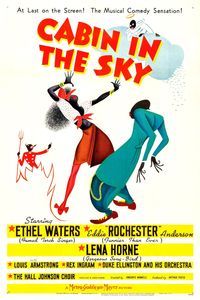
(On Cable TV, July 2020) What’s historically important about Cabin in the Sky is that it was one of the very few black-dominated musicals at a time when major film studios were reluctant to even put black performers on-screen at all. The story is a religious-themed (but funny) parable about God and the devil battling it out over a man’s soul, but the film exists for the decent musical numbers, showing a very different rhythm than other musical comedies of the time. Clearly, the reason to see the film is for Lena Horne as a sexy seductress… whew! This being said, she’s not the star here: Ethel Waters has more to do (musical wise) and deserves the spotlight. Elsewhere in the cast, Louis Armstrong shows up playing the trumpet. Cabin in the Sky is billed as Vincente Minelli’s first solo directorial effort even if some of the musical numbers are directed by Busby Berkeley. The worth of the performances that the film captures easily outweighs the sometimes-racist plot elements (and the other assorted stereotypes, such as facing off the mammy against the town harlot). It’s easy to make comparisons between this and Stormy Weather, as both were rare examples of black-cast MGM musicals in successive years—Cabin in the Sky is stronger on plot, but weaker in just about everything else, most crucially dancing and music. Still, both make a compelling case for a parallel universe in which black cinema from studios would be kick-started decades before the blaxploitation era—and it’s hard not to notice how these musicals play on an entirely different and more uplifting register.
(Second Viewing, On Cable TV, December 2022) It’s easy to re-watch any movie with Lena Horne, and since Cabin in the Sky remains her second-best-known role after Stormy Weather, I had to have another look. Comparisons with Horne’s other big movie are inevitable—both were rare examples of major-studio black-cast films, and in my mind they form an essential double feature. Cabin in the Sky is probably the more ambitious film from a thematic standpoint, being concerned about a good-versus-evil battle for a man’s soul. On the other hand, it’s not quite impressive on a moment-to-moment basis, with generally weaker musical numbers and a pacing that frequently lags. Still, the film has a few undeniable assets, the best of them being Horne cast in a supporting role as an outright jezebel temptress—something of a welcome change from her usual roles as a featureless torch singer. Cabin in the Sky is heavier on the comedy, and with that comes a big helping of stereotypes… and another kick at the question—is the film racist or not? “Much better than the norm at the time” is a double-edged sword—what was progressive then is not necessarily as tolerable today, and this film is caught in the middle. You get strong black roles, but you also get a few unfortunate moments along the way. Still, the film remains very enjoyable—not only for Horne, but for other performers such as the distinctive Eddie Anderson and Ether Waters. The music also holds up, with too-brief appearances from Duke Ellington and Louis Armstrong. (Rex Ingram is also a lot of fun as Lucifer.) I’ll readily watch Cabin in the Sky again the next time it shows up on the TCM schedule.


![Tacones lejanos [High Heels] (1991)](https://www.christian-sauve.com/wp-content/uploads//high-heels-1991.jpg)