Will Success Spoil Rock Hunter? (1957)
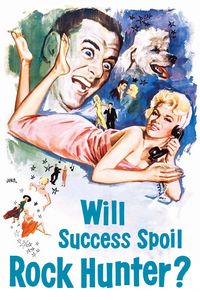
(On TV, July 2020) We often think of 1950s America as this unthinking haven of conformity, and that is nonsense—people back there were as smart as today, as skeptical as today, and as intent on satirizing the excesses of the day. From the get-go, with a scene in which Tony Randall addresses the audience and introduces the film (after a commercial break), Will Success Spoil Rock Hunter? is meant to be a satire of everything bothering the screenwriters about the then-modern era, and most specifically the burgeoning advertising industry. Midway through the film, it even stops its story for another interjection directly from Randall to the audience, this time lampooning the way audiences were increasingly turning to TV rather than the movies. It also, significantly, takes aim at materialism and corporate success at a time when such values were more likely to be championed, in Hollywood or elsewhere. As a social satire, Will Success Spoil Rock Hunter? is often hilarious—although some of the references can need a handbook of the era to be understandable—I mean, it’s amusing to have a character read Peyton Place in the bathroom, or see Groucho Marx in a long-awaited cameo. Randall is quite good as the lead, although the film is perhaps equally notable for being Jayne Mansfield’s definitive film, and showcasing why she was such a bombshell (even though her appeal may not be as obvious if you’re not into vapidly-portrayed blondes à la Monroe). Seeing an older Joan Blondell in a supporting role is one of those jokes you may need a handbook for. Still, the film remains quite funny—lines like “I’ll be a writer’s subplot!” have a lovely metatextual quality decades before spoof comedies. They help the film feel substantially more modern than it is—even Frank Tashlin’s direction gets into it with imaginary sequences that weren’t the norm at the time. Will Success Spoil Rock Hunter? does suffer a bit from a lack of a clear climax, and a rather flat ending, although some of it does play into the film’s comedy. It’s an utterly fascinating film for those who would like another look at the 1950s—I put it up there with A Face in the Crowd and Sweet Smell of Success (both also from 1957, as is Silk Stockings and its “Stereophonic Sound” rant-number) as an informal cynical trilogy showing that some people in the 1950s knew exactly what the decade was about.