Cleopatra (1912)
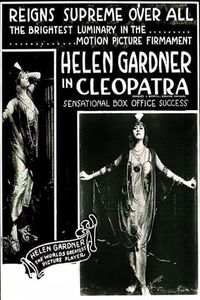
(On Cable TV, August 2020) I admit that I didn’t watch the 1912 version of Cleopatra for the plot. I was far more interested in what a state-of-the-art feature film looked like at the time – this is almost certainly the oldest feature film I’ve seen so far (Un voyage dans la lune is older but much shorter) and it also ranks as one of the first American feature films ever produced. There are, obviously, two ways to see it: Either as its own thing, or insisting on comparing it to what came after. When measured against current movies, this Cleopatra couldn’t be more technically primitive: The acting is as broad as pantomime, the static camera never moves or zooms (although there are a handful of close-ups later during the film, as it attempts to film around the idea of a sea battle) and there are no less than 106 numbered title cards in an 88-minute film. The 2000 restoration is fine, except for the jarring inclusion of songs with lyrics. On the other hand, the film does remain impressive for what it tried doing at the dawn of the movie age: present a full narrative at a time when short films were the norm, and recreate a historical setting through costumes, outdoors shooting and the adaptation of a theatrical play. Cleopatra does remain far more interesting as an illustration of how far we’ve come in nearly eleven decades of movie innovation, but I can see why it wowed the crowds back then.