Filière 13 (2010)
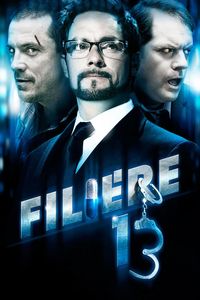
(On TV, October 2020) French-Canadian cinema has an addiction to cop comedies, explained by their relatively low costs, high audience appeal and ease of execution when many French-Canadian actors have a comedy background. There’s usually one every year or so, which is a lot considering that barely a dozen French-Canadian movies ever get high-profile releases. Just have the characters run around Montréal in goofy situations interspaced with stunts or gunplay and you’ve got enough to get audiences in theatres. But not all of them are equally successful, and Filière 13 is a far cry from such successes as Bon Cop Bad Cop or De Père en Flic: While helmed by veteran actor Patrick Huard, this mixture of police action and comedy feels like an awkward mashup rather than a truly satisfying hybrid. The issues start with the script, which can’t quite figure out what story it’s telling: the film starts by showing us three policemen with serious mental health issues (headaches, heartache, and panic attacks), then sidelines two of them in a meaningless stakeout, while the third one gets increasingly stalkerish in his behaviour toward his ex-wife. But everything feels like a subplot until the stakeout characters go for full police overreach and fixate their sights on a white-collar criminal—at which point the real plot of the film kicks in midway through –and even then, in ways that aren’t fully satisfying: The cowboy cop trope is overused to the point of making us care less and less about the characters skirting the edge of sociopathic behaviour. Whatever effective treatment of mental health issues is sidelined in favour of reprehensible behaviour and strikingly unpleasant comic set-pieces: there’s a homophobic sequence here that would have been offensive and out-of-touch even a decade earlier, and the comedic aspect of it (which could have worked in other circumstances) is made worse by what is supposed to be a serious character’s reaction to it. Women don’t get plum roles in Filière 13, with nearly all of them being portrayed as sources of conflicts, and the remaining one played by Anik Jean, being cute to the point of unbelievability. Still, the men don’t do any better: Claude Legault, Guillaume Lemay-Thivierge and Paul Doucet have intriguing characters that are then completely steamrolled by the script. Even André Sauvé (no relation) is a bit of a drawback as a psychologist written so broadly as to be unlikable. In other words, Filière 13 seems to ape a better movie’s building blocks without quite knowing how to put them together—in doing so, it actively manages to do worse than following the usual formula. It’s no wonder it sank without a trace: there have been much better examples of the form before and after.