Flower Drum Song (1961)
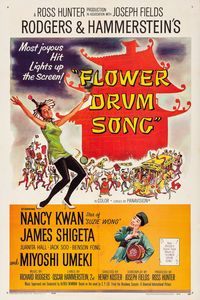
(On Cable TV, October 2020) In racial sensitivity terms, I expected the worst from 1961 musical romantic comedy Flower Drum Song, but was surprised at how much of it still holds up decently today. Oh, it’s certainly not immune to criticism: Its central love triangle inelegantly recreates some Asian stereotypes, the characters are sometimes written in blunt archetypes and the fantasy portrait of San Francisco’s Chinatown is in unrealistic Technicolor. But considering that even sixty years later, it’s still one of the rare Hollywood movies featuring a mostly Asian cast (albeit of mixed nationalities) with male Asian romantic leads, it’s not a bad idea to look at the positive. It does feature racialized characters defined by their own personality traits, with a minimum of condescension, and they all have agency to pursue their own choices. While I may have issues with the film’s length, the way it presents the immigrant experience with far too many references to white-American cultural makers, or the uneven nature of its musical content, it still leaves a striking impression. If I’m less enthusiastic about the film, it’s largely because it’s from a Rodgers and Hammerstein musical, and I don’t particularly like these kinds of musicals as much as others. Still, there are good moments: Nancy Kwan is great (despite being dubbed) in “I Enjoy Being a Girl,” there is a rather dazzling mixture of musical elements in “Chop Suey” (despite lyrics that I find questionable), and “Gliding Through My Memoree” is a truly amusing bit of countercultural appropriation. Still, much of the film’s interest is in the ethnic details rather than the increasingly tedious romantic hijinks that end up forming the film’s last third. But overall, the film remains a high point of Hollywood openness to the Asian-American community—and one that, sadly, would remain as such for decades: considering the fuss that attracted 2018’s Crazy Rich Asians, there’s still quite a bit of work to do there.