Reveille with Beverly (1943)
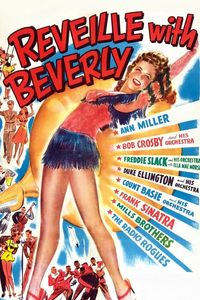
(On Cable TV, October 2020) I won’t try to hide that I watched Reveille with Beverly solely because of Ann Miller—and while the film itself is now almost obscure for understandable reasons, it’s quite a delight for her fans. Here Miller, barely twenty years old (and possibly even nineteen when the film was shot—she played loose with her age early in her career), plays a radio station assistant with dream of having her own show. Opportunity presents itself when the stuffy host of a morning classical music show goes on vacation, leaving her free to shake things up with more modern music. Since Reveille with Beverly was designed as a home-front wartime propaganda film, it’s no surprise if her program is picked up by the local army training camp and then by the wider military forces. There are a few romantic shenanigans between her and two soldiers (resolved by shipping both of them to the front), but the film is primarily an excuse to showcase musical numbers. As the titular Beverly spins the tunes, the camera zooms in on the record and an optical effect takes us to what is essentially a music video of the performance. What’s noteworthy here is the unusually heavy percentage of black artists in the mix—from Count Basie to The Mills Brothers, to Duke Ellington. Musically, there’s some interesting material here—acting as an anthology of 1943 pop music, there are a few classics (“Take the A Train,” and “Night and Day” as sung by Frank Sinatra), plus a few fun surprises: “Cow-Cow Boogie” is fun (sung by Ella Mae Morse), but my favourite is probably “Sweet Lucy Brown.” Non-musically, the film does feature one of Miller’s relatively rare leading roles—and while much of the character is about non-dancing, non-singing comedy, she gets a very brief tap number at the start that foreshadows her climactic tap-dancing singing number. It’s not a great film, and we can understand how the thin plot, sometimes-dated material (including a comedy routine that’s maybe a fourth intelligible to modern audiences given how heavy it is on contemporary references) and wartime nature have made it a bit of a forgotten curio today. But fans of Ann Miller will get quite a kick out of it, and so will students of circa-1943 American pop music.