Month: December 2020

  • Gemini Man (2019)

    Gemini Man (2019)

    (Amazon Streaming, December 2020) As someone who read a lot of middle-tier thrillers in the 1990s, I could tell you about Richard Steinberg’s The Gemini Man… except that Gemini Man is not its adaptation. Although I originally read the novel, twenty years ago, thinking it was going to be the source of the film – the premise of having an assassin facing off against a younger clone has been kicking around Hollywood since the late 1990s, and it’s finally through director Ang Lee and Will Smith that we get to see it on screens at last. Smith is a great choice for the part – not only does he have the pedigree of an action star, he has also been in the public eye since the early 1990s, so it’s easy for viewers to feel, on an instinctual level, the impact of seeing younger and older versions of Smith on-screen at once. Meanwhile, Lee has often been attracted to technically challenging films, and Gemini Man must have been a handful to manage through complex action sequences, wall-to-wall CGI and a mixture of scientific wizardry and emotional drama for it to come together. But does it come together? There’s an undeniable thrill at seeing some of the action sequences: While the CGI is really not always convincing, it is fun to see just how (imperfectly) the state of the art has come and the ways an actor can be duplicated and de-aged. Alas, this technical trick is roughly all that Gemini Man has to offer: The rest of the film seems like a rehash of clichés, Hollywood shortcuts, dull moments, trite dialogue and genetic determinism. Despite a promising concept (dual Will Smiths, not the nonsense cloning fearmongering), the film doesn’t rise to its potential. In fact, once you snip out the CGI sequences, the rest of the film is roughly undistinguishable from dozens of already-forgotten assassin thrillers that have overloaded screens over the years. That’s the point where anyone can look at the film’s two-decade production history and say, “Really? All of this effort for such an underwhelming result?”


  • Booksmart (2019)

    Booksmart (2019)

    (Amazon Streaming, December 2020) While I’ll be among the first to bemoan the excessive coarseness of today’s crop of comedy films, I also have to recognize when something works. Booksmart, for all of its raunchy foul-mouthed riot-nrrd female empowerment protagonists going out of their way to be offensive and crude, is reliably funny from beginning to end. Much of the credit for this success goes to Kaitlyn Dever and Beanie Feldstein for playing a couple of best friends out to have a memorable night on the town: Their obvious rapport is delivered in high-energy fashion, through a crucial 24-hour period that goes to the extremes. Actor-turned-first-time-director Olivia Wilde also manages to nail a tricky tone that balances in-your-face excesses with a solid core of cute sentiment. Booksmart so closely embraces left-wing values of the late 2010s that I’m not sure how well it’s going to age – but then again, I’m not sure how well I’m going to age, and that means not being so quick to tut-tut the younger generations for making their own mistakes. In the meantime, we’ve got a teen comedy that pushes the envelope, sustains a fast-paced rhythm, stars two terrific performances and overcomes its grossest moments with old-school values. I’ll take it: at least it’s not another formulaic superhero film with nothing to say.

  • Guns Girls and Gangsters (1959)

    Guns Girls and Gangsters (1959)

    (On Cable TV, December 2020) There is something a bit too easy in the way Guns Girls and Gangsters is put together – too obvious, like its title. Coming at the tail end of the original film noir movement, it’s perhaps a bit too self-aware about the elements it has to include (like, er, Guns, Girls and Gangsters) but not witty or sophisticated enough to be able to make much out of it. The story has to do with a Vegas armed car robbery pulled off by ex-convicts, complicated by a sexy seductress cheating on one of the criminals with another. Produced away from the major studios, the film feels a bit threadbare when it comes to production values – but it did have the good sense of putting its dollars where the stars were: Lee Van Cleef is an excellent choice as a vengeful husband, while Mamie Van Doren dominates the film as a sultry blonde femme fatale. The narration underscores things a bit too much, exemplifying the theme of excessive self-awareness combined with the lack of skill to pull it off. While thoroughly mediocre (easily in the lower-middle-tier of first-generation film noir thrillers), Guns Girls and Gangsters still has enough to entertain, but it’s going to be as a semi-unintentional comedy more than a hardcore noir.

  • Make Way for Tomorrow (1937)

    Make Way for Tomorrow (1937)

    (On Cable TV, December 2020) Some incredible movies should come with a warning, and Make Way for Tomorrow is a tragic tearjerker in sheep’s clothing. The setup looks as if it’s setting up a comforting watch, as a fifty-year-long couple is forced by economics to live apart “for a while”: They have five children, but none are able to accommodate them both. As time passes, the two elderly parents’ efforts to get back together are fruitless, and their children are of absolutely no help. But if you’re waiting for everyone to figure out a solution, for the cavalry to arrive, for the Hollywood happy ending to wrap it up, here is your last and most essential warning: This is not going to turn out well. Director Leo McCarey (often better known for comedies!) is merciless in hammering the script’s message for 92 almost unbearable minutes. If you really want to be clinical about it, this isn’t much of a film for a narrative standpoint: there is no reversal of fortune, there is no improvement, there are no twists: it just keeps getting worse every single minute. But the most tragic thing about Make Way for Tomorrow (what a title!) is not what specifically happens to the characters – it’s the cold certainty, rarely expressed in cinema, that we don’t usually get happy endings in real life. Unlike film, the camera doesn’t cut away to the ending credits: people keep on living, degrading, becoming increasingly isolated and that is the natural order of things.

  • Book Club (2018)

    Book Club (2018)

    (On TV, December 2020) Cinema should be for everyone, and that includes demographic groups far, far away from mine. Thus enters Book Club, a romantic comedy featuring and aimed at women of retirement age. As four decades-long friends have their mutual social life revolve around a book club, their newest pick is Fifty Shades of Grey, and things pick up from there—from rekindling loveless marriages to golden age online dating to reuniting with an old flame, Book Club keeps things at a naughty titter (which isn’t much, but it’s the thought that counts). Perhaps the film’s most valuable contribution is allowing a cast made of Diane Keaton, Jane Fonda, Candice Bergen and Mary Steenburgen (superb, no matter the age) to play against each other, and provide some representation for a demographic often neglected in mainstream cinema. (Let’s also admire the intricate joke of having Don Johnson play in a film where Fifty Shades of Gray is explicitly mentioned.) The material doesn’t rise much above mediocrity and the humour barely pokes at the PG-13 level, but Book Club is still somewhat endearing – this is a fun group of actresses, and they are apparently having fun here.

  • Think Like a Dog (2020)

    Think Like a Dog (2020)

    (On Cable TV, December 2020) So, if I’ve seen the same film as everyone else, Think Like a Dog is a kids’ comedy with a talking dog in which the mom is played by (check notes)… Megan Fox? And the dad is… Josh Duhamel? Okay, we’ve got the makings of a whole-family pleaser here. Released straight to VOD, this isn’t meant to be a particularly slick, high-end, imaginative kind of production. In fact, it’s almost endearing how closely Think Like a Dog hews closely to an almost-parodic concept of a “talking dog” archetypical family film. Does it work? Sure, if you’re indulgent: the comedy beats are broad, the antagonists are pure caricature and the comic potential of having a dog suddenly being intelligible to humans is only explored at a superficial level. Still, Think Like a Dog is watchable, especially if your expectations are low or if the kids control the remote.

  • Long Shot (2019)

    Long Shot (2019)

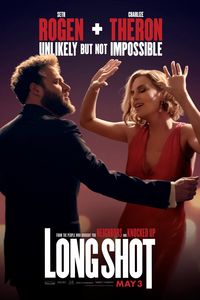
    (Amazon Streaming, December 2020) The question as to whether romantic comedy can blend with a political drama is about as relevant as the odd coupling for Charlize Theron and Seth Rogen in Long Shot. Is this stoner comedy or wish-fulfillment fantasy? Much of the film wants to be an old-fashioned mismatched-couple kind of rom-com; the other half wants to be crude and irresponsible and party on. It’s an odd blend nearly everywhere you look, and it’s to Theron and Rogen’s credit that the film doesn’t split apart from its blended identity. There’s also some weirdness here in the film being almost ashamed of its own liberal leanings and working overtime to do some late-film bipartisanship. But at least it’s funny, and also endearing in replicating the attractive-woman-funny-man archetype. In the end, though –aside from a few moments that could have been toned down—Long Shot makes it across the finish line acceptably enough: it’s sweet and funny and unthreatening enough despite its R rating. It would have been better as a PG-13, but that too is part of its split personality.

  • Rocketman (2019)

    Rocketman (2019)

    (Amazon Streaming, December 2020) I’m not a big Elton John fan, but I’m marginally more of a fan now that I’ve seen the flamboyant jukebox biopic Rocketman. The narrative arc will be familiar, tracking how a shy, self-effacing boy gradually transforms into an exuberant performer, falls prey to addiction, and then gradually climbs back to sobriety while remaining a pop icon. A picture of its time, Rocketman doesn’t shy away from discussing the singer’s homosexuality – and even throws in what’s marketed as “the first film by a major studio to include a gay male sex scene.” The jukebox underscoring all of this, fortunately, is very broad and memorable: Even casual fans will recognize something like a dozen songs, so thoroughly has John’s music permeated half a dozen decades. In the hands of director Dexter Fletcher, Rocketman is a colourful, fast-paced and easy-to-watch homage. The style arguably elbows the substance out of the way, resulting in a sketchier portrait of the person when put against the music and fashion. Still, Taron Egerton does surprisingly well as the singer, and the film almost manages to become an old-fashioned movie musical with its emphasis on impressionistic musical numbers. There’s a formula at play in Rocketman, clearly, but it is very well executed. Watch it once, listen to it twice or more.

  • Sometimes Always Never (2018)

    Sometimes Always Never (2018)

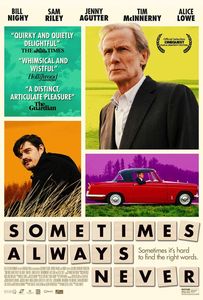
    (On Cable TV, December 2020) Bill Nighy has a considerable amount of charm, but it’s a mistake to think that this specific appeal is enough to compensate for a dull movie project. Sometimes Always Never proves that this is not the case. Nighy ably plays a grieving father who, after years of searching for his lost son, tries to grow closer to his other son, identify a body, and perhaps find his missing son behind an online pseudonym. Stylized, off-beat and yet not quite compelling enough, this is a moody film that tries hard, but struggles to succeed. It’s not as if it’s completely uninteresting – the focus on Scrabble is promising, Ella-Grace Gregoire is very cute, Nighy is up to his high standards, and Alexei Sayle makes a welcome appearance. But despite Sometimes Always Never’s self-conscious quirk, it never manages to lift and carry audiences with it.

  • American Pastoral (2016)

    American Pastoral (2016)

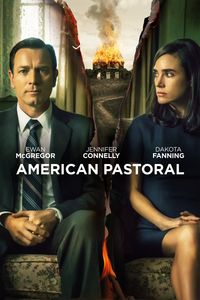
    (On Cable TV, December 2020) As you know, constant reader, there is no need to lump generations in one monolith: We can find greater affinities with similarly minded members of other generations than create artificial divisions between ourselves and OH MY GOD HERE’S ANOTHER ACCURSED 1960s BABY BOOMER MOVIE. Ahem. Sorry. That just came out. Directed and starring Ewan McGregor (born 1971; a GenXer, if that matters), American Pastoral is an adaptation of the 1997 novel by Philip Roth (born 1933; a Silent Generation, if that also matters) that takes place throughout the 1960s. It focuses on an ordinary man as he undergoes crises marked by his wife’s infidelity but, more crucially, the involvement of their daughter in a deadly bombing. The novel sold well and was acclaimed all the way to a Pulitzer Prize; the film is in the process of disappearing without a trace. Directed without flair by McGregor, American Pastoral struggles to have something to say – the daughter is rebellious, the wife grows distant, the father looks for his fugitive girl and… that’s that. The awards-baiting quality of the film isn’t even remotely matched by bland dialogue and unconvincing plotting. I understand that the adaptation is a rushed, slimmed-down and earnest depiction of a novel that’s far more ironic in framing and purpose. Maybe; but the film itself is also long, uninvolving and featureless. Jennifer Connelly is wasted, but she’s not the only one – all of American Pastoral feels like an aimless production. Hopefully, it will unite all generations – against it.

  • Let Them All Talk (2020)

    Let Them All Talk (2020)

    (On Cable TV, December 2020) How did Let Them All Talk go so wrong? It has a genius-level director, an impeccable cast (even just with Meryl Streep, Candice Bergen and Dianne Wiest), the backdrop of an ocean liner, a writer-as-protagonist, the always-cute Gemma Chan, and yet it all falls flat. One of my favourite settings in fiction is the ocean liner – a vast but enclosed space in which dramas can play out on a very romantic stage. But director Steven Soderbergh somehow manages to make it all look and feel so banal. The dialogue is trite and uninteresting, the characters are bland and over-privileged (Oh, no, you based your book on my life and my life is now ruined – get a grip over yourself) and the directing is both flat and unremarkable. Really, it’s as if Soderbergh went on an all-destroying mission to leech away all energy from what he had at his disposal. Part of it can be explained by the film’s production, heavy on naturalistic light and staging, as well (more crucially) on rambling improvised dialogue. But that’s the price to pay for Soderbergh’s unquenchable thirst for experimentation: Sometimes, you get a masterpiece, and other times, you get the antithesis of that. At least there’s Chan to make it slightly better.

  • The Rose (1979)

    The Rose (1979)

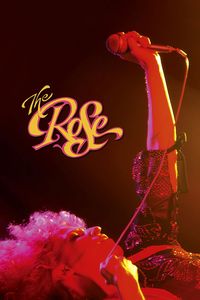
    (In French, On Cable TV, December 2020) If you wanted an actress for a high-energy rock singer biography in the late 1970s, you really only had two choices: Barbra Streisand or Bette Midler. While Streisand had hers in A Star is Born, here is Midler taking on not-Janis Joplin’s role in The Rose. While the script doesn’t stray too far away from the usual showbiz-sex-drugs-and-rock-and-roll template (albeit without a redemption arc, because Joplin was the inspiration and the 1970s were mean like that), the entire film is carried by Midler. Her high-energy performance is far better than the (rather decent) material she’s given, and even at a time when Joplin is a distant memory, Midler is still fit to impress here. Amazingly enough – this was her big-screen acting debut (other than one previous concert film) and she effortlessly crosses from singing sensation to acting. The rest of the film, directed competently by Mark Rydell, is far more ordinary – but the period atmosphere is getting enjoyable with time. Still, The Rose is Midler’s show – and the single best reason to seek this out.

  • Little Women (2019)

    Little Women (2019)

    (Amazon Streaming, December 2020) After seeing a few versions of Little Women through the history of filmmaking, I love that this is a story that gets a remake every few decades. It’s a splendid lens through which to see the evolution of cinema, whether technically, thematically or socially. Keep the same story, but do it differently with a new cast – the differences become the real content. Are you more of a Katharine Hepburn, Wynona Ryder or Saoirse Ronan fan? This newest version, thanks to writer-director Greta Gerwig, is in fairly intense conversation with Louisa May Alcott’s written material– the social values of 1869 being interrogated (but not always criticized) by 2019. It helps that I find the base story comforting – and it’s not hard at all to cheer for the writer-protagonist. Technically, this is the best adaptation of Little Woman to date – superb cinematography, immersive set design, great costumes and top-notch sound design. Acting-wise, time will tell if the all-star cast will endure as well (or better!) than previous takes on the same material. But one thing’s for sure – this is the definitive circa-2019 take. Now let’s wait for the 2039 one.

  • The Lighthouse (2019)

    The Lighthouse (2019)

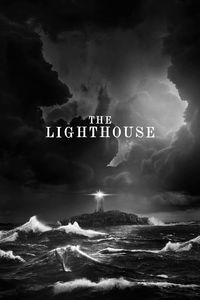
    (Amazon Streaming, December 2020) I’m not necessarily unsympathetic to unusual cinema, but The Lighthouse clearly tested my patience through interminable lengths, sparse plotting, show-off atmosphere, uncertain genre affiliation and a downer ending. Granted, writer-director Robert Eggers has trained viewers to expect strange things from him with The Witch, and The Lighthouse is clearly in a similar genre: minimal cast, closed-off location, astonishing attention to period detail, and no happy ending in sight. Willem Defoe and Robert Pattinson star as two 1890s lighthouse keepers, isolated on an island off the coast of New England, whose rough-hewn camaraderie is tested by cabin fever, ominous portents, hallucinations and supernatural appearances. Or something like that: I use “supernatural appearances” as if this was a done deal when, in fact, this could all be a psychological drama. Naaah — movies are more fun when it’s supernatural, so supernatural is what we’ll call it. And trust me – you’ll need every bit of spare fun in order to make it through this intentionally interminable ordeal. Eggers seems intent on giving you the whole weeks-long experience, just so that you’ll sympathize with the character going stir-crazy. To be fair, Defoe and Pattinson are quite good in their roles (in fact, Defoe is absolutely terrific), their dialect is suitably thick, and the period atmosphere (even in a monochromatically shot hermetic universe like the lighthouse and its island) is so thick it’s almost oppressive. (The boxy aspect ratio certainly helps in creating confinement.) But in the end, and this despite a hefty dose of dark comedy, The Lighthouse leaves no bigger question than “So what?” Eggers clearly shot the film he wanted to, with scarcely any compromise to commercial appeal. I suppose that is something to be treasured in today’s cinematic hyper-financial obsession. But being weird and being worthwhile are not strictly aligned values. After seeing the extraordinary efforts made to make The Lighthouse off-beat and rebarbative, I’m just tempted to shrug and ask again – so what?

  • Nez Rouge (2003)

    Nez Rouge (2003)

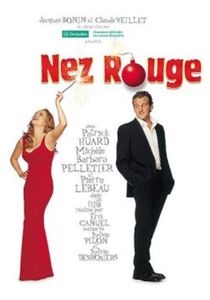
    (On Cable TV, December 2020) One of Québec’s most charming cultural institutions is the Nez Rouge car escorting service, in which inebriated partygoers can call and have a volunteer drive them home in the weeks prior to Christmas. Nominally free (but usually considered a charity service), it’s a near-fixture in French Canada during the first half of December – and you’d be hard-pressed to find anyone with something bad to say about it. In other words – a perfect crowd-pleasing backdrop for a mainstream Christmas romantic comedy. In Nez Rouge, Patrick Huard stars as a literary critic and Michèle-Barbara Pelletier as an author he has harshly criticized: Over the course of the Nez Rouge season, their antagonism becomes something far more romantic. Directed in straightforward fashion by Érik Canuel, Nez Rouge isn’t particularly good, but it scratches the kind of “it’s December, let’s see a homegrown Christmas movie!” impulse that grabs theatre owners, TV programmers and French-Canadian audiences alike.