The Honey Pot (1967)
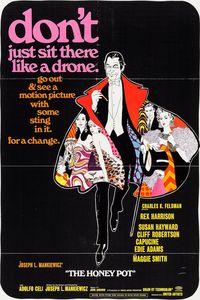
(On Cable TV, January 2021) I’m rarely disappointed by a Joseph L. Mankiewicz film, and The Honey Pot is no exception. It’s clearly a latter-day work by a filmmaker who understands the business inside and out, so deftly does it play with conventions and delivers something that escapes pure formula. It constantly (but smoothly) shifts tone and rhythm in ways that would seem doomed in theory, but works out well on-screen. It starts with a lengthy sequence during which an out-of-work actor is hired by a rich man for a special kind of acting job. Then things change as three past flames arrive, and murder interrupts everyone’s plans. Mankiewicz changes protagonist, plays with voice-overs (all the way to giving a voice to a dead character), messes with story structure and can’t help but include some really good quotable material in the middle of it all. If you think that you’ve got a handle on the story, you’ll keep changing your mind. Rex Harrison turns in a good performance as an aged playboy calling back his most significant past flames, while Cliff Robertson isn’t bad as the one we’re supposed to cheer for (well, maybe)—there’s a Jason Bateman-like quality to his performance that would almost justify a remake. If The Honey Pot has a flaw, it’s that it’s very obviously a film that relies on being different—the behaviour of the characters is clearly manipulated by the demands of the script, the overly cute references to other material or the artificial conventions of romantic comedies. The last few minutes of the film rely on a wrinkle of inheritance law that clearly belongs to legal fiction. But, somehow, it works. Even the damp dark depressing setting of overcast Venice (done 1970s-style in what looks like an un-restored print, which is even drearier than reality) can’t quite sap the narrative inventiveness of the result. I strongly suspect that The Honey Pot won’t sit well with viewers simply looking for something simple to watch. But it’s a bit of a gift to jaded audiences looking for someone intent on colouring outside the lines.