And Now a Word from Our Sponsor (2013)
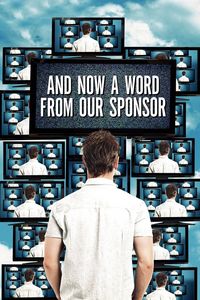
(On TV, February 2021) The lineage going from Being There to And Now a Word from Our Sponsor is obvious. Both films feature central characters speaking in gnomic utterances that allow the other characters to pick and choose the meaning they want. While Being There’s character was a certifiable simple-minded innocent speaking in the familiar language of gardening, the protagonist of the later film is a brain-damaged ad executive who wakes up from a cerebrovascular incident, only able to speak in ad slogans. No, it’s not meant to make sense: this is a comedy, and I suppose that the larger point being made has something to do with how advertising takes over our brains and shapes our language. (I’m looking, or rather not looking forward to the movie in which the characters only speaking in memes and media quotes, but that could be too asinine to tolerate.) In execution, the film often feels like a showy exercise in screenwriting and acting. I’m sure that writer Michael Hamilton-Wright must have high-fived himself in the mirror upon coming up with some of that stuff, but at times the film is obviously contrived to lead up to some punchlines. Fortunately, there’s Bruce Greenwood to convincingly deliver the material — and since the words don’t always manage to convey what he thinks, it’s all up to his body language to fill in the rest. Heck, you could even argue that this is close to a silent performance given how the content of the dialogue is so irrelevant. (The film’s end-credit sequence features an alternate take of the film’s single most impressive one-shot in which Greenwood sings his lengthy dialogue.) Once you learn to accept the conceit, And Now a Word from Our Sponsor works in fits and spurts —the material between mom and daughter works well, even as the corporate takeover shenanigans are less convincing. (Although it does lead to a slogan-to-slogan verbal joust.) Parker Posey looks wonderful in glasses and long hair, bolstering a role that does give her some good dramatic material to chew on. Still, director Zack Bernbaum’s work is more akin to a performance piece rather than something to authentically enjoy — there’s a feature-length air of “watch what I’m about to do!” that does entertain, but also reinforces the artifice of the story. The conclusion is what reinforces the parallels between this film and its more illustrious 1970s predecessor — like Chance Gardner, the last scene featuring our protagonist hops into magical realism to offer you a variety of possible interpretations. My own take is that in hearing a slogan repeated back to him, he has finally become one with the all-consuming noosphere—but I’ll let you figure out your own meaning.