Show Boat (1951)
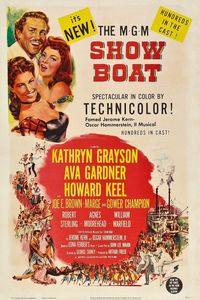
(On Cable TV, February 2021) It’s not unfair to criticize a film for shortcomings external to the film itself. If you accept that a good chunk of criticism is assessing if a film meets its own objectives, it becomes fair game to explore the production history for the film to explain on-screen issues — and assess whether the filmmakers were on an impossible mission. On a surface level, Show Boat feels a lot like the pinnacle of the MGM musical circa 1950. The original Broadway show is reportedly a landmark in American musical history, being the first to combine serious dramatic themes in a musical form until then used for more comic pursuits. The big-budget production re-creates the Mississippi on the MGM backlot, along with a show boat that has little basis in reality. The visual sheen of the production is immensely colourful, with dozens of extras milling through the musical sequences as the film re-creates the lifestyle of a travelling troupe of actors making their way up and down the river. So far so good — I really enjoyed Show Boat when it focused on those elements, and would have given high marks to the film had it stuck to that. But there’s a lot more on Show Boat’s mind than what I’ve described so far — in addition to doomed romance between mismatched partners, it makes quite a bit of a subplot featuring a half-black character passing as white, and the impossibility of any interracial relationship at the time the film is set. Unfortunately, Show Boat self-destructs on that subplot: The half-black character is played by the very white (and not-a-singer) Ava Gardner, and a peek at the production history of the film reveals that no less than the divine Lena Horne was considered then rejected for the role, reportedly because her very blackness went against the Hays Code’s ban on interracial relationship on-screen. This is infuriating enough, but it’s even worse considering that the re-creation of the musical in Till the Clouds Roll By did include Lena Horne in that role. It doesn’t help that much of Show Boat, as presented here, is a bit dull — the comedy of the film quickly disappears, and the more dramatic material seems kneecapped by the film’s own production constraints. The only sequence that I completely enjoyed is the acknowledged highlight of the film — William Warfield’s fantastic take on “Ol’ Man River” — an anthology piece if the film has one. I find it telling that while Show Boat was meant to be MGM’s big musical of 1951 and was initially a solid box-office success, contemporary audiences only have eyes for that other mildly successful MGM musical of 1951: Singin’ in the Rain.