It’s a Great Feeling (1949)
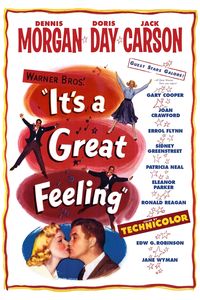
(On Cable TV, March 2021) As much as I’ll take any occasion to recommend classic Hollywood movies to everyone, there are a few movies that are best seen once you’re a few hundred titles deep in the Golden-Age Hollywood back-catalogue. Many of them are films that are best classified as parodies, satires or ensemble comedies poking fun at the other movies churned out by Hollywood at that time. It’s a Great Feeling is a crystal-clear example of that form, as it tells viewers a tall tale about a young actress being discovered by a studio that becomes eager to feature her on the big screen. The point of the film, however, isn’t as much the plot as selling, in colour!, the fantasy of the studio system at the end of the 1940s, and more specifically Warner Brothers’ stable of contract actors. Doris Day, in one of her earlier, more free-wheeling roles, plays a cafeteria girl with big dreams who tries to make nice with the director and lead actor of an upcoming prestige production… but things soon turn awry when they have to get studio head approval. Nearly everyone here plays themselves, at the exception of Day, the studio executive and a few character roles. From the first moments of It’s a Great Feeling (featuring directors Vidor, Curtiz and Walsh turning down a project), there are many, many cameos and finding them funny is a litmus test on your knowledge of circa-1949 Hollywood. The best of those cameos has to be Joan Crawford, throwing a hissy fit as the protagonists because that’s what she does in every film. Also funny is Edward G. Robinson convincing a security guard to play up his image as a tough guy. More conventional comedy segments (such as a still-funny series of technical mishaps sabotaging a screen test) are interspaced between a few musical numbers to showcase Day’s singing talents. The clever script, written by frequent Billy Wilder collaborator I. A. L. Diamond, spoofs Hollywood without quite criticizing it (polishing its mythology in doing so) but keeps its most iconoclastic joke for the end, as Hollywood life isn’t for our protagonist… and then immediately flips that joke on its head with a quick final cameo that may or may not work as a comedy capstone depending on whether you recognize Clark Gable. In some ways, it does feel like a backlot-budget version of other better musicals of that time, but the style of comedy here is very specific and quite specifically dated to 1949. These days, It’s a Great Feeling works best as an inside joke for classic Hollywood fans — spot the celebrities, bask in the idyllic portrait of studio contracts and smile at the not-too-satirical take on something that was intensely familiar to everyone involved in the film’s production.