Life Like (2019)
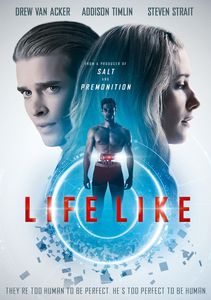
(On Cable TV, March 2020) Every so often, a low-budget science fiction film just gets stuck in my craw. Most of the time, it’s because the filmmakers involved don’t understand the subtleties of Science Fiction as well as your average SF prose writer, and think that the genre is just an excuse to say anything without rigour. (The contrary is true—since SF has anything-goes potential, it has to be more rigorous in order to get people to accept its deliberate deviations from reality.) That’s how we end up at the confounding, somewhat obnoxious Life Like—A Science Fiction thriller that actually doesn’t have the guts to remain Science Fiction, but boldly reinvents obvious ideas while it still pretends to be. (Unlike the film, I won’t try to deceive you: Spoilers are coming… so prepare yourself.) From the first moments, it’s obvious that writer-director Josh Janowicz’s film is going to be ham-fisted and detestable, but the true magnitude of it only becomes apparent later. The characters are unlikable from the get-go (what with the female lead firing servants without consulting her husband, but then interrupting him at work with substantial entitlement) and the plot only gets more vexing when this ultra-rich couple gets themselves an android as a servant. The script barely makes sense at this point, but just wait—it’s the good old story of a boy and a girl getting an android, and then getting into all sorts of psychosexual shenanigans. If you’re thinking “ménage à trois,” congratulations—you’re smarter than the script’s third act, which (after making a fuss about how androids are better than humans) finally reveals that the android… is really a human? Wait, what? The film’s clunkiness implodes on itself at this point: why should we care about such a terrible film so ill-conceived from the get-go? It’s not a third-act twist—it’s nonsense that doesn’t even fit with the thematic concerns so badly articulated in the film’s first two acts. Life Like, ironically enough, is fake from beginning to end—in conception, in characterization, in execution, in themes, in plot, in progression. The third act becomes a thriller that barely resolves anything nor builds upon earlier themes of slavery, psychosexual desire and misguided religious symbolism. It’s so terrible, it would have been vastly improved had it been made as a pornographic film.