The Private Life of Henry VIII. (1933)
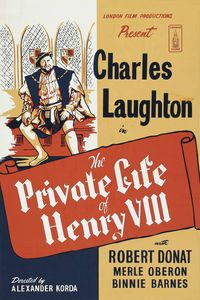
(On Cable TV, May 2020) Alexander Korda was a foreign-born British film producer who sought glory in many ways, and not necessarily his own personal glory. His filmography is packed with movies that extolled British virtues and crowd-pleasing entertainment that revitalized British cinema itself. He believed that movies could effectively influence minds, and he got an early reward for this belief in The Private Life of Henry VIII when that film triumphed at the box office, and won the first-even Academy Awards given to a non-American film. Later on, the uncouth and gluttonous portrait of Henry VIII as depicted in the film became, unfairly, how newer generations began to perceive the historical character. It certainly helped that the king was played by none of that Charles Laughton, looking quite young at times: it became his breakout role and the one that won him an Oscar. Surprisingly enough, this is a black-and-white historical epic that has aged far better than you’d expect—it’s often a gentle comedy even in the opening credits, as one character is said to be of no interest in being a “respectable lady.” The irreverent touches of humour continue throughout the film, with some moments playing in a very iconoclastic fashion. Better than expected, The Private Life of Henry VIII gets a few honest laughs: the chicken-eating scene is funny, as is the divorce negotiation sequence. The humour partly comes from the early matter of love and marriage in a royal context, partly from the court’s difficulties in adjusting to a difficult king, and also partly because of Laughton’s performance itself. Far less stuffy than a history lesson, The Private Life of Henry VIII clearly reached its audience and continues to do so—but be wary of thinking that this is a historically accurate film.