Aaron Sorkin

  • The Trial of the Chicago 7 (2020)

    The Trial of the Chicago 7 (2020)

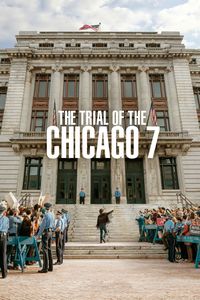
    (Netflix Streaming, February 2021) The events surrounding the National Democratic Convention of 1968 are still amazing enough that I kept being surprised no one had made a movie about them. But the wait is now over, because Aaron Sorkin’s The Trial of the Chicago 7 is here to tell us how it all went down, albeit with a typically skewed-enough-to-be-interesting perspective. Largely taking place months after the Convention, this film is built around the courtroom drama of how organizers of the protests during the convention were tried for various crimes. The approach allows us to see effect before cause, or rather to keep exploring the core events after their sometimes-tendentious description. With Sorkin at the pen, it’s no surprise if the film proves amazingly full of great lines, clever scenes and substantial roles for the actors to dive into — although one notes that the dialogue feels a bit less self-consciously flamboyant than in previous Sorkin films, and appropriately so. This does shift much of the praise about the film to the exceptional cast assembled for the occasion — too many to mention in a capsule review, although Sacha Baron Cohen deservedly gets much attention as Abbie Hoffman, a great case of a larger-than-life actor playing a larger-than-life historical figure. As usual for Sorkin, there’s a lot to like in the way it ferociously engages in political material, this time poking at history in order to make a point about current concerns. This intention, combined with above-average execution of material that could have ben unbearably dry in lesser hands, makes The Trial of the Chicago 7 a great engrossing film, and one with additional relevance right now.

  • The American President (1995)

    The American President (1995)

    (In French, On TV, April 2019) At this point in American history, the idea of a likable, virtuous, law-abiding president is the stuff of comforting fantasy, so here’s The American President to remind us of what that was like. This rather charming romantic comedy takes on the premise of having a widowed president woo a lobbyist. Written by Aaron Sorkin, the film can certainly be seen as a dry run for The West Wing—voluble, clever, and idealistic at once. (Checking the film’s original English-language quotes, it’s obvious that the film loses something in translation.)  Even though other movies and shows have mined the same terrain since 1995, The American President still provides an interesting glimpse at the heart of a presidency, and doesn’t forget to tackle the more honest aspects of the power dynamics of a relationship between the president and a citizen. A great cast anchors Rob Reiner’s straightforward direction: While Michael Douglas gets to play the president opposite Annette Bening’s fiery lobbyist, the film can also count on Martin Sheen (I told you it was a West Wing dry run), Michael J. Fox and John Mahoney. The American President is a good movie, but the current political context makes it even better, with its romance being as idealistic as its political nature—presupposing a president of good moral character and a concerned effort to curb emission gasses. It is a bit disheartening to hear a film nearly twenty-five-year-old tackling things that really should have been done back then. But when it comes to escapism, Hollywood does it best.

  • Molly’s Game (2017)

    Molly’s Game (2017)

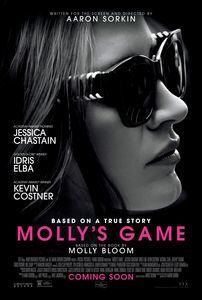
    (On Cable TV, October 2018) So… Jessica Chastain as the lead in an Aaron Sorkin film? You definitely have my attention. But Molly’s Game goes many steps further in giving us a real-life story of poker, Hollywood, organized crime, Idris Elba, a brainy leggy heroine and a two-hour stream of patented Sorkin dialogue. A fascinating example of an adaptation that goes further than the source material, this film not only adapts the content of Molly Bloom’s story as published in the original Molly’s Game, but updates it through a framing device taking place after the book’s publication. The fascination here is evenly distributed between Sorkin’s usual brand of rapid-fire witty dialogue, Molly Bloom’s extraordinary personality and Chastain’s uncanny ability to inhabit the role. It’s a great match between actress and subject, as the attractive Chastain gets to play a ferociously smart character who turns to the legally dubious side in order to make a living. Her conceit is simple enough: take care of all the necessary arrangements for wealthy poker players to have their regular games. It’s not entirely legal, certainly not completely safe, and much of the film’s interest is in detailing all the precautions she has to take in order to attract and retain the high-rollers while protecting herself. Michael Cera plays against type as a slimy Hollywood actor (reportedly Tobey Maguire) who ends up becoming one of Molly’s worst opponents, while Elba is his usual charismatic self as a high-powered lawyer. Sorkin also has fun directing his own script, fully getting into his heroine’s mind and history. (Kevin Costner pops up for a few scenes as her father, and gets a great scene in which he fast-forwards through years of therapy with his immensely intelligent daughter.) At 140 minutes, Molly’s Game is not a short movie, but it is seldom less than engrossing thanks to its script, directors and multiple subject matters. It’s thoroughly entertaining, and a strong demonstration of what Sorkin and Chastain can do at their best.

  • Steve Jobs (2015)

    Steve Jobs (2015)

    (Video on Demand, March 2016) It’s a good thing that Ashton Kutcher’s critically-dismissed Jobs (2013) exists, if only as a point of comparison to the far more audacious Steve Jobs. Both try to capture on-screen the life of the famously abrasive Apple co-founder, but the first plays it as straight as it can, while the latter takes a far more experimental approach to its subject. The crucial decision in making this film special is screenwriter Aaron Sorkins’s crucial intuition to structure the film around three key product presentations, allowing the film to focus on Jobs at three moments in his life. The consequences of this choice (including how mini-stories condense around those crucial moments) are nowhere near historically accurate, but they do make the film far more powerful. It helps that Steve Jobs is directed by Danny Boyle, who shoots each act differently and brings just enough of his stylistic experimentation to bear. Michael Fassbender doesn’t look all that much like Jobs, but he creates a mesmerizing performance that carries the character. He’s ably supported by a number of good actors used effectively, but the star of the movie remains the script, with its overlapping dialogues, technically accurate jargon, fast-switching subplots and quotable moments (“I play the orchestra”). It amounts to a surprisingly good film, made even more surprising by how audience may think they already know enough about Jobs. And that may be Steve Jobs’s legacy: a thrilling execution that manages to prove that a fresh angle is often enough to make the familiar fascinating again.

  • The Social Network (2010)

    The Social Network (2010)

    (In theaters, October 2010) I will admit my scepticism regarding the idea of this film.  A drama about Mark Zuckerberg and Facebook’s early days?  Why would David Fincher waste his time doing that?  Granted, I find Facebook more interesting as a socio-technological phenomenon than as the hub of my online life, but still:  Isn’t it a bit early to start making films about such a trivial subject?  What I should have figured out is that five years ago is forever in Internet time, that Fincher knew what he was doing and that there was an interesting story at the heart of it all.  Very loosely based on Ben Mezrich’s docu-fictive The Accidental Billionaires, The Social Network does manage to tell a compelling drama in an entertaining way and even comment on a few contemporary issues along the way.  The heart of the piece is in the story of how intellectual arrogance and runaway success can ruin friendships, but the real delight of The Social Network is in the ever-compelling script penned by Aaron Sorkin, from a fast-paced first dialogue that sets the tone, to a structure that jumps back in forth in time (the latter chronology being nowhere in the book), to the clever weaving of themes between old-school social clubs and new-style social media.  As an acknowledged nerd, I was stuck at the picture’s fairly accurate portrait of how some very smart people behave, as well as the accuracy of some technical details early in the film.  Fincher’s direction may be less visually polished here than in his other film, but it’s effective and coherent: this is a solid drama, and it deserves a flat and grainy picture.  (The film’s most striking bit of visual polish, at a regatta, echoes the miniature-faking tilt-shift focus meme that briefly fascinated internet photographers a while back.)  The Social Network also benefits from a number of striking performances, from Jesse Eisenberg’s deliberately stunted portrait of Zuckerberg to Justin Timberlake’s magnetic Sean Parker to Armie Hammer’s Winklevii.  Part of the appeal is seeing high-powered people interacting (the script uses a “that’s the famous person” joke at least twice to good effect.) in ways that are at least plausibly based on reality.  It all amounts to a film that’s quite a bit better than the sum of its parts would suggest –true moviemaking alchemy that leaves viewers wondering how and why it all worked so well.