Benny Goodman

  • The Benny Goodman Story (1956)

    The Benny Goodman Story (1956)

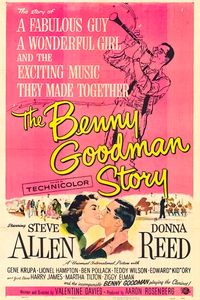
    (On TV, October 2020) I never expected to have watched so many movies about American band leaders, even less having an opinion on them, but we’re in the middle of a pandemic and weirder things are happening. There aren’t many clearer illustrations of how American pop culture has evolved as how band leaders have been replaced by other kinds of stars (usually lead singers of musical groups) in the popular imagination. Now, I’ve had a soft spot for Benny Goodman for plenty of reasons—Goodman was image-conscious, he regularly showed up in Hollywood movies between 1937 and 1948 and as luck would have it, I ended up watching his only featured role in Sweet and Low-Down a few weeks before The Benny Goodman Story. Here, Steve Allen (who would go on to become an exemplary talk-show host) has a credible take on Goodman, round glasses and general bonhomie included. The film is clearly in the Hollywood biopic mould, focused on his long-running romance with Alice Hammond (Donna Reed), whose character comes to exemplify the acceptance of Goodman’s brand of “hot” jazz by the American mainstream. There’s plenty of music to go along, and his classic cover of “Sing, Sing, Sing” is kept for the very end of the film. The Benny Goodman Story is an enjoyable film (and it’s just as good as something you listen to while doing other things) and a decent immortalization of Goodman. There’s some illustrative value here for jazz enthusiasts in depicting the transition of the art form into a more modern form, as well as a modest message of integration along the way.

  • Sweet and Low-Down (1944)

    Sweet and Low-Down (1944)

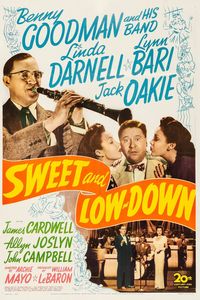
    (On Cable TV, September 2020) Few things get me thinking about the changing nature of pop-culture as much as seeing Classic Hollywood movies presenting band leaders as celebrities. Glenn Miller, Tommy Dorsey and Kay Kyser have each played or been played in major Hollywood productions of the time, and if Sweet and Low-Down has any claim to enduring worth, it’s in presenting Benny Goodman playing Benny Goodman in a fictionalized story about a band leader (Goodman, naturally) taking a young musician under his wing. There’s more conflict than you’d expect, especially at the end, but the story of the film is almost inconsequential when compared to having captured Goodman and his band doing what they did best. The music is particularly good if you’re a fan of jazz and swing (or even swing revival genres such as swing-house, which samples a lot of this material)—there’s a really good jam session in there that’s worth a listen. Goodman himself plays a mean flute in one of the film’s highlights. The film’s lack of narrative makes a bit more sense when you realize that it was made as counterprogramming for heavier military propaganda films on the home front, and as entertainment for the troops abroad. While Sweet and Low-Down is practically obscure these days (most people are more likely to associate the title with the 1999 Woody Allen movie—I know I did!), I really enjoyed the look at pop culture as it existed then. Benny Goodman is an immortal, though, and we’re insanely lucky to have preserved on film some of his charm and musical talent.

  • Stage Door Canteen (1943)

    Stage Door Canteen (1943)

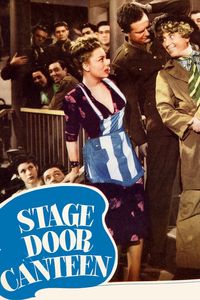
    (On TV, March 2020) What you should know before watching Stage Door Canteen is that it’s very much based on a true story. During World War II, Hollywood stars (led in part by Bette Davis) financed and staffed a canteen for soldiers on leave from 1942 to 1945—as a photo opportunity for Hollywood’s commitment, it was beyond ideal. But the Hollywood Canteen was preceded by New York’s Stage Door Canteen, which drew upon Broadway talent to operate the establishment. That relative lack of cinema star power on the east coast was quickly fixed when Hollywood adapted the concept for revue-like musical Stage Door Canteen. The story, about a serviceman dating a stewardess encountered at the canteen, is a mere device to string along musical and comedy acts in a recreation of what could have been the experience of sitting in the canteen on its best nights. (While this film does mention the no-fraternization rule between hostesses and servicemen… it then goes on to ignore it. There’s no real way around the implied “prostitution for the country” aspect of having hostesses entertain the troops, although it’s not quite as off-putting as a similar subplot in sister film Hollywood Canteen.) Still, the main reason to watch Stage Door Canteen is the various cameos, bit parts and performances. Of note is Ray Bolger’s dancing, the chastest stripping routine ever performed by Gypsy Rose Lee, as well as short cameos by Katharine Hepburn, Tallulah Bankhead and Johnny Weissmuller, among many others. What’s equally entertaining is the way explicit propaganda is worked into the film as if it was perfectly normal—Gracie Fields singing “Machine Gun Song” (a funny song about a jet pilot shooting down other planes) has to be the crowning moment of that aspect of the film. To twenty-first century viewers, though, the entire film is a remarkable cultural artifact: a reflection of an entirely different wartime, a weaponized blend of propaganda entertainment and a glimpse as people who were stars in their own time but, as of now, have all more or less fallen into obscurity. Sic transit gloria and all that—but I’m happy that something like Stage Door Canteen exists to capture it all.

    (Second Viewing, On Cable TV, April 2021) Considering that Stage Door Canteen is the twin film to Hollywood Canteen, a recent second viewing of one quickly led me to the other. Much like the real-life Hollywood Canteen (opened October 1942) attempted to replicate the success and good will of the real-life Stage Door Canteen (opened March 1942) in having Broadway stars servicing US servicemen, this 1942 film is a first capture of something that would be imitated and perfected in the later 1944 film. Both plot and approach replicate its sister film, as a serviceman falls in love with a member of the canteen (a volunteer rather than a star this time around), and several celebrities appear in-character as performers or volunteers at the Canteen. In between the short bursts of fictional dramatic scenes, we get a front-row seat to some of the acts performing at the canteen – essentially a revue show. That too is very much in-sync with the other Canteen film – except that this time around, the arcs are heavier on the music and a bit less on the comedy. There’s one striking exception, though: A “striptease” number from the legendary Gypsy Rose Lee, both cute and funny because, as her performance constantly reminds the leering sailors, there’s a hard limit to how much she can take off. It’s probably the most innocuous striptease you’ll see, as well as one of the funniest – and it’s a great showcase for her. While Stage Door Canteen doesn’t have as many Hollywood stars as the first film, it does feature an exceptional assortment of bands: Count Basie, Benny Goodman, Kay Kyser and Guy Lombardo can all be seen here. Other good comedy/musical numbers include Edgar Bergen having fun with a ventriloquist puppet, a “Machine Gun Song” combining novelty song with patriotism and Katharine Hepburn showing up at the end. While inferior to Hollywood Canteen in most respects, this earlier film does one thing better, and it’s being somewhat self-aware of the terrible optics of offering the hostesses as love interests for the boys: While there is some romance-rewarding-the-troops, the film does begin with the character being fired because of excessive fraternization with the soldiers. It’s not much, but it’s already a bit better than the borderline-prostitution plot of the other film. As with many revue shows, Stage Door Canteen is often best appreciated as a document of past entertainers showcasing what they did best – the Lee number alone is fantastic, and that’s before getting into the band leaders.
  • A Song Is Born (1948)

    A Song Is Born (1948)

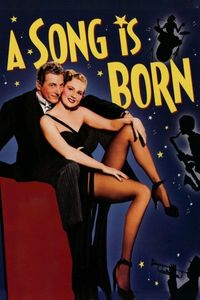
    (On TV, January 2020) By sheer coincidence, I happened to have A Song is Born sitting on the DVR right after seeing Ball of Fire — The first film being a musical remake of the second. Considering how much I liked Ball of Fire, I was both curious and apprehensive about a remake, especially one made barely seven years after the original and by the same director Howard Hawks. Of course, it turns out that there were at least two reasons for the remake: picture and sound. For one thing, A Song is Born is shot in glorious early-colour cinematography, improving upon the atmosphere of the original and making it just a bit more accessible to modern audiences. For another, A Song is Born clearly listened to those who raved about the musical number in Ball of Fire and repurposed the plot to focus on musical elements. Our encyclopedia-writing professors are now putting together a compendium of musical styles, and the lounge singing aspect of the heroine takes far more importance. According to the historical record, production on the film was difficult (Howard Hawks coming back as a director solely for the paycheque, lead actor Danny Kaye being in the middle of a rough divorce) but little of it is visible on-screen as the film bounces from one comic set-piece to another. In many ways, A Song is Born is not as good a movie as Ball of Fire: Danny Kaye is working only at half-speed compared to Gary Cooper (Kaye’s divorce had an impact on the film in that Kaye refused to sing—with the result being a musical in which the lead actor doesn’t sing: strange!), and the set-pieces seem far more deliberate than the first film. Most modern viewers will miss an entire layer to the film that was obvious to late-1940s audiences: the film is crammed with cameos from then-famous musicians. If you’re not familiar with the era, many jokes will fly over our heads –the (admittedly very funny) Benny Goodman sequence being a case in point, as he plays a professor being asked to perform as Goodman would. Still, A Song is Born does have its qualities: it’s very amiable, does change just enough from the original film to feel fresh, and -in its own way—affirms how good the first film was. It’s not quite as good indeed, but I didn’t have the impression that I wasted my time having a look at it.