Carrie-Anne Moss

  • The Matrix Resurrections (2021)

    The Matrix Resurrections (2021)

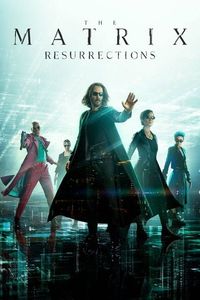
    (Youtube Streaming, December 2021) Is it really a surprise if a Wachowski film ends up being a mixed bag of highs and lows? After all, that’s been the norm for them even since The Matrix — they never quite managed to recapture the blend of elements that made that film such a success, and it’s not The Matrix Resurrections that will break the streak. Let me be clear: The first Matrix film is (now) a classic, and (still) one of my favourites: As such, I could help but be attracted to and apprehensive about the idea of a belated sequel. To its credit, this fourth instalment does grapple with that apprehension: it features a lot of meta-referential material, especially in a first act that seems delighted in rerunning through the first film’s key scenes while joking about how it refers to it. Alas, it doesn’t start the film on the right foot: that first act can be tedious at times, as the references pile up and so many clips from the first films are shown that it creates the impression that this newest take lacks confidence in itself: “See how cool those first movies were? Yeah, we’re in that tradition!”  Except that it is not, at least crucially in the execution. While many will appreciate how Lana Wachowski, Keanu Reeves and Carrie-Anne Moss are back, the absence of Bill Pope (cinematography), John Gaeta (Special Effects), Don Davis (score) and Zack Staenberg (editing) is far more noteworthy: The atmosphere of The Matrix series is absent, and what replaces it seems perfunctory most of the time. The action sequences are underwhelming (although they get better toward the end) and there’s nowhere near the degree of visual innovation in the Wachowskis’ previous work. As for the story, things improve after a fan-fiction-worthy first act: That’s when The Matrix Resurrections finally finds its own plot, makes intriguing additions to the canon (well, not all of them — I’m still wondering why Lambert Wilson showed up if it was to be a green-screen special) and engages in a surprisingly romantic arc. It’s the Matrix, but doesn’t much feel like it: in-between the humdrum directing and a script that features very little memorable material, it feels like a disappointment. Of course, the question can be: what was I expecting? One can’t step in the same river twice and all that, but even then, the result seems both ambitious and timid at once. I expect that it will take a while for people to decide whether this is a good film (let alone a fitting follow-up)… and I’ll probably have another look real soon to take it all in again.

    (Second Viewing, YouTube Streaming, December 2021) Whew—I hadn’t revisited a film critically at less than a week’s notice since, well, the last Matrix movie. But a second look at The Matrix Resurrections doesn’t really change my mind — There are some really interesting things in the concepts featured in here that are ill-served by their execution. A fair amount of meta-commentary on the nature of a next-generation sequel is amusing, but there’s a point when the self-reference becomes a dismissive poke at the fans who are the reason why the film was produced. (Similarly, self-awareness can be catnip for detached critics and a really great excuse for anyone arguing in bad faith to say, “If you don’t like it, you’re not smart enough.”)  Similarly, I liked the bold flashforward sixty years after the previous instalments and how some things have evolved, while others have not panned out to the previous generation’s hopes. But that aspect is shoehorned and relegated to supporting material, as the film is first consumed by its self-referentiality and then by a far less cerebral love story that feels stretched to twice the length it really needed. The idea of undermining the idea that Neo is the One to make him part of a pair is intriguing, but it’s completely botched in the execution, with a point made about him being supported by a flying Trinity… only to cut to a scene where the flying thing is a done deal. I certainly haven’t changed my mind about the lacklustre and plodding action sequences that are pale shadows of even the worst moments of the original trilogy. I thought that a lower budget may have been a factor, but then I learned that the film still costs a generous $160M to produce — clearly cost was not the limiting factor here, especially with cheaper CGI now available. Even after a second go-around, I’m still thoroughly mixed on the result, probably tipping toward “disappointed” — The Matrix Resurrections is not terrible, but it certainly causes irritation in many of the unforced choices it makes. Was that the result worth waiting twenty years for? Expectations do count for much.
  • Knife Fight (2012)

    Knife Fight (2012)

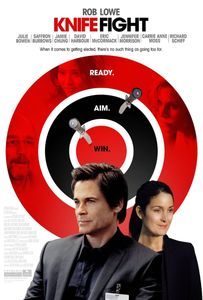
    (On Cable TV, July 2015) As a political junkie, campaign strategist is high on the list of dream jobs I’ll never have –but Knife Fight is good enough to make me live the experience vicariously.  Starring Rob Lowe as an expect fixer working for political campaigns, Knife Fight delves deep into the dirty tricks deployed to make sure that “the right guy” wins.  Interestingly, this does comes with a bit of soul-searching about what “the right guy” means and whether there’s a correlation between being a good leader and a fallible human being.  Knife Fight certainly isn’t a perfect film (its chronology is a bit strange, it doesn’t delve quite long enough in the dark side of the dirty tricks, practically repeats itself at times, and gives short thrift to a few characters), but it’s unusual in that it’s co-written by an actual campaign consultant and so has more than a whiff of authenticity to it.  Other than Lowe, who’s clearly having fun, the film does have a few likable performances by Jamie Chung as a budding strategist and Carrie-Anne Moss as an improbable gubernatorial candidate.  Knife Fight will most directly appear to left-leaning political junkies with its mixture of behind-the-scenes manipulation, wry humor and satire.  It’s an enjoyable comedy in a very specific mold, and all the better for it.

  • Unthinkable (2010)

    Unthinkable (2010)

    (On DVD, January 2011) Direct-to-Video thrillers are usually exercises in cheap minimalism, bad dialogue, paycheck-grabbing C-list actors and little lasting impact.  But not always, and Unthinkable is that rare example of a D2V film that should have played in theatres… even if few people would have seen it.  Deliberately structuring its premise on a manipulative scenario, this is a horror-thriller hybrid that sets out to explore the moral choices in torturing a terrorist that may know where a few nuclear bombs are ticking away.  Carrie-Anne Moss is the audience’s stand-in as a FBI agent confronted with the lengths at which the US government will go in the name of national security; she’s faces down not only Michael Sheen as an uncommonly-prepared terrorist, but also Samuel L. Jackson as a “consultant” who’s as ruthless as he may be necessary.  Jackson’s performance is showy: At times threatening, charming, sociopathic and respectable, he’s the devilish imp whispering about the dark side that torture apologists are ready to embrace –and he’s easily one of the top reasons to see the film.  While Unthinkable eventually tips its hand toward the dramatic demands of the ticking-bomb scenario, it does so in a way that doesn’t shy from the moral stains that accompany the choice: there are at least two oh-cripes! moments where the film escalates well beyond what we’re used to see, and the constant horror-film atmosphere is as disturbing in its depiction of surgically-precise torture as anything else.  Suffice to say that film sticks in mind well after a good chunk of what’s in theatres fades away.  On the other hand, similar (yet far more gentle) films tacking contemporary moral issues such as Rendition, In the Valley of Elah and Lions for Lambs all flopped spectacularly at the box-office.  If you listen really carefully to the intriguing DVD audio commentary, you can almost understand that the film’s producing company got in financial trouble in early 2009 and a direct-to-DVD releasing strategy became the only way for the film to reach a public.  No matter, though: The result is an unnerving mixture of techno-thriller premise with a horrific tone.  The DVD offers a solid audio commentary (stay tuned for the discussion of their very special “subject matter consultant”) and an alternate ending that’s even grimmer than the finished film.

  • The Matrix (1999)

    The Matrix (1999)

    (In theaters, March 1999) Oh! That’s probably one of the few things left to say right after seeing this film. Oh cool; a mixture of Hong Kong-style action, far-out existentialist Science-Fiction, straight-out over-the-top theatrics and pure imagination. Oh sharp; the direction is simply wonderful, bringing stylistic excess to mesh with the carefree hyperkinetic action. Oh yeah; this is the best action movie since Face/Off, the best SF film since Dark City and the best comic book visualization since The Fifth Element. Whatever your “Oh!” means, The Matrix is one heck of a ride. Despite the numerous logical flaws in the script (don’t get me started on that…), some juvenile pop-philosophy and uneven pacing (not to mention the criminal underusage of Carrie-Anne Moss), The Matrix gets top marks as a superlatively put-together blockbuster. See it on the biggest screen you can.

    (Second viewing, In theaters, April 1999) I very seldom go twice to the same movie, but The Matrix is definitely cool enough to make me do so. (Okay, granted, I was going with someone else, but still…) Though I wouldn’t go as far as saying it’s as good the second time around, it’s still so technically well-done that even another viewing is worthwhile. The Wachowskis’ direction is very visually exciting and makes even the slow moments (of which there are quite a few, all things reconsidered) interesting. The stoopid science, plot holes and juvenile philosophy are still sore spots, though. Now a surefire choice for my top-ten list of 1999, The Matrix almost compensate for all the other awful SF movies released by Hollywood lately. Almost.

    (Third viewing, On DVD, September 1999) At a time where most SF films tend to be brief flash-in-the-pan visual delights, it’s a relief to see that The Matrix still holds up pretty well to a third viewing. The special effects are still as good, the pop philosophy is still as unsubtle and the bad science still as grating, but the direction, art design and acting each do a lot to maintain interest. The DVD is exceedingly well-done, packed with a “Making of…” feature, two short special effects documentaries and a rather tepid commentary track by Carrie-Anne “Trinity” Moss, Special Effects supervisor John Geta and Editor Zach Straenberg. (Unfortunately, the commentary is badly edited, often redundant and with lengthy pauses.) The DVD-ROM content is promising, but will have to wait until I get an adequate player.

    (Fourth viewing, On DVD, May 2003) Four years later, I’m still jazzed up about this film, which holds up admirably well to yet another repeat viewing. The direction is still as good as ever and shores up a film that suffers a lot from structural problems both in the first half (where all is explained and nothing happens) and the second (where a lot of stuff blows up but nothing is explained). It’s a shame, in retrospect, that the heavy noir influence of the first five minutes is seldom seen afterwards. Well worth another look in light of the last two volumes of the trilogy, as the meanly focused nature of the story expands into something much bigger later on, and given that two or three throw-away images of this original film end up taking quite another significance after even only The Matrix Reloaded