Daniel Radcliffe

  • Escape from Pretoria (2020)

    (Netflix Streaming, December 2021) There’s a fun prison breakout film in Escape from Pretoria, but the real interest of the film is in the abstract questions it raises— when do we decide that a prison sentence is so unjust that we cheer for evasion? A prison defines inmates as criminals, but that definition does not always align with what other people would consider a crime. Set in the depths of South Africa’s apartheid regime, the story adapted from true events follows two white activists as they are sentenced to years of prison for their role in distributing anti-apartheid propaganda. Twenty-first century viewers are squarely on their side as they start preparing a very long plan to escape prison and make their way out of the country. To say that they succeed is not much of a spoiler, considering the historical record. Still, Escape from Pretoria becomes an interesting blend of procedural details describing the most minute elements of their complex escape, as well as a consideration of the difference between what the government says is criminal (hence unjust incarceration, hence righteous escape) and what observers with different values would consider to be criminal. Daniel Radcliffe does well as one of the escapees, working alongside Daniel Webber. It’s all handled with a tight attention to detail that pays off when the escape sequence begins. After so much time spent in the tight dark corners of the Pretoria Prison, the wide-open vistas of the conclusion feel like an escape for the viewers as well.
  • Guns Akimbo (2019)

    (Prime Streaming, September 2021) I quite liked writer-director Jason Lei Howden’s debut feature Deathgasm, so my expectations ran high for his follow-up Guns Akimbo. It does not disappoint too much. Set in the same irreverent, gory, raunchy and fast-paced style as the previous film, Guns Akimbo focuses on a young video-game developer (Daniel Radcliffe, not bad at all) who, after going troll-hunting on the comment section of a popular deadly livestream series, wakes up to find two guns bolted to his hands and a featured role in the next instalment of the series. Pitted against an extraordinarily competent assassin, he quickly realizes that there’s no one else to turn to. It’s probably useless to complain (even as a formality) that the result is far too violent for its own good. Still, the breakneck pacing of the rest of the film helps in making up for it. Howden gets to the action quickly and lets his camera fly to keep us involved: it’s all frantic in trying to keep up with the convoluted plotting, but the approach will make videogame fans feel right at home. There’s a valid criticism that the film is a lot of flash and not much substance, but then again — Guns Akimbo is more comfortable on a shelf next to Crank and Hardcore Henry than anything else more respectable.

  • Swiss Army Man (2016)

    Swiss Army Man (2016)

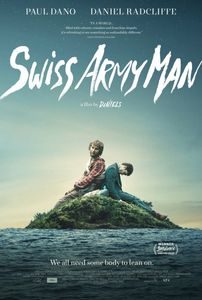
    (On Cable TV, January 2017) I’m the kind of viewer that should be open to weirdness in movies, but that’s not always true and Swiss Army Man clearly shows the limits of what I can tolerate. To be clear, the idea of a man using a farting corpse to escape from a desert island ranks as quirky and faintly cool. But it’s when Swiss Army Man gets deeper into “explaining life as if to a child or alien” that it steps from weird to twee and loses me along the way. By the time the ending of the film attempts to blur the lines between dream-logic and magical realism, imposes some kind of moral conclusion and crafts a magical soaring coda, I have checked out. The film, literally and figuratively spends too much time in the woods for me to care, and it’s not the frank language, candid looks at humanity or piled-upon weirdness that help the film along the way. To be fair, Paul Dano is almost perfectly cast as the protagonist, while Daniel Radcliffe has a terrific turn as a corpse gradually coming back to life while revealing prodigious capabilities. Sometimes, a film’s details don’t matter as much as the way it’s put together, and it’s that overall atmosphere that annoyed me so much about Swiss Army Man. Perhaps I wasn’t in the right mood for twee, or perhaps I’m just far too much of a square to tolerate the kind of questions asked by the film. All I know is that I found the film far less interesting than its hype suggested.

  • Victor Frankenstein (2015)

    Victor Frankenstein (2015)

    (Video on Demand, March 2016) I wasn’t expecting much from this film, even well into its first act. Part of it was misapprehension: For some reason, I was convinced that Victor Frankenstein was another attempt to reboot a Frankenstein franchise along the lines of the underwhelming I, Frankenstein. But this film turns out to be another kind of creature. Focusing on Igor (Daniel Radcliffe, playing a genius-level autodidact doctor escaping the circus in order to be Doctor Frankenstein’s protégé) and his relationship with his mad-genius benefactor Frankenstein, this is a Victorian fantasy with an occasionally playful intent, going over a familiar story with some wit—at least until a generic third act. Victor Frankenstein will play best with those who are a bit tired of the usual take on Frankenstein: It clearly focuses on the doctor and his apprentice, and by the time the monster comes to life, everyone realizes how big a mistake this is. The production design of the movie is probably what shines most: It’s wonderful and Victorian and wouldn’t take much to veer into steampunk. Against that backdrop, Radcliffe turn in a likable performance, while James McAvoy is almost fearsome as the driven Dr. Frankenstein. Clearly patterned on other contemporary retellings such as the Sherlock Holmes revivals, Victor Frankenstein works best when it moves fast, plays with its own ideas and leaves enough breathing space to its two lead actors. (It could have done with less knee-jerk “resurrection is evil!” material, though, given how familiar that sounds.) It significantly falters during its more conventional third act, as we converge on the usual blasts of lightning, evil monster, confrontation above a big hole and other such familiar elements of modern SF&F climax sequences. Oh well; the theorem of convergent premises strikes again. In the meantime, Victor Frankenstein makes for a decent take on the classic story, and it certainly works better than I, Frankenstein.

  • Horns (2013)

    Horns (2013)

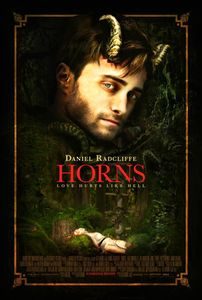
    (On Cable TV, November 2015) Tone control is a tricky thing, and few films show this as well as Horns.  Adapting Joe Hill’s novel is not an easy proposition, considering how the book veers between comedy and horror and heartfelt redemption story.  Novelists can usually control tone better than directors: prose works differently, and what shows up on-screen often suffers from excessive literalism.  So it is that while Horns’ screenplay considerably simplifies and strengthens the book’s story (to the point where reading a synopsis of the book can feel like a comedy of overstuffed plotlines), this big-screen version can’t quite manage its transition from comedy to horror.  The film is best in its first half, as our protagonist discovers that he’s been cursed with invisible horns, the power of persuasion and a gift for allowing strangers to tell them their deepest secrets.  This leads to a number of very funny sequences, but those laughs get fewer and fewer as his newfound powers lead him to understand what happened on the night of his girlfriend’s murder –a murder for which he’s the prime suspect.  Chaos engulfs his small town, friends turn to enemies, parents can’t be trusted and the secrets he discover may not be the ones he wants to hear about.  Daniel Radcliffe is quite good in the lead role, with Juno Temple being as angelic as she can be as the (idealized?) dead girlfriend.  Despite Horns’ problems, this is Alexandre Aja’s least repulsive film yet and one that suggests that he may have a future beyond genre-horror shlock.   

  • The Woman in Black (2012)

    The Woman in Black (2012)

    (On Cable TV, November 2012) There’s something deliciously old-fashioned in this gothic throwback to an era where horror films were about chills rather than gore.  Here, Daniel Radcliffe isn’t too bad in his first major post-Harry Potter film role as a young solicitor asked to settle the affairs of a deceased aristocrat.  The tiny community in which he arrives is hostile to his presence for reasons he understands only after spending some time in a vast and spooky house cut off by the high tide.  While much of the film is fairly standard supernatural horror, it’s handled with an unusual amount of grace, letting the slow pacing and the carefully creepy visuals take precedence over exposed blood and guts.  There are a few visual gems–the sequence with a gunk-covered carriage solely identifiable in reflected light is remarkably effective and the lengthy overnight exploration of a gothic mansion positively drips with atmosphere.  Though suitably different from Susan Hill’s original novel, the adaptation is skillful in condensing events in an even tighter time-frame.  There are a few narrative ironies here and there (one of the best being that the protagonist’s early ally, played with gravitas by Ciaran Hinds, is the one that’s mistaken about the nature of the events taking place whereas all of his opponents are basically right) to enliven what is basically yet another ghost story, but The Woman in Black is well-made enough to deserve a favourable mention, especially or those looking for a more unnerving and less gory kind of horror film.

  • Harry Potter and the Deathly Hallows: Part 2 (2011)

    Harry Potter and the Deathly Hallows: Part 2 (2011)

    (In theaters, July 2011) As review-proof as they come, this second installment of J.K. Rowling’s final Potter book is all narrative pay-off after the often interminable setup of Part One.  The action moves back to Hogwarts and stays there, although what happens is closer to a local Armageddon than a traditional school year as the two opposing camps of the wizard civil war finally clash.  There are a few deaths (quickly glossed over), but also a few triumphs along the way:  Neville and Mama Weasley each get unusually good moments for themselves, and the film goes have the feel of an eight-volume epic conclusion.  There isn’t much more to say than even though this conclusion may not be a startling cinematic achievement it itself, it delivers what fans were hoping for.  (If you didn’t see it opening day with a psyched-up audience, well, you missed one of the rare times where seeing a film with a big raucous crowd can add a lot to the experience.)  It’s far more appropriate to take this opportunity to salute the eight-film series with a deep bow and a flashy tip of the hat: I don’t think there’s been such a long-running series with this sustained level of quality before, and the bet that Warner Brothers made in going forward with this series has handsomely paid off for everyone even as other attempts to create kids-film franchise haven’t gone past a first film.  The way the actors have grown up in front of our eyes is amazing, and Deathly Hallows Part 2 can’t resist showing us a few sequences of baby-faced Daniel Radcliffe to remind us of the long ten-year road from the first film to this one.  While it hasn’t been all good (Alfonson Cuaron’s job on the third film hasn’t been equaled, and the seventh film seriously dragged at times), it’s been a remarkable adaptation of complex books and the result will, I think, be enjoyed by many people for a long time to come.