Debra Winger

  • Kajillionaire (2020)

    Kajillionaire (2020)

    (On Cable TV, June 2021) I suppose that if you’re interested in quirky character-driven drama, Kajillionaire should be enough to make you happy. It’s not for everyone, though: Focusing on a family of small-time grifters multiplying elaborate schemes in search of two or three-figure payouts, it’s a film about serial schemers and liars, hardly the kind of person you’d like to meet (you’d be lucky to escape without your wallet — hopefully they don’t get your house keys). They are not normal people, and that’s especially apparent when it comes to the film’s lead, a twentysomething woman pretty far along the autism spectrum. Their miserable life does have a certain routine to it, but everything suddenly spins out of control when they befriend a young woman who seems curiously amenable to their lifestyle. For our protagonist, it’s a chance to grow up… but it’s not going to be easy. Anchored by Richard Jenkins and Debra Winger as the parents, the film is perhaps best served by its younger leads. While Gina Rodriguez looks great in an improbable series of close-fitting tops, it’s Evan Rachel Woods who impresses as the impassive, emotionless “Old Dolio” (the explanation eventually comes up) who has to get away from her exploitative, sociopathic parents. The narrative is self-consciously quirky to a fault, leading viewers a predefined plot that feels moved along by contrivances rather than organic developments. While the conclusion satisfies, it’s largely because we won’t have to spend one more single minute with these people. Writer/director Miranda July is clearly after something specific and deliberate here, but it’s not going to be for everyone.

  • The Sheltering Sky (1990)

    The Sheltering Sky (1990)

    (In French, On TV, August 2020) As much as I’d like to blame director Bernardo Bertolucci for the waste of my time that was The Sheltering Sky, that would be mis-aiming my ire, which is really directed to the source material, a 1949 novel by Paul Bowles. Bertolucci does provide perhaps the best thing about the result, which is a visually striking depiction of Northern Africa, against which a married couple experiences the dissolution of their marriage. Despite a dramatic premise and a handful of sex scenes (and, later on, tragedy striking), The Sheltering Sky feels like a boring set of tableaux more than a drama. The setting is magnificent, but what’s happening in front of it can’t keep our attention, then becomes increasingly ludicrous as one bad thing happens after another. John Malkovich is playing the kinds of roles he played back then, while Debra Winger sports an androgynous look throughout the film. Don’t bother looking for a moral lesson, don’t bother looking for moments of entertainment, don’t even hope for any mirth along the way: it’s ponderous musings all the way through until a lead character dies and finally shuts up. But then The Sheltering Sky keeps going anyway for what feels like a pointlessly long time. While I’m obviously not the target audience for this film, it really could and should have been a bit better along the way.

  • Legal Eagles (1986)

    Legal Eagles (1986)

    (In French, On Cable TV, June 2019) I don’t think anyone would remember Legal Eagles today if it wasn’t for Daryl Hannah and Robert Redford, but that’s kind of the point of casting stars. The premise of the film has Redford and Debra Winger as competing lawyers who somehow agree to investigate the case they have in common—a sombre painting robbery that turns out to have links with the death of an artist killed eighteen years earlier. As our romantic pair bickers themselves into a healthy romantic tension, we’re free to enjoy the sight of middle-aged Redford at his most charming self, extremely cool even when slightly bumbling. Meanwhile Hannah plays the seductress with dull practice, leaving Winger as the film’s MVP as a combative attorney. Consciously written to feel like a 1940s belligerent romantic comedy, Legal Eagles is definitely middle-of-the-road stuff: there’s a substantial plot, but it’s a star vehicle almost designed to leave viewers with a pleasant feeling that soon evaporates—I’m not sure anyone can recall the details of the narrative even a week later. Still, fifty-year-old Redford is a joy to watch, and the film moves through the motions of its plot so confidently that it does give the impression of going somewhere even despite the banter. I quite liked it, but I can’t guarantee that I’ll remember why in a few months.

  • An Officer and a Gentleman (1982)

    An Officer and a Gentleman (1982)

    (On DVD, February 2018) I’ve got a soft spot for academy movies, or more specifically movies in which our protagonist matures by attending a tough school. And while that certainly doesn’t describe all of An Officer and a Gentleman, it certainly covers what’s most interesting in the film—as the no-good son of a sailor enlists in a military academy to become an officer. The training is merciless, and that’s not even getting into the issue of repeating his parents’ mistakes in romancing local girls. Richard Gere (at times with a crew cut) stars as the protagonist, while Debra Winger plays a strong love interest with issues of her own and Louis Gossett Jr. is a rough instructor. There’s a fairly predictable B-couple romance meant to illustrate the worst-case scenario as well, but never mind—much of the film’s entertainment comes from the hero undergoing the rigours of training, and much of the film’s emotional power comes from its romance. Firmly establishing itself in a grimy reality from the first few moments, the film does exemplify a certain seventies/early eighties rawness that makes the latter triumph more meaningful. While I shouldn’t exaggerate An Office and a Gentleman’s effectiveness (there isn’t much here that hasn’t been done elsewhere), it does nicely click together and works better than expected.

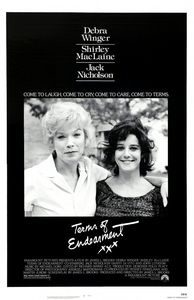
  • Terms of Endearment (1983)

    Terms of Endearment (1983)

    (In French, On Cable TV, May 2017) Get your hankies out, because Terms of Endearment is here to make you sob as hard as you can. The story of a relationship between a mother and her daughter spanning decades, this is the kind of slice-of-life movie where mundane details add up to epochal drama. The weight of the passing years heighten the sweep of the drama, but it’s not all wall-to-wall dourness as the film does reach for comedy under writer/director James L. Brooks. Some of the film’s most memorable moments are very funny, although they do take on a more sombre quality knowing how the film ends. Shirley MacLaine and Debra Winger both turn in best-of-career performances as the mother/daughter duo, with Jack Nicholson, Jeff Daniels, Danny Devito and John Lightgow all delivering good supporting roles along the way. It’s a kind of A-list picture that big studios don’t make anymore (although you’ll find similar material in independent films) and while it still works today, it’s a kind of movie made for a specific audience—I didn’t respond all that deeply to it, but I suspect that’s because I fall outside its target demographic.