Eddie Cantor

  • Forty Little Mothers (1940)

    (On Cable TV, May 2022) An awkward mixture of genres stops Forty Little Mothers from being completely successful, but it’s still worth a look. Much of the film rests on the shoulder of Eddie Cantor, in a far more dramatic vein than his earlier, lighter roles: Here, he plays a down-on-his-luck schoolteacher who finds an abandoned baby and decides to raise it himself rather than give it to an orphanage. That would be enough material for an entire drama, but then he gets a job at an all-girl school and has to content both with resentful schoolgirls (mad that he replaced their favourite teacher, and trying their best to get him fired) and hiding the baby from the school administrators, since he’s a boarder. The drama, fortunately, gets less overpowering when the girls become his biggest allies in raising the kid, and Forty Little Mothers goes for a more comic approach in its later half. Fortunately, it all ends well for everyone – including the baby and its mother. It’s regrettable that the film stuck so much to the drama, because director Busby Berkeley (best known for his musical choreography) is on firmer footing when shooting comedy. There’s quite a bit of delightful material involving the headmistress and her assistant, with a few glances and chuckles suggesting much naughtier material right under the surface. Alas, this was six years in the pre-Code era, and so the potential for something much more enjoyable remains unrealized. If you think you spot Veronica Lake and Virginia O’Brien in the background, you’re not wrong – MGM went deep in its roster of ingenues to fill up those forty schoolgirl roles. Too bad that Forty Little Mothers, as presented, seems a bit scattered between heart-wrenching drama and much lighter comedy – the film’s tone goes from one end of the spectrum to another, at the expense of a unified comic approach.
  • Thank Your Lucky Stars (1943)

    Thank Your Lucky Stars (1943)

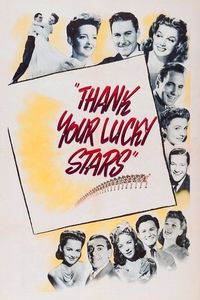
    (On Cable TV, July 2021) The more you learn about Hollywood history, the more you discover sub-sub-genres with maybe a handful of titles. Sometimes, they even prove to be a lot of fun… for the right audience. Thank Your Lucky Stars can be loosely included in the “wartime musical revue” subgenre, pleasantly overlapping with the “studio self-satire” one. In other words, here we have Warner Bros putting together a loose collection of sketches featuring their own stars, loosely connected with a slight and amusing plot. There’s one important caveat for twenty-first century audiences, though: This kind of satire, heavily based on screen personas, is completely dependent on audiences knowing quite a bit about what is being parodied. So it is that Thank Your Lucky Stars largely depends on audience knowledge of Eddie Cantor, as Cantor sends up his screen persona by playing a dual role as his self-obsessed self and a humbler look-alike. Much of the humour in the narrative is in the mistaken identities, but far more of the film’s laughs come from the various sketches and musical numbers scattered in-between — especially when they feature performers not known for singing, such as Ida Lupino (!) and Betty Davis (!!). Other highlights have S.Z. Sakall intimidating Humphrey Bogart, and Erroll Flynn as a blowhard soldier. Thank Your Lucky Stars served as a fundraiser for the Hollywood Canteen, which also spawned another film of the same name that is very much in the same genre. Cantor himself is fearless in sending himself up (and has a few good comic moments, such as when he finds himself on an operating table), while the sight of Davis crooning about the lack of eligible men is a sight upon itself. The caveat is that the comic revue is only a fraction as enjoyable if you’re not familiar with the names that are featured in it — but if you are, it’s a lot of fun. Like most movies of that subgenre, Thank Your Lucky Stars is worth revisiting regularly as you learn more about Hollywood History.